
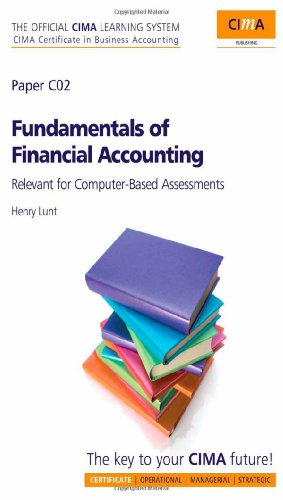
CIMA Official Learning System Fundamentals of Financial Accounting Sixth Edition by Henry Lunt ISBN 978-1856177856 1856177856

Original price was: $50.00.$35.00Current price is: $35.00.
CIMA Official Learning System Fundamentals of Financial Accounting Sixth Edition by Henry Lunt – Ebook PDF Instant Download/Delivery: 978-1856177856, 1856177856
Full download CIMA Official Learning System Fundamentals of Financial Accounting Sixth Edition after payment
Product details:
ISBN 10: 1856177856
ISBN 13: 978-1856177856
Author: Henry Lunt
You are referring to the book CIMA Official Learning System: Fundamentals of Financial Accounting (Sixth Edition) – Henry Lunt. This is the official textbook published by CIMA (Chartered Institute of Management Accountants) for the subject Fundamentals of Financial Accounting (FA), usually part of the CIMA Certificate in Business Accounting program.
Table of contents:
1 The Accounting Scene
Learning Outcomes
1.1 Introduction
1.2 What is accounting?
1.2.1 The objectives of accounting
1.3 Who uses financial statements?
1.4 The qualitative characteristics of financial statements
1.5 Terminology
1.5.1 Bookkeeping
1.5.2 Financial accounting
1.5.3 Management accounting
1.6 The differences between external and internal information
1.7 What is a business organisation?
1.7.1 Profit-making organisations
1.7.2 Non-profit-making organisations
1.8 Summary
Revision Questions
Solutions to Revision Questions
2 The Framework of Financial Statements
Learning Outcomes
2.1 Introduction
2.2 The separate entity convention
2.3 The accounting equation
2.3.1 The accounting equation in action
2.4 The accounting equation and the statement of financial position
2.4.1 The contents of a statement of financial position
2.4.2 Vertical presentation of a statement of financial position
2.5 The income statement
2.5.1 The cost of goods sold
2.6 Profit and cash
2.7 Capital and revenue
2.7.1 Capital transactions
2.7.2 Revenue transactions
2.8 Summary
Revision Questions
Solutions to Revision Questions
3 The Accounting System in Action
Learning Outcomes
3.1 Introduction
3.2 What is a ledger account?
3.3 What is double-entry bookkeeping?
3.4 Bookkeeping entries for expenses and revenue
3.4.1 Bookkeeping entries for purchases and sales
3.4.2 Nominal ledger accounts
3.5 Balancing the accounts
3.5.1 Calculating the balance on the account
3.6 Summary
Revision Questions
Solutions to Revision Questions
4 Summarising the Ledger Accounts
Learning Outcomes
4.1 Introduction
4.2 Preparing the trial balance
4.2.1 Does the trial balance prove the accuracy of the ledger accounts?
4.3 Preparing a statement of profit
4.3.1 The trading account
4.3.2 The income statement
4.3.3 The balance on the income statement
4.3.4 Dealing with drawings
4.4 Preparing the statement of financial position
4.5 Balancing off the ledger accounts
4.6 Columnar ledger accounts
4.7 Summary
Revision Questions
Solutions to Revision Questions
5 Further Aspects of Ledger Accounting
Learning Outcomes
5.1 Introduction
5.2 Accounting for specialised transactions
5.2.1 Carriage costs
5.2.2 Discounts
5.3 Accounting for sales tax
5.3.1 Sales tax on non-current assets and expenses
5.3.2 Sales tax in separate ledger accounts
5.3.3 Non-registered businesses
5.3.4 Zero-rated and exempt supplies
5.4 Accounting for wages and salaries
5.4.1 Gross pay and net pay
5.4.2 Other deductions
5.4.3 Pension contributions
5.5 Accruals and prepayments
5.5.1 Recording accruals and prepayments in the ledger accounts
5.6 Bad debts and allowance for receivables
5.6.1 Accounting for bad debts
5.6.2 Bad debts recovered
5.6.3 Allowance for receivables
5.7 The exchange of goods
5.8 Summary
Revision Questions
Solutions to Revision Questions
6 Accounting for Non-current Assets
Learning Outcomes
6.1 Introduction
6.2 Capital and revenue expenditure
6.3 Depreciation
6.4 Calculating depreciation
6.4.1 The straight-line method
6.4.2 The reducing-balance method
6.4.3 The machine-hour method/units of production method
6.4.4 The revaluation method
6.4.5 Depreciation in the year of acquisition and disposal
6.5 Accounting for the disposal of a non-current asset
6.6 A comprehensive example
6.7 Controlling tangible non-current assets
6.8 Accounting for intangible non-current assets
6.8.1 What is goodwill?
6.9 Summary
Revision Questions
Solutions to Revision Questions
7 Preparation of Financial Statements with Adjustments
Learning Outcome
7.1 Introduction
7.2 The trial balance
7.3 The adjustments
7.4 Step1: Labelling the trial balance
7.5 Step2: Preparing workings
7.6 Step3: Preparing the financial statements
7.7 Summary
Revision Questions
Solutions to Revision Questions
8 Organising the Bookkeeping System
Learning Outcomes
8.1 Introduction
8.2 Organising the ledger accounts
8.2.1 Advantages of dividing the ledger
8.3 Supporting books and records
8.3.1 Source documents
8.4 Sales, purchases and returns daybooks
8.4.1 Recording transactions in the daybooks
8.4.2 Making the ledger entries
8.4.3 Extending the use of daybooks
8.5 The cash books
8.5.1 The banking system
8.5.2 The cash book
8.5.3 The petty cash book
8.6 The journal
8.6.1 The layout of the journal
8.6.2 Using the journal for miscellaneous transactions
8.6.3 Using the journal for end-of-year transactions
8.7 Inventory records and methods of inventory measurement
8.7.1 The process of inventories measurement
8.7.2 Application of methods of inventory measurement (also known as cost formulas)
8.7.3 Issues and receipts
8.8 Summary
Revision Questions
Solutions to Revision Questions
9 Controlling the Bookkeeping System
Learning Outcomes
9.1 Introduction
9.2 Preventing errors
9.2.1 Authorisation procedures
9.2.2 Documentation
9.2.3 Organisation of staff
9.2.4 Safeguarding assets
9.3 Detecting errors
9.3.1 Spot checks
9.3.2 Comparison with external evidence
9.3.3 Reconciliations
9.3.4 Carrying out an audit
9.4 Bank reconciliation statements
9.5 Reconciliation of suppliers’ statements
9.6 Control accounts
9.6.1 The status of the control account
9.6.2 Contra entries
9.6.3 Credit balances in the sales ledger; debit balances in the purchase ledger
9.6.4 The control account and allowance for receivables
9.6.5 Advantages of control accounts
9.6.6 Reconciling control accounts and ledger accounts
9.7 Suspense accounts and the correction of errors
9.8 Computers in accounting
9.8.1 Aspects of computerised accounting systems
9.9 Accounting coding systems
9.10 Summary
Revision Questions
Solutions to Revision Questions
10 The Regulatory Framework of Accounting
Learning Outcomes
10.1 Introduction
10.2 Accounting conventions
10.2.1 The business entity convention
10.2.2 The money measurement convention
10.2.3 The historical cost convention
10.2.4 The objectivity convention
10.2.5 The dual aspect convention
10.2.6 The realisation convention
10.2.7 The periodicity convention
10.2.8 The accruals and matching conventions
10.2.9 The materiality convention
10.2.10 The stable monetary unit convention
10.2.11 The going concern convention
10.2.12 The consistency convention
10.2.13 The prudence convention
10.3 Accounting policies and estimation techniques
10.4 The historical cost convention and its alternatives
10.4.1 The theory of capital maintenance
10.4.2 Current purchasing power (CPP) accounting
10.4.3 Current cost accounting
10.4.4 Fair value
10.4.5 Value to the business (or deprival value)
10.4.6 The valuation of intangible assets
10.5 Regulations in accounting
10.5.1 Company law
10.5.2 The accountancy profession
10.5.3 International accounting standards
10.5.4 The IASB Framework for the Preparation and Presentation of Financial Statements (the ‘Framework’)
10.6 The role of the auditor
10.6.1 Fair presentation or true and fair
10.6.2 The role of the external auditor
10.6.3 The role of the internal auditor
10.6.4 The value-for-money audit
10.7 The role of management
10.8 Summary
Revision Questions
Solutions to Revision Questions
11 Incomplete Records; Income and Expenditure Statements
Learning Outcomes
11.1 Introduction
11.2 Calculating ‘missing figures’
11.2.1 Sales figures
11.2.2 Purchases figures
11.2.3 Expenses figures
11.2.4 Opening capital
11.2.5 Cash and bank summaries
11.3 Financial statements of non-profit-making bodies
11.3.1 Accounting terminology for non-profit-making bodies
11.3.2 Accounting for membership fees and subscriptions
11.3.3 The financial statements of non-trading organisations
Revision Questions
Solutions to Revision Questions
11.4 Summary
12 The Manufacturing Account
Learning Outcomes
12.1 Introduction
12.2 Why is a manufacturing account needed?
12.2.1 Inventories in manufacturing organisations
12.3 Costs to include in the manufacturing account
12.3.1 Other direct costs
12.3.2 Prime cost
12.3.3 Indirect costs
12.3.4 Factory cost of production
12.3.5 Work in progress
12.3.6 Factory cost of goods completed
12.4 Layout of manufacturing and trading accounts
12.5 Income statement for manufacturing organisations
12.6 Statements of financial position for manufacturing organisations
12.7 The accounting system for manufacturing organisations
12.8 Summary
Revision Questions
Solutions to Revision Questions
13 The Financial Statements of Limited Companies and the Statement of Cash Flows
Learning Outcomes
13.1 Introduction
13.2 Limited companies
13.2.1 The financial statements of companies
13.2.2 Presentation of company income statements
13.2.3 Taxation in company financial statements
13.2.4 Directors of limited companies
13.2.5 Sources of finance for a limited company
13.2.6 Dividends
13.2.7 Reserves
13.2.8 Statement of comprehensive income
13.2.9 Statement of changes in equity
13.3 Statement of cash flows
13.3.1 What is a statement of cash flows?
13.3.2 Why does the profit earned not equal the change in bank and cash balances?
13.3.3 Cash flows from operating activities – cash generated from operations
13.3.4 Cash flows from operating activities net cash from operating activities
13.3.5 Cash flows from investing activities
13.3.6 Cash flows from financing activities
13.3.7 Statement of cash flows for sole traders
13.4 Summary
Revision Questions
Solutions to Revision Questions
14 The Interpretation of Financial Statements
Learning Outcomes
14.1 Introduction
14.2 What is meant by ‘interpretation of financial statements’?
14.3 Calculating ratios
14.3.1 Using the ratios
14.4 Types of ratios
14.5 Profitability ratios
14.5.1 Gross profit margin
14.5.2 Gross profit mark-up
14.5.3 Operating profit margin
14.5.4 Return on capital ratios
14.6 Liquidity ratios
14.6.1 The current ratio
14.6.2 The quick ratio
14.7 Efficiency ratios
14.7.1 Asset turnover ratios
14.7.2 Inventories days
14.7.3 Receivables days
14.7.4 Payable days
14.7.5 Total working capital ratio
14.8 Capital structure ratios
14.8.1 The gearing ratio (or leverage ratio)
14.8.2 Interest cover
14.9 Ratio analysis for sole traders
14.10 Summary
Revision Questions
Solutions to Revision Questions
People also search for:
cima digital learning
cima official learning system
cima platform
cima f3 lectures
cima instructor login
Tags: Henry Lunt, CIMA Official, System Fundamentals, Financial Accounting