
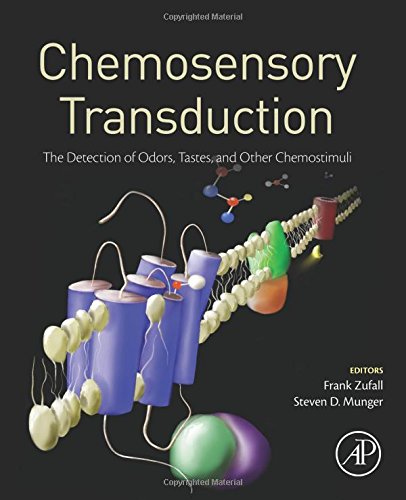
Chemosensory Transduction The Detection of Odors Tastes and Other Chemostimuli 1st Edition by Frank Zufall, Steven Munger ISBN 978-0128016947 0128016949

Original price was: $50.00.$35.00Current price is: $35.00.
Chemosensory Transduction The Detection of Odors Tastes and Other Chemostimuli 1st Edition by Frank Zufall, Steven D. Munger – Ebook PDF Instant Download/Delivery: 978-0128016947, 0128016949
Full download Chemosensory Transduction The Detection of Odors Tastes and Other Chemostimuli 1st Edition after payment
Product details:
ISBN 10: 0128016949
ISBN 13: 978-0128016947
Author: Frank Zufall, Steven D. Munger
Written by leaders in the field of chemosensation, Chemosensory Transduction provides a comprehensive resource for understanding the molecular mechanisms that allow animals to detect their chemical world. The text focuses on mammals, but also includes several chapters on chemosensory transduction mechanisms in lower vertebrates and insects. This book examines transduction mechanisms in the olfactory, taste, and somatosensory (chemesthetic) systems as well as in a variety of internal sensors that are responsible for homeostatic regulation of the body. Chapters cover such topics as social odors in mammals, vertebrate and invertebrate olfactory receptors, peptide signaling in taste and gut nutrient sensing. Includes a foreword by preeminent olfactory scientist Stuart Firestein, Chair of Columbia University’s Department of Biological Sciences in New York, NY.
Chemosensory Transduction describes state-of-the-art approaches and key findings related to the study of the chemical senses. Thus, it serves as the go-to reference for this subject for practicing scientists and students with backgrounds in sensory biology and/or neurobiology. The volume will also be valuable for industry researchers engaged in the design or testing of flavors, fragrances, foods and/or pharmaceuticals.
Provides a comprehensive overview for all chemosensory transduction mechanisms
Valuable for academics focused on sensory biology, neurobiology, and chemosensory transduction, as well as industry researchers in new flavor, fragrance, and food testing
Edited by leading experts in the field of olfactory transduction
Focuses on mammals, but lower vertebrates and invertebrate model systems are also included
Table of contents:
Section I. Social Odors and Chemical Ecology
Chapter 1. Specialized Chemosignaling that Generates Social and Survival Behavior in Mammals
-
What Are Specialized Odors?
-
Search for the Sensory Neurons Underlying Specialized Olfactory Behavior
-
Are Certain Types of Olfactory Ligands Specialized?
-
The VNO Detects Specialized Odors
-
The MOE Also Detects Specialized Ligands
-
Neural Circuits that Process Specialized Ligands
-
Transforming Specialized Ligands into Social Behavior
Chapter 2. Chemical Ecology in Insects
-
Introduction
-
Chemostimuli and Receptors
-
Insect Homeostasis
-
Insect Reproduction
-
Insect–Plant Interactions: Exploiting the System
-
Evolutionary Aspects
Section II. Olfactory Transduction
Chapter 3. Vertebrate Odorant Receptors
-
Toward the Discovery of the OR Genes
-
The OR Gene Family
-
Functional Aspect of ORs
-
Conclusions
Chapter 4. Odor Sensing by Trace Amine-Associated Receptors
-
Introduction
-
The TAAR Family
-
TAAR Expression Patterns
-
TAAR Ligands and Behaviors
-
TAAR Neuron Projections to the Main Olfactory Bulb in Mouse
-
Conclusions and Future Perspectives
Chapter 5. Aquatic Olfaction
-
Introduction
-
The Evolutionary Origin of Vertebrate Olfactory Receptor Genes
-
Aquatic vs. Terrestrial Olfaction
-
Evolutionary Dynamics in Teleost Fish vs. Tetrapods
-
Lobe-Finned Fish and Mixed Characteristics
-
Amphibian Olfaction in Transition
-
Pseudogenization in Secondarily Aquatic Vertebrates
-
Aquatic Odors
-
Ligand Spectra of Aquatic Receptors
-
Four Olfactory Sensory Neuron Types
Chapter 6. Insect Olfactory Receptors: An Interface between Chemistry and Biology
-
Introduction
-
Odorant Receptors
-
Ionotropic Receptors
-
CO₂-Sensitive Gustatory Receptors
-
Other Peripheral Olfactory Proteins
-
Methods for Functional Characterization
Chapter 7. Cyclic AMP Signaling in the Main Olfactory Epithelium
-
Introduction
-
Early History of cAMP
-
Molecular Components of Olfactory Transduction
-
Regulation of the cAMP Cascade
-
Future Directions
-
Summary
Chapter 8. Cyclic GMP Signaling in Olfactory Sensory Neurons
-
Introduction
-
Soluble Guanylyl Cyclase
-
Membrane-Bound Guanylyl Cyclase
-
Cyclic Nucleotide Phosphodiesterases
-
Monitoring cGMP Changes
-
Future Perspectives
Chapter 9. Ciliary Trafficking of Transduction Molecules
-
Introduction
-
Cilia Structure
-
Lipid Composition
-
Protein Movement within the Cilium
-
Regulation of Olfactory Protein Enrichment
-
Ciliary Localization of Odorant Receptors
-
Ciliopathies and Olfactory Function
-
Potential Treatments for Anosmia
-
Summary
Chapter 10. Vomeronasal Receptors: V1Rs, V2Rs, and FPRs
-
Introduction
-
Type 1 Vomeronasal Receptors
-
Type 2 Vomeronasal Receptors
-
Formyl Peptide Receptors
-
Odorant Receptors
-
Coding Lines
Chapter 11. Vomeronasal Transduction and Cell Signaling
-
Introduction
-
Anatomy and Cell Composition of the VNO
-
Chemoreceptor Function
-
Receptor-Dependent Pathways and Secondary Signaling
Chapter 12. Comparative Olfactory Transduction
-
Introduction
-
Olfactory System Similarities and Diversity
-
Functional OSN Subsets
-
Olfactory Receptors
-
Noncanonical Odorant Signaling
-
Opponent Signaling: Excitation and Inhibition
-
Noncompetitive Inhibition
-
Comparative Insights
Section III. Gustatory Transduction
Chapter 13. G Protein–Coupled Taste Receptors
-
Introduction
-
Type 1 Taste Receptors
-
Sweet and Umami Receptors
-
Bitter Taste Receptors
-
Fatty Acid Receptors
-
Outlook
Chapter 14. Mechanism of Taste Perception in Drosophila
-
Introduction
-
Adult Gustatory System
-
Cellular and Behavioral Analysis
-
Molecular Taste Modalities
-
Signal Transduction
-
Larval Gustatory Perception
-
Beyond Taste
Chapter 15. G Protein–Coupled Taste Transduction
-
Introduction
-
Taste Cell Types and Innervation
-
G Protein–Coupled Receptors
-
Downstream Signaling
-
ATP Release and Gustatory Afferent Activation
-
Summary and Future Directions
Chapter 16. The Mechanisms of Salty and Sour Taste
-
Introduction
-
Salt Taste
-
Sour Taste
-
Conclusions
Chapter 17. Peptide Signaling in Taste Transduction
-
Introduction
-
Taste Bud Cells
-
Leptin, Glucagon, and GLP-1
-
Insulin, Angiotensin II, CCK
-
VIP, NPY, PYY
-
Oxytocin, Ghrelin, Galanin
-
Conclusion
Section IV. Stimulus Transduction in Other Chemodetection Systems
Chapter 18. O₂ and CO₂ Detection by the Carotid and Aortic Bodies
-
Introduction
-
Carotid Body and Hypoxia Sensing
-
CO₂ Sensing
-
Aortic Bodies
Chapter 19. Chemosensation in the Ventricles of the CNS
-
Introduction
-
Choroid Plexus–CSF System
-
Tanycytes
-
Concluding Remarks
Chapter 20. Gut Nutrient Sensing
-
Introduction
-
Gut Taste Receptors and Signaling
-
Why the Gut Senses Nutrients
-
Sensor Locations
-
Carbohydrate, Fat, and Protein Sensing
-
Role of Microbiota
-
Closing Remarks
Chapter 21. Molecular Pharmacology of Chemesthesis
-
Introduction
-
Chemesthesis Overview
-
TRP Channels: TRPV1, TRPM8, TRPA1, TRPV3
-
Potassium Channels
-
Conclusions and Future Perspectives
People also search for:
chemosensory transduction the detection
chemosensory receptors
chemosensory system
chemosensory cells
chemosensory def
Tags: Frank Zufall, Steven Munger, Chemosensory Transduction, The Detection