
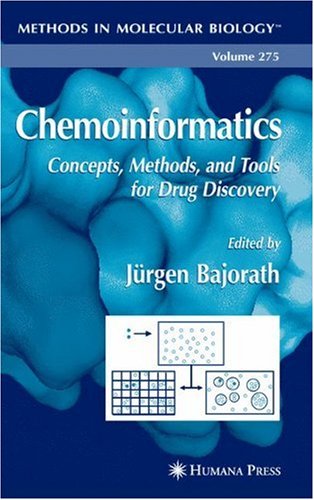
Chemoinformatics Concepts Methods and Tools for Drug Discovery 1st Edition by Gerald Maggiora ISBN 978-1592598021 1592598021

Original price was: $50.00.$35.00Current price is: $35.00.
Chemoinformatics Concepts Methods and Tools for Drug Discovery 1st Edition by Gerald M. Maggiora- Ebook PDF Instant Download/Delivery: 978-1592598021, 1592598021
Full download Chemoinformatics Concepts Methods and Tools for Drug Discovery 1st Edition after payment
Product details:
ISBN 10: 1592598021
ISBN 13: 978-1592598021
Author: Gerald M. Maggiora
In the literature, several terms are used synonymously to name the topic of this book: chem-, chemi-, or chemo-informatics. A widely recognized de- nition of this discipline is the one by Frank Brown from 1998 (1) who defined chemoinformatics as the combination of “all the information resources that a scientist needs to optimize the properties of a ligand to become a drug. ” In Brown’s definition, two aspects play a fundamentally important role: de- sion support by computational means and drug discovery, which distinguishes it from the term “chemical informatics” that was introduced at least ten years earlier and described as the application of information technology to ch- istry (not with a specific focus on drug discovery). In addition, there is of course “chemometrics,” which is generally understood as the application of statistical methods to chemical data and the derivation of relevant statistical models and descriptors (2). The pharmaceutical focus of many developments and efforts in this area—and the current popularity of gene-to-drug or si- lar paradigms—is further reflected by the recent introduction of such terms as “discovery informatics” (3), which takes into account that gaining kno- edge from chemical data alone is not sufficient to be ultimately successful in drug discovery. Such insights are well in accord with other views that the boundaries between bio- and chemoinformatics are fluid and that these d- ciplines should be closely combined or merged to significantly impact b- technology or pharmaceutical research (4).
Table of contents:
-
Molecular Similarity Measures
-
Evaluation of Molecular Similarity and Molecular Diversity Methods Using Biological Activity Data
-
A Web-Based Chemoinformatics System for Drug Discovery
-
Application of Chemoinformatics to High-Throughput Screening
-
Strategies for the Identification and Generation of Informative Compound Sets
-
Methods for Applying the Quantitative Structure-Activity Relationship Paradigm
-
3D-LogP
-
Derivation and Applications of Molecular Descriptors Based on Approximate Surface Area
-
Cell-Based Partitioning
-
Partitioning in Binary-Transformed Chemical Descriptor Spaces
-
Comparison of Methods Based on Diversity and Similarity for Molecule Selection and the Analysis of Drug Discovery Data
-
Using Recursive Partitioning Analysis to Evaluate Compound Selection Methods
-
Designing Combinatorial Libraries Optimized on Multiple Objectives
-
Approaches to Target Class Combinatorial Library Design
-
Simulated Annealing
-
Genetic Algorithms for Classification of Olfactory Stimulants
-
How to Describe Chirality and Conformational Flexibility
-
Novel Scoring Methods in Virtual Ligand Screening
-
Prediction of Drug-Like Molecular Properties
People also search for:
how designers think
9 designers
synopsis of how designers think
what makes designer designer
think like a fashion designer
Tags: Gerald Maggiora, Chemoinformatics Concepts, Methods and Tools