
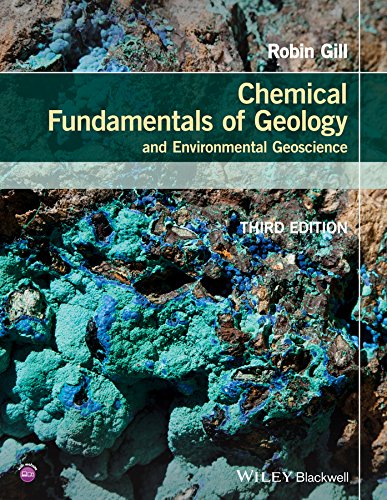
Chemical Fundamentals of Geology and Environmental Geoscience 3rd Edition by Robin Gill ISBN 978-0470656655 0470656654
Original price was: $50.00.$35.00Current price is: $35.00.
Chemical Fundamentals of Geology and Environmental Geoscience 3rd Edition by Robin Gill – Ebook PDF Instant Download/Delivery: 978-0470656655, 0470656654
Full download Chemical Fundamentals of Geology and Environmental Geoscience 3rd Edition after payment
Product details:
ISBN 10: 0470656654
ISBN 13: 978-0470656655
Author: Robin Gill
Chemical principles are fundamental to the Earth sciences, and geoscience students increasingly require a firm grasp of basic chemistry to succeed in their studies. The enlarged third edition of this highly regarded textbook introduces the student to such ‘geo-relevant’ chemistry, presented in the same lucid and accessible style as earlier editions, but the new edition has been strengthened in its coverage of environmental geoscience and incorporates a new chapter introducing isotope geochemistry.
The book comprises three broad sections. The first (Chapters 1–4) deals with the basic physical chemistry of geological processes. The second (Chapters 5–8) introduces the wave-mechanical view of the atom and explains the various types of chemical bonding that give Earth materials their diverse and distinctive properties. The final chapters (9–11) survey the geologically relevant elements and isotopes, and explain their formation and their abundances in the cosmos and the Earth. The book concludes with an extensive glossary of terms; appendices cover basic maths, explain basic solution chemistry, and list the chemical elements and the symbols, units and constants used in the book.
Table of contents:
1. Energy in Geochemical Processes
-
Introduction
-
Energy in mechanical systems
-
Energy in chemical and mineral systems: free energy
-
Stable, unstable and metastable minerals
-
Further reading
2. Equilibrium in Geological Systems
-
The significance of mineral stability
-
Systems, phases and components
-
Equilibrium
-
Phase diagrams in P–T space
-
Phase diagrams in T–X space
-
Ternary phase diagrams
-
Review
-
Further reading
-
Sources of thermodynamic data for minerals
-
Exercises
3. Kinetics of Earth Processes
-
Defining the rate of a reaction
-
Temperature-dependence of reaction rate
-
Diffusion
-
Melt viscosity
-
Persistence of metastable minerals: closure temperature
-
Review
-
Further reading
-
Exercises
4. Aqueous Solutions and the Hydrosphere
-
Ways of expressing the concentrations of major constituents
-
Equilibrium constant
-
Non-ideal solutions: activity coefficient
-
Natural waters
-
Oxidation and reduction: Eh-pH diagrams
-
Further reading
-
Exercises
5. Electrons in Atoms
-
Why does a geologist need to understand atoms?
-
The atom
-
Stationary waves
-
Electron waves in atoms
-
The shapes of electron orbitals
-
Electron energy levels
-
Review
-
Further reading
-
Exercises
6. What We Can Learn from the Periodic Table
-
Ionization energy
-
The Periodic Table
-
Electronegativity
-
Valency
-
Atomic spectra
-
Review
-
Further reading
-
Exercises
7. Chemical Bonding and the Properties of Minerals
-
The ionic model of bonding
-
The covalent model of bonding
-
Bonding in minerals
-
Other types of atomic and molecular interaction
-
Review
-
Further reading
-
Exercises
8. Silicate Crystals and Melts
-
Silicate polymers
-
Cation sites in silicates
-
Optical properties of crystals
-
Defects in crystals
-
Further reading
-
Exercises
9. Some Geologically Important Elements
-
Major and trace elements
-
Alkali metals
-
Hydrogen
-
Alkaline earth metals
-
Aluminium
-
Carbon
-
Silicon
-
Nitrogen and phosphorus
-
Oxygen
-
Sulfur
-
Fluorine
-
Noble gases
-
Transition metals
-
Rare earth elements
-
Actinides
-
Further reading
-
Exercises
10. What Can We Learn from Isotopes?
-
Isotope systems
-
Radiogenic isotope systems
-
Stable isotope systems
-
Cosmogenic radioisotope systems
-
Review
-
Further reading
-
Exercises
11. The Elements in the Universe
-
The significance of element abundance
-
Measuring cosmic and Solar System abundances
-
The composite abundance curve
-
Cosmic element production
-
Elements in the Solar System
-
Chemical evolution of the Earth
-
Review
-
Further reading
-
Exercises
Answers to Exercises
Appendix A: Mathematics Revision
Appendix B: Simple Solution Chemistry
Appendix C: Alphabetical List of Chemical Abbreviations and Element Names, with Atomic Number and Relative Atomic Mass
Appendix D: Symbols, Units, Constants and Abbreviations Used in this Book
People also search for:
chemical fundamentals of geology pdf
what are the fundamentals of chemistry
chemistry of geology
chemical geology definition
how is geology related to chemistry
Tags: Robin Gill, Chemical Fundamentals, Geology and Environmental