
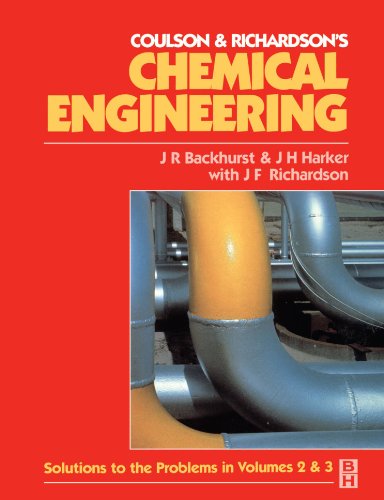
(Ebook PDF) Chemical Engineering Solutions to the Problems in Volumes 2 3 1st Edition by Harker 0750656399 9780750656399 Full chapter


Original price was: $50.00.$35.00Current price is: $35.00.
Chemical Engineering Solutions to the Problems in Volumes 2 3 1st Edition by J H Harker – Ebook PDF Instant Download/Delivery: 0750656399, 978-0750656399
Full dowload Chemical Engineering Solutions to the Problems in Volumes 2 3 1st Edition after payment
Product details:
ISBN 10: 0750656399
ISBN 13: 978-0750656399
Author: J H Harker
Whilst the main volumes contains illustrative worked examples throughout the text, this book contains answers to the more challenging questions posed at the end of each chapter of the main texts.
These questions are of both a standard and non-standard nature, and so will prove to be of interest to both academic staff teaching courses in this area and to the keen student. Chemical engineers in industry who are looking for a standard solution to a real-life problem will also find the book of considerable interest.
Chemical Engineering Solutions to the Problems in Volumes 2 3 1st Table of contents:
Volume 2: Process Operations and Separations
1. Particulate Solids
- Solutions to problems related to the behavior of particulate solids in various industrial processes.
2. Reduction and Enlargement of Particle Sizes
- Problem-solving techniques for size reduction (crushing, grinding) and enlargement (agglomeration, pelletizing) processes.
3. Motion of Particles in a Fluid
- Solutions to problems in the dynamics of particles suspended in fluids (sedimentation, drag forces, etc.).
4. Flow of Fluids through Granular Beds and Packed Columns
- Solutions to problems involving the flow of fluids through packed beds, columns, and granular media, including pressure drop and flow rate calculations.
5. Sedimentation
- Problem-solving techniques for designing sedimentation processes, including the settling velocity of particles.
6. Fluidization
- Solutions related to fluidized bed reactors, including the calculation of bed expansion, pressure drop, and flow characteristics.
7. Liquid Filtration
- Solutions to problems in filtration processes, including filter design, pressure drop across filters, and filtration rates.
8. Membrane Separation Processes
- Problem-solving for membrane filtration processes, such as reverse osmosis, ultrafiltration, and microfiltration.
9. Centrifugal Separations
- Solutions to problems related to centrifugal separation processes, including design and operation of centrifuges.
10. Leaching
- Solutions to problems involving the extraction of solutes from solids using a solvent.
11. Distillation
- Solutions to distillation problems including column design, number of stages, and separation efficiency.
12. Absorption of Gases
- Solutions to problems in gas absorption columns, including design considerations and mass transfer calculations.
13. Liquid-Liquid Extraction
- Solutions to problems involving the extraction of solutes from one liquid phase to another, including partition coefficients and stage-wise calculations.
14. Evaporation
- Problem-solving techniques for evaporation processes, including heat and mass transfer considerations.
15. Crystallization
- Solutions to problems in crystallization, including nucleation and growth rates, and design of crystallizers.
16. Drying
- Solutions to drying processes, including moisture content, drying rate, and drying curve analysis.
17. Adsorption
- Solutions to problems involving adsorption of gases or liquids on solid surfaces, including isotherm and kinetics.
18. Ion Exchange
- Solutions to problems related to ion exchange processes, including bed design and capacity calculations.
19. Chromatographic Separations
- Solutions to chromatography-related problems, including column design, retention time, and separation efficiency.
Volume 3: Reactor Design and Process Control
1. Reactor Design – General Principles
- Solutions to problems involving reactor design fundamentals such as material balance, energy balance, and reactor sizing.
2. Flow Characteristics of Reactors – Flow Modelling
- Solutions related to flow patterns in reactors, including plug flow, laminar flow, and dispersion models.
3. Gas-Solid Reactions and Reactors
- Solutions to problems related to gas-solid reaction kinetics and the design of reactors for such processes (e.g., fixed-bed reactors, fluidized beds).
4. Gas-Liquid and Gas-Liquid-Solid Reactors
- Solutions to problems involving the design and operation of reactors with multiple phases (e.g., gas-liquid reactors, bubble columns).
5. Biochemical Reaction Engineering
- Solutions to problems in biochemical reactions, including enzyme kinetics, fermentation processes, and bioreactor design.
6. Process Control
- Solutions to problems related to the control of chemical processes, including PID controllers, process dynamics, and stability analysis.
People also search for Chemical Engineering Solutions to the Problems in Volumes 2 3 1st:
gate 2023 chemical engineering solutions
himmelblau chemical engineering solutions
chemical engineering problems and solutions pdf
what chemicals do chemical engineers use
basic principles and calculations in chemical engineering solutions
Tags:
Harker,Chemical,Engineering,Solutions,Problems,Volumes 2 3 1st