
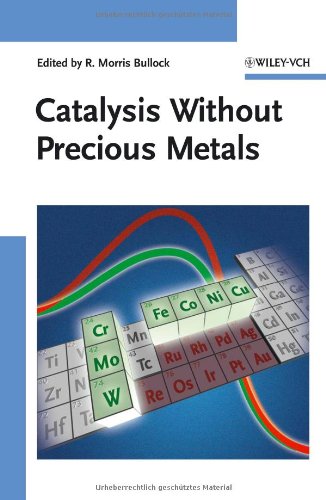
Catalysis without Precious Metals 1st Edition by Morris Bullock ISBN 978-3527323548 3527323546

Original price was: $50.00.$35.00Current price is: $35.00.
Catalysis without Precious Metals 1st Edition by R. Morris Bullock – Ebook PDF Instant Download/Delivery: 978-3527323548, 3527323546
Full download Catalysis without Precious Metals 1st Edition after payment
Product details:
ISBN 10: 3527323546
ISBN 13: 978-3527323548
Author: R. Morris Bullock
Written for chemists in industry and academia, this ready reference and handbook summarizes recent progress in the development of new catalysts that do not require precious metals. The research thus presented points the way to how new catalysts may ultimately supplant the use of precious metals in some types of reactions, while highlighting the remaining challenges.
An essential copanion for organic and catalytic chemists, as well as those working with/on organometallics and graduate students.
From the contents:
* Catalysis Involving the H’ Transfer Reactions of First-Row Transition Metals
* Catalytic Reduction of Dinitrogen to Ammonia by Molybdenum Complexes
* Molybdenum and Tungsten Catalysts for Hydrogenation, Hydrosilylation and Hydrolysis
* Iron in Catalytic Alkene and Carbonyl Hydrogenation Reactions
* Olefin Oligomerizations and Polymerizations Catalyzed by Iron and Cobalt Complexes
* Cobalt and Nickel Catalyzed Reactions Involving C-H and C-N Activation Reactions
* Development of Molecular Electrocatalysts for H2 Oxidation and Production Based on Inexpensive Metals
* Nickel-Catalyzed Reductinve Couplings and Cyclizations
* Copper-Catalyzed Ligand Promoted Ullmann-Type Coupling Reactions
* Copper-Catalyzed Azide-Alkyne Cycloaddition
* “Frustrated Lewis Pairs”: A Metal-Free Strategy for Hydrogenation Catalysis
Table of contents:
-
Catalysis Involving the H• Transfer Reactions of First-Row Transition Metals
-
H• Transfer Between M–H Bonds and Organic Radicals
-
H• Transfer Between Ligands and Organic Radicals
-
H• Transfer Between M–H and C–C Bonds
-
Chain Transfer Catalysis
-
Catalysis of Radical Cyclizations
-
Competing Methods for the Cyclization of Dienes
-
Summary and Conclusions
-
Catalytic Reduction of Dinitrogen to Ammonia by Molybdenum
-
Introduction
-
Some Characteristics of Triamidoamine Complexes
-
Possible [HIPTN₃N]Mo Intermediates in a Catalytic Reduction of Molecular Nitrogen
-
Interconversion of Mo(NH₃) and Mo(N₂)
-
Catalytic Reduction of Dinitrogen
-
MoH and Mo(H₂)
-
Ligand and Metal Variations
-
Comments
-
Molybdenum and Tungsten Catalysts for Hydrogenation, Hydrosilylation and Hydrolysis
-
Introduction
-
Proton Transfer Reactions of Metal Hydrides
-
Hydride Transfer Reactions of Metal Hydrides
-
Stoichiometric Hydride Transfer Reactivity of Anionic Metal Hydride Complexes
-
Catalytic Hydrogenation of Ketones with Anionic Metal Hydrides
-
Ionic Hydrogenation of Ketones Using Metal Hydrides and Added Acid
-
Ionic Hydrogenations from Dihydrides: Delivery of the Proton and Hydride from One Metal
-
Catalytic Ionic Hydrogenations with Mo and W Catalysts
-
Mo Phosphine Catalysts with Improved Lifetimes
-
Tungsten Hydrogenation Catalysts with N-Heterocyclic Carbene Ligands
-
Catalysts for Hydrosilylation of Ketones
-
Cp₂Mo Catalysts for Hydrolysis, Hydrogenations and Hydrations
-
Conclusion
-
Modern Alchemy: Replacing Precious Metals with Iron in Catalytic Alkene and Carbonyl Hydrogenation Reactions
-
Introduction
-
Alkene Hydrogenation
-
Carbonyl Hydrogenation
-
Outlook
-
Olefin Oligomerizations and Polymerizations Catalyzed by Iron and Cobalt Complexes Bearing Bis(imino)pyridine Ligands
-
Introduction
-
Precatalyst Synthesis
-
Precatalyst Activation and Catalysis
-
The Active Catalyst and Mechanism
-
Other Applications
-
Conclusions and Outlook
-
Cobalt and Nickel Catalyzed Reactions Involving C–H and C–N Activation Reactions
-
Introduction
-
Catalysis with Cobalt
-
Catalysis with Nickel
-
A Modular Approach to the Development of Molecular Electrocatalysts for H₂ Oxidation and Production Based on Inexpensive Metals
-
Introduction
-
Concepts in Catalyst Design Based on Structural Studies of Hydrogenase Enzymes
-
A Layered or Modular Approach to Catalyst Design
-
Using the First Coordination Sphere to Control the Energies of Catalytic Intermediates
-
Using the Second Coordination Sphere to Control the Movement of Protons between the Metal and the Exterior of the Molecular Catalyst
-
Integration of the First and Second Coordination Spheres
-
Summary
-
Nickel-Catalyzed Reductive Couplings and Cyclizations
-
Introduction
-
Couplings of Alkynes with α,β-Unsaturated Carbonyls
-
Couplings of Alkynes with Aldehydes
-
Conclusions and Outlook
-
Copper-Catalyzed Ligand Promoted Ullmann-Type Coupling Reactions
-
Introduction
-
C–N Bond Formation
-
C–O Bond Formation
-
C–C Bond Formation
-
C–S Bond Formation
-
C–P Bond Formation
-
Conclusion
-
Copper-Catalyzed Azide-Alkyne Cycloaddition (CuAAC)
-
Introduction
-
Azide–Alkyne Cycloaddition: Basics
-
Copper-Catalyzed Cycloadditions
-
“Frustrated Lewis Pairs”: A Metal-Free Strategy for Hydrogenation Catalysis
-
Phosphine–Borane Activation of H₂
-
“Frustrated Lewis Pairs”
-
Metal-Free Catalytic Hydrogenation
-
Future Considerations
People also search for:
alternative precious metals
catalytic converter without precious metals
non precious metal catalyst
catalytic converter without palladium
catalytic converter without platinum
Tags: Morris Bullock, Precious Metals