
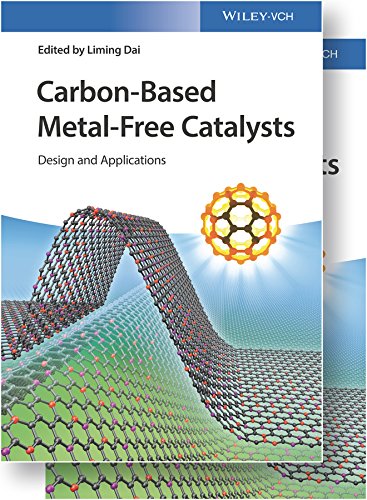
Carbon Based Metal Free Catalysts 2 Volumes Design and Applications 1st Edition by Liming Dai ISBN 3527343415 978-3527343416


Original price was: $50.00.$35.00Current price is: $35.00.
Carbon Based Metal Free Catalysts 2 Volumes Design and Applications 1st Edition by Liming Dai – Ebook PDF Instant Download/Delivery: 3527343415, 978-3527343416
Full download Carbon Based Metal Free Catalysts 2 Volumes Design and Applications 1st Edition after payment
Product details:
ISBN 10: 3527343415
ISBN 13: 978-3527343416
Author: Liming Dai
Offering comprehensive coverage of this hot topic, this two-volume handbook and ready reference treats a wide range of important aspects, from synthesis and catalytic properties of carbon materials to their applications as metal-free catalysts in various important reactions and industrial processes.
Following a look at recent advances in the development of carbon materials as carbon-based metal-free catalysts, subsequent sections deal with a mechanistic understanding for the molecular design of efficient carbon-based metal-free catalysts, with a special emphasis on heteroatom-doped carbon nanotubes, graphene, and graphite. Examples of important catalytic processes covered include clean energy conversion and storage, environmental protection, and synthetic chemistry.
With contributions from world-leading scientists, this is an indispensable source of information for academic and industrial researchers in catalysis, green chemistry, electrochemistry, materials science, nanotechnology, energy technology, and chemical engineering, as well as graduates and scientists entering the field.
Table of contents:
1 Design Principles for Heteroatom‐Doped Carbon Materials as Metal‐Free Catalysts
1.1 Introduction
1.2 Basic Approaches for Catalyst Design
1.3 Design Principles for Electrocatalysis of Oxygen
1.4 Design Principles for Catalysis of Hydrogen Production
Acknowledgments
References
2 Design of Carbon‐Based Metal‐Free Electrocatalysts
2.1 Introduction
2.2 C‐MFECs for ORR
2.3 C‐MFECs for OER
2.4 C‐MFECs for HER
2.5 Bifunctional ORR/OER Electrocatalysts for Rechargeable Metal–Air Battery
2.6 Bifunctional HER/OER C‐MFECs for Full Water Splitting
2.7 C‐MFECs for CDR
2.8 Carbon‐Based Electrocatalysts for Dye‐Sensitized Solar Cells (DSSCs)
2.9 Conclusions and Perspectives
Acknowledgments
References
3 Defective Carbons for Electrocatalytic Oxygen Reduction
3.1 Introduction
3.2 Defect‐Driven ORR Catalysts
3.3 Summary
References
4 Designing Porous Structures and Active Sites in Carbon‐Based Electrocatalysts
4.1 Introduction
4.2 Porous Carbon as ORR Electrocatalysts
4.3 Porous Carbon for HER Applications
4.4 Summary and Conclusions
Acknowledgments
References
5 Porous Organic Polymers as a Molecular Platform for Designing Porous Carbons
5.1 Introduction
5.2 Porous Carbons Derived from Porous Aromatic Frameworks
5.3 Porous Carbons Derived from Conjugated Microporous Polymers
5.4 Porous Carbons Derived from Hyper‐Cross‐Linked Polymers
5.5 Porous Carbons Derived from Covalent Triazine Frameworks
5.6 Porous Carbons Derived from Covalent Organic Frameworks
5.7 Summary and Perspectives
References
6 Nanocarbons from Synthetic Polymer Precursors and Their Catalytic Properties
6.1 Introduction
6.2 Carbon Catalysts Derived from Non‐templated Synthetic Polymers
6.3 Hard Templating of Polymer‐Derived Carbons
6.4 Soft Templated Carbons
6.5 Templating by Carbon/Polymer Hybrids
6.6 Polymer‐Derived Carbons as Catalysts
6.7 Conclusions and Outlook
Acknowledgments
References
7 Heteroatom‐Doped, Three‐Dimensional, Carbon‐Based Catalysts for Energy Conversion and Storage by Metal‐Free Electrocatalysis
7.1 Introduction
7.2 3D Carbon Catalysts for Oxygen Reduction Reaction (ORR)
7.3 Carbon‐Based 3D Electrocatalysts for Oxygen Evolution Reaction (OER)
7.4 Carbon‐Based 3D Electrocatalysts for Hydrogen Evolutions Reaction (HER)
7.5 Carbon‐Based 3D Electrocatalysts for Carbon Dioxide Reduction Reaction (CO2RR)
7.6 Carbon‐Based 3D Electrocatalysts for H2O2 Reduction (HPRR)
7.7 Conclusions and Perspectives
Acknowledgments
References
8 Active Sites in Nitrogen‐Doped Carbon Materials for Oxygen Reduction Reaction
8.1 Introduction
8.2 Debate for the Active Sites (Pyridinic‐N or Graphitic‐N?)
8.3 The Differences Between Pyridinic‐N and Graphitic‐N
8.4 Pyridinic‐N Creates the Active Sites for ORR
8.5 Role of Pyridinic‐N and Conjugation Size
8.6 Effect of the Local Structure Around Pyridinic‐N on ORR
8.7 ORR Selectivity in Acid and Basic Condition by DFT Study
8.8 Perspective and Future Directions for Nitrogen‐Doped Carbon Materials
References
9 Unraveling the Active Site on Metal‐Free, Carbon‐Based Catalysts for Multifunctional Applications
9.1 Introduction
9.2 Electrochemical Reduction Reaction: Oxygen Reduction Reaction (ORR) and Hydrogen Evolution Reaction (HER)
9.3 Electrochemical Oxidation: Oxygen Evolution Reaction (OER)
9.4 Bifunctional ORR and OER Electrocatalyst
9.5 CO2 Reduction Reaction (CO2RR)
9.6 Identification of Possible Active Site by Poisoning
9.7 Summary
References
10 Carbocatalysis: Analyzing the Sources of Organic Transformations
10.1 How to Identify Active Sites?
10.2 Oxygen Atoms in Carbon‐Driving Catalysis
10.3 Carbon–Carbon and Carbon–Nitrogen Coupling Catalyzed by Carbonaceous Materials
10.4 Acidic Sites at Nanocarbons for Carbocatalysis
10.5 Carbocatalysis with Carbon Holes and Edges
10.6 Frustrated Lewis Pairs in Nanocarbon Structures
10.7 Beyond Localized Chemical Functionality as the Active Site: Collective Solid‐State Effects in Catalysis
10.8 The Heterojunction and Dyad Concepts in Catalysis
10.9 Nitrogen, Sulfur, and Boron Doping to Construct Active Sites
10.10 Summary of the Current State of the Art of Carbocatalysis and Future Developments
People also search for:
what metals are used as catalysts
how is catalytic carbon made
is carbon a catalyst
carbon based metals
metal-free carbon catalyst
Tags:
Liming Dai,Carbon Based Metal Free,Design and Applications