
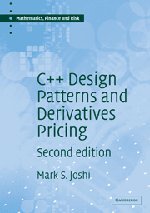
C Design Patterns and Derivatives Pricing 2nd Edition by Joshi ISBN 0521721628 978-0521721622

Original price was: $50.00.$35.00Current price is: $35.00.
C Design Patterns and Derivatives Pricing 2nd Edition by M. S. Joshi – Ebook PDF Instant Download/Delivery: 0521721628, 978-0521721622
Full download C Design Patterns and Derivatives Pricing 2nd Editionafter payment
Product details:
ISBN 10: 0521721628
ISBN 13: 978-0521721622
Author: M. S. Joshi
Newly updated second edition and now in paperback! This is the first book on implementing financial models using object-oriented C++. Assuming only a basic knowledge of C++ and mathematical finance, the reader learns how to produce well-designed, structured, reusable code via carefully-chosen examples. This new edition includes several new chapters covering topics of increasing robustness in the presence of exceptions, designing a generic factory, interfacing C++ with EXCEL, and improving code design using the idea of decoupling. Complete ANSI/ISO compatible C++ source code is hosted on an accompanying website for the reader to study in detail, and reuse as they see fit. Whether you are a student of financial mathematics, a working quantitative analyst or financial mathematician, you need this book. Offering practical steps for implementing pricing models for complex financial products, it will transform your understanding of how to use C++.
Table of contents:
1 A simple Monte Carlo model
1.1 Introduction
1.2 The theory
1.3 A simple implementation of a Monte Carlo call option pricer
1.4 Critiquing the simple Monte Carlo routine
1.5 Identifying the classes
1.6 What will the classes buy us?
1.7 Why object-oriented programming?
1.8 Key points
1.9 Exercises
2 Encapsulation
2.1 Implementing the pay-off class
2.2 Privacy
2.3 Using the pay-off class
2.4 Further extensibility defects
2.5 The open-closed principle
2.6 Key points
2.7 Exercises
3 Inheritance and virtual functions
3.1 ‘is a’
3.2 Coding inheritance
3.3 Virtual functions
3.4 Why we must pass the inherited object by reference
3.5 Not knowing the type and virtual destruction
3.6 Adding extra pay-offs without changing files
Contents
3.7 Key points
3.8 Exercises
4 Bridging with a virtual constructor
4.1 The problem
4.2 A first solution
4.3 Virtual construction
4.4 The rule of three
4.5 The bridge
4.6 Beware of new
4.7 A parameters class
4.8 Key points
4.9 Exercises
5 Strategies, decoration, and statistics
5.1 Differing outputs
5.2 Designing a statistics gatherer
5.3 Using the statistics gatherer
5.4 Templates and wrappers
5.5 A convergence table
5.6 Decoration
5.7 Key points
5.8 Exercises
6 A random numbers class
6.1 Why?
6.2 Design considerations
6.3 The base class
6.4 A linear congruential generator and the adapter pattern
6.5 Anti-thetic sampling via decoration
6.6 Using the random number generator class
6.7 Key points
6.8 Exercises
7 An exotics engine and the template pattern
7.1 Introduction
7.2 Identifying components
7.3 Communication between the components
7.4 The base classes
7.5 A Black-Scholes path generation engine
7.6 An arithmetic Asian option
7.7 Putting it all together
7.8 Key points
7.9 Exercises
8 Trees
8.1 Introduction
8.2 The design
8.3 The TreeProduct class
8.4 A tree class
8.5 Pricing on the tree
8.6 Key points
8.7 Exercises
9 Solvers, templates, and implied volatilities
9.1 The problem
9.2 Function objects
9.3 Bisecting with a template
9.4 Newton-Raphson and function template arguments
9.5 Using Newton-Raphson to do implied volatilities
9.6 The pros and cons of templatization
9.7 Key points
9.8 Exercises
10 The factory
10.1 The problem
10.2 The basic idea
10.3 The singleton pattem
10.4 Coding the factory
10.5 Automatic registration
10.6 Using the factory
10.7 Key points
10.8 Exercises
11 Design pattems revisited
11.1 Introduction
11.2 Creational patterns
11.3 Structural patterns
11.4 Behavioural patterns
11.5 Why design patterns?
11.6 Further reading
11.7 Key points
11.8 Exercise
12 The situation in 2007
12.1 Introduction
12.2 Compilers and the standard library
12.3 Boost
12.4 QuantLib
12.5 xlw
12.6 Key points
12.7 Exercises
13 Exceptions
13.1 Introduction
13.2 Safety guarantees
13.3 The use of smart pointers
13.4 The rule of almost zero
13.5 Commands to never use
13.6 Making the wrapper class exception safe
13.7 Throwing in special functions
13.8 Floating point exceptions
13.9 Key points
14 Templatizing the factory
14.1 Introduction
14.2 Using inheritance to add structure
14.3 The curiously recurring template pattern
14.4 Using argument lists
14.5 The private part of the ArgumentList class
14.6 The implementation of the ArgumentList
14.7 Cell matrices
14.8 Cells and the ArgumentLists
14.9 The template factory
14.10 Using the templatized factory
14.11 Key points
14.12 Exercises
15 Interfacing with EXCEL
15.1 Introduction
15.2 Usage
15.3 Basic data types
15.4 Extended data types
15.5 xlw commands
15.6 The interface file
15.7 The interface generator
15.8 Troubleshooting
15.9 Debugging with xlls
15.10 Key points
15.11 Exercises
untented
16 Decoupling
16.1 Introduction
16.2 Header files
16.3 Splitting files
16.4 Direction of information flow and levelization
16.5 Classes as insulators
16.6 inlining
16.7 Template code
16.8 Functional interfaces
16.9 Pimpls
16.10 Key points
16.11 Exercises
People also search for:
embedded c design patterns
embedded c design patterns pdf
objective c design patterns
c design patterns examples
c design patterns book
Tags: Joshi, C Design, Patterns and Derivatives