
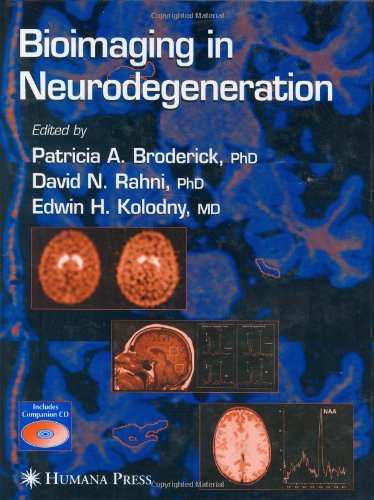
Bioimaging in Neurodegeneration 1st Edition by Patricia Broderick, David Rahni, Edwin Kolodny ISBN 978-1588293916 1588293916

Original price was: $50.00.$35.00Current price is: $35.00.
Bioimaging in Neurodegeneration 1st Edition by Patricia A. Broderick, David N. Rahni, Edwin H. Kolodny – Ebook PDF Instant Download/Delivery: 978-1588293916, 1588293916
Full download Bioimaging in Neurodegeneration 1st Edition after payment
Product details:
ISBN 10: 1588293916
ISBN 13: 978-1588293916
Author: Patricia A. Broderick, David N. Rahni, Edwin H. Kolodny
Bioimaging is in the forefront of medicine for the diagnosis and helps to predict the progression of AD via mild cognitive treatment of neurodegenerative disease. Conventional magnetic impairment (MCI) studies. resonance imaging (MRI) uses interactive external magnetic fields Novel neuroimaging technologies, such as neuromolecular and resonant frequencies of protons from water molecules. imaging (NMI) with a series of newly developed BRODERICK ® However, newer sequences, such as magnetization-prepared rapid PROBE sensors, directly image neurotransmitters, precursors, acquisition gradient echo (MPRAGE), are able to seek higher and metabolites in vivo, in real time and within seconds, at separate levels of anatomic resolution by allowing more rapid temporal and selective waveform potentials. NMI, which uses an imaging. Magnetic resonance spectroscopy (MRS) images electrochemical basis for detection, enables the differentiation of metabolic changes, enabling underlying pathophysiologic neurodegenerative diseases in patients who present with mesial dysfunction in neurodegeneration to be deciphered. Neuro- versus neocortical temporal lobe epilepsy. In fact, NMI has some 1 chemicals visible with proton H MRS include N-acetyl aspartate remarkable similarities to MRI insofar as there is technological (NAA), creatine/phosphocreatine (Cr), and choline (Cho); NAA dependence on electron and proton transfer, respectively, and is considered to act as an in vivo marker for neuronal loss and/or further dependence is seen in both NMI and MRI on tissue neuronal dysfunction. By extending imaging to the study of composition such as lipids.
Table of contents:
I. PARKINSON’S DISEASE
Magnetic Resonance Imaging and Magnetic Resonance Spectroscopy in Parkinson’s Disease: Structural vs Functional Changes
W. R. Wayne Martin
Positron Emission Tomography and Single-Photon Emission Tomography in the Diagnosis of Parkinson’s Disease: Differential Diagnosis From Parkinson-Like Degenerative Diseases
Paul D. Acton
Positron Emission Tomography in Parkinson’s Disease: Cerebral Activation Studies and Neurochemical and Receptor Research
André R. Troiano and A. Jon Stoessl
Hubert H. Fernandez, Paula D. Ravin, and Dylan P. Wint
Positron Emission Tomography and Embryonic Dopamine Cell Transplantation in Parkinson’s Disease
Yilong Ma, Vijay Dhawan, Curt Freed, Stanley Fahn, and David Eidelberg
II. ALZHEIMER’S DISEASE
Neurotoxicity of the Alzheimer’s β-Amyloid Peptide: Spectroscopic and Microscopic Studies
David R. Howlett
Functional Imaging and Psychopathological Consequences of Inflammation in Alzheimer’s Dementia
Jan Versijpt, Rudi A. Dierckx, and Jakob Korf
Neurotoxic Oxidative Metabolite of Serotonin: Possible Role in Alzheimer’s Disease
Ladislav Volicer, Monika Z. Wrona, Wayne Matson, and Glenn Dryhurst
Predicting Progression of Alzheimer’s Disease With Magnetic Resonance
Kejal Kantarci and Clifford R. Jack, Jr.
Stages of Brain Functional Failure in Alzheimer’s Disease: In Vivo Positron Emission Tomography and Postmortem Studies Suggest Potential Initial Reversibility and Later Irreversibility
Stanley I. Rapoport
III. EPILEPSY
Neocortical Epilepsy: O-Methyl-L-Tryptophan and Positron Emission Tomography Studies
Jun Natsume, Andrea Bernasconi, and Mirko Diksic
Pediatric Cortical Dysplasia: Positron Emission Tomography Studies
Bharathi Dasan Jagadeesan, Csaba Juhász, Diane C. Chugani, and Harry T. Chugani
Bioimaging L-Tryptophan in Human Hippocampus and Neocortex: Subtyping Temporal Lobe Epilepsy
Steven V. Pacia and Patricia A. Broderick
In Vivo Intrinsic Optical Signal Imaging of Neocortical Epilepsy
Sonya Bahar, Minah Suh, Ashesh Mehta, and Theodore H. Schwartz
Intraoperative Magnetic Resonance Imaging in the Surgical Treatment of Epilepsy
Theodore H. Schwartz
Periodic Epileptiform Discharges Associated With Increased Cerebral Blood Flow: Role of Single-Photon Emission Tomography Imaging
Imran I. Ali and Noor A. Pirzada
Imaging White Matter Signals in Epilepsy Patients: A Unique Sensor Technology
Patricia A. Broderick and Steven V. Pacia
IV. LEUKODYSTROPHY (WHITE MATTER) DISEASES
Overview of the Leukoencephalopathies: An MRI Point of View
Edwin H. Kolodny
Pyramidal Tract Involvement in Adult Krabbe’s Disease: Magnetic Resonance Imaging and Proton Magnetic Resonance Spectroscopy Abnormalities
Laura Farina, Alberto Bizzi, and Mario Savoiardo
Imaging Leukodystrophies: Focus on Lysosomal, Peroxisomal, and Non-Organelle Pathology
Annette O. Nusbaum
Advanced Magnetic Resonance Imaging in Leukodystrophies
Edwin Y. Wang and Meng Law
Childhood Mitochondrial Disorders and Other Inborn Errors of Metabolism Presenting With White Matter Disease
Adeline Vanderver and Andrea L. Gropman
Mitochondrial Disease: Brain Oxidative Metabolism Studied by 31P, 1H, and 13C Magnetic Resonance Spectroscopy, Functional Magnetic Resonance Imaging, and Positron Emission Tomography
Graham J. Kemp
People also search for:
bioimaging in neurodegeneration
biomarkers in neurodegenerative diseases
imaging biomarkers in neurodegeneration current and future practices
neurodegeneration biomarkers
center for biostructural imaging of neurodegeneration
Tags: Patricia Broderick, David Rahni, Edwin Kolodny, Bioimaging in Neurodegeneration