
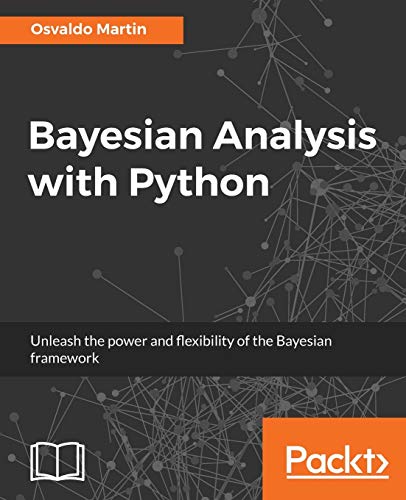
Bayesian Analysis with Python 1st Edition by Osvaldo Martin ISBN 978-1785883804 1785883801

Original price was: $50.00.$35.00Current price is: $35.00.
Bayesian Analysis with Python 1st Edition by Osvaldo Martin – Ebook PDF Instant Download/Delivery: 978-1785883804, 1785883801
Full download Bayesian Analysis with Python 1st Edition after payment
Product details:
ISBN 10: 1785883801
ISBN 13: 978-1785883804
Author: Osvaldo Martin
Unleash the power and flexibility of the Bayesian framework
Key Features:
Simplify the Bayes process for solving complex statistical problems using Python;
Tutorial guide that will take the you through the journey of Bayesian analysis with the help of sample problems and practice exercises;
Learn how and when to use Bayesian analysis in your applications with this guide.
Book Description:
The purpose of this book is to teach the main concepts of Bayesian data analysis. We will learn how to effectively use PyMC3, a Python library for probabilistic programming, to perform Bayesian parameter estimation, to check models and validate them. This book begins presenting the key concepts of the Bayesian framework and the main advantages of this approach from a practical point of view. Moving on, we will explore the power and flexibility of generalized linear models and how to adapt them to a wide array of problems, including regression and classification. We will also look into mixture models and clustering data, and we will finish with advanced topics like non-parametrics models and Gaussian processes. With the help of Python and PyMC3 you will learn to implement, check and expand Bayesian models to solve data analysis problems.
What You Will Learn:
Understand the essentials Bayesian concepts from a practical point of view
Learn how to build probabilistic models using the Python library PyMC3
Acquire the skills to sanity-check your models and modify them if necessary
Add structure to your models and get the advantages of hierarchical models
Find out how different models can be used to answer different data analysis questions
When in doubt, learn to choose between alternative models.
Predict continuous target outcomes using regression analysis or assign classes using logistic and softmax regression.
Learn how to think probabilistically and unleash the power and flexibility of the Bayesian framework
Who this book is for:Students, researchers and data scientists who wish to learn Bayesian data analysis with Python and implement probabilistic models in their day to day projects. Programming experience with Python is essential. No previous statistical knowledge is assumed.
Table of contents:
Chapter 1: Thinking Probabilistically – A Bayesian Inference Primer
Statistics as a form of modeling
Exploratory data analysis
Inferential statistics
Probabilities and uncertainty
Probability distributions
Bayes’ theorem and statistical inference
Single parameter inference
The coin-flipping problem
The general model
Choosing the likelihood
Choosing the prior
Getting the posterior
Computing and plotting the posterior
Influence of the prior and how to choose one
Communicating a Bayesian analysis
Model notation and visualization
Summarizing the posterior
Highest posterior density
Posterior predictive checks
Installing the necessary Python packages
Summary
Exercises
Chapter 2: Programming Probabilistically – A PyMC3 Primer
Probabilistic programming
Inference engines
Non-Markovian methods
Markovian methods
PyMC3 introduction
Coin-flipping, the computational approach
Model specification
Pushing the inference button
Diagnosing the sampling process
Summarizing the posterior
Posterior-based decisions
ROPE
Loss functions
Summary
Keep reading
Exercises
Chapter 3: Juggling with Multi-Parametric and Hierarchical Models
Nuisance parameters and marginalized distributions
Gaussians, Gaussians, Gaussians everywhere
Gaussian inferences
Robust inferences
Student’s t-distribution
Comparing groups
The tips dataset
Cohen’s d
Probability of superiority
Hierarchical models
Shrinkage
Summary
Keep reading
Exercises
Chapter 4: Understanding and Predicting Data with Linear Regression Models
Simple linear regression
The machine learning connection
The core of linear regression models
Linear models and high autocorrelation
Modifying the data before running
Changing the sampling method
Interpreting and visualizing the posterior
Pearson correlation coefficient
Pearson coefficient from a multivariate Gaussian
Robust linear regression
Hierarchical linear regression
Correlation, causation, and the messiness of life
Polynomial regression
Interpreting the parameters of a polynomial regression
Polynomial regression – the ultimate model?
Multiple linear regression
Confounding variables and redundant variables
Multicollinearity or when the correlation is too high
Masking effect variables
Adding interactions
The GLM module
Summary
Keep reading
Exercises
Chapter 5: Classifying Outcomes with Logistic Regression
Logistic regression
The logistic model
The iris dataset
The logistic model applied to the iris dataset Making predictions
Multiple logistic regression
The boundary decision
Implementing the model
Dealing with correlated variables
Dealing with unbalanced classes
How do we solve this problem?
Interpreting the coefficients of a logistic regression
Generalized linear models
Softmax regression or multinomial logistic regression
Discriminative and generative models
Summary
Keep reading
Exercises
Chapter 6: Model Comparison
Occam’s razor – simplicity and accuracy
Too many parameters leads to overfitting
Too few parameters leads to underfitting
The balance between simplicity and accuracy
Regularizing priors
Regularizing priors and hierarchical models
Predictive accuracy measures
Cross-validation
Information criteria
The log-likelihood and the deviance
Akaike information criterion
Deviance information criterion
Widely available information criterion
Pareto smoothed importance sampling leave-one-out cross-validation
Bayesian information criterion
Computing information criteria with PyMC3
A note on the reliability of WAIC and LOO computations
Interpreting and using information criteria measures
Posterior predictive checks
Bayes factors
Analogy with information criteria
Computing Bayes factors
Common problems computing Bayes factors
Bayes factors and information criteria
Summary
Keep reading
Exercises
Chapter 7: Mixture Models
Mixture models
How to build mixture models
Marginalized Gaussian mixture model
Mixture models and count data
The Poisson distribution
The Zero-Inflated Poisson model
Poisson regression and ZIP regression
Robust logistic regression
Model-based clustering
Fixed component clustering
Non-fixed component clustering
Continuous mixtures
Beta-binomial and negative binomial
The Student’s t-distribution
Summary
Keep reading
Exercises
Chapter 8: Gaussian Processes
Non-parametric statistics
Kernel-based models
The Gaussian kernel
Kernelized linear regression
Overfitting and priors
Gaussian processes
Building the covariance matrix
Sampling from a GP prior
Using a parameterized kernel
Making predictions from a GP
Implementing a GP using PyMC3
Posterior predictive checks
Periodic kernel
People also search for:
bayesian analysis with python github
bayesian analysis with python second edition pdf
bayesian analysis with python book
bayesian analysis with python packt
bayesian analysis with python pdf github
Tags: Osvaldo Martin, Bayesian Analysis