
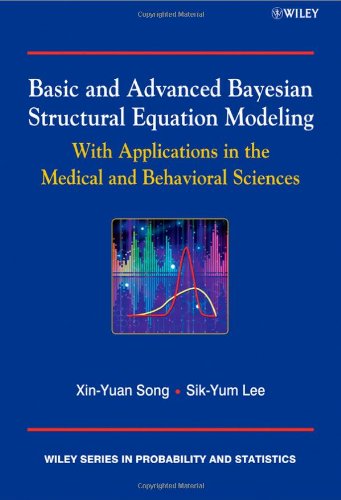
Basic and Advanced Bayesian Structural Equation Modeling With Applications in the Medical and Behavioral Sciences 1st Edition by Sik-Yum Lee, Xin-Yuan Song ISBN 978-0470669525 0470669527


Original price was: $50.00.$35.00Current price is: $35.00.
Basic and Advanced Bayesian Structural Equation Modeling With Applications in the Medical and Behavioral Sciences 1st Edition by Sik-Yum Lee, Xin-Yuan Song – Ebook PDF Instant Download/Delivery: 978-0470669525, 0470669527
Full download Basic and Advanced Bayesian Structural Equation Modeling With Applications in the Medical and Behavioral Sciences 1st Edition after payment
Product details:
ISBN 10: 0470669527
ISBN 13: 978-0470669525
Author: Sik-Yum Lee, Xin-Yuan Song
This book provides clear instructions to researchers on how to apply Structural Equation Models (SEMs) for analyzing the inter relationships between observed and latent variables.
Basic and Advanced Bayesian Structural Equation Modeling introduces basic and advanced SEMs for analyzing various kinds of complex data, such as ordered and unordered categorical data, multilevel data, mixture data, longitudinal data, highly non-normal data, as well as some of their combinations. In addition, Bayesian semiparametric SEMs to capture the true distribution of explanatory latent variables are introduced, whilst SEM with a nonparametric structural equation to assess unspecified functional relationships among latent variables are also explored.
Statistical methodologies are developed using the Bayesian approach giving reliable results for small samples and allowing the use of prior information leading to better statistical results. Estimates of the parameters and model comparison statistics are obtained via powerful Markov Chain Monte Carlo methods in statistical computing.
Introduces the Bayesian approach to SEMs, including discussion on the selection of prior distributions, and data augmentation.
Demonstrates how to utilize the recent powerful tools in statistical computing including, but not limited to, the Gibbs sampler, the Metropolis-Hasting algorithm, and path sampling for producing various statistical results such as Bayesian estimates and Bayesian model comparison statistics in the analysis of basic and advanced SEMs.
Discusses the Bayes factor, Deviance Information Criterion (DIC), and $L_nu$-measure for Bayesian model comparison.
Introduces a number of important generalizations of SEMs, including multilevel and mixture SEMs, latent curve models and longitudinal SEMs, semiparametric SEMs and those with various types of discrete data, and nonparametric structural equations.
Illustrates how to use the freely available software WinBUGS to produce the results.
Provides numerous real examples for illustrating the theoretical concepts and computational procedures that are presented throughout the book.
Researchers and advanced level students in statistics, biostatistics, public health, business, education, psychology and social science will benefit from this book.
Table of contents:
1 Introduction
1.1 Observed and latent variables
1.2 Structural equation model
1.3 Objectives of the book
1.4 The Bayesian approach
1.5 Real data sets and notation
Appendix 1.1: Information on real data sets
References
2 Basic concepts and applications of structural equation models
2.1 Introduction
2.2 Linear SEMS
2.2.1 Measurement equation
2.2.2 Structural equation and one extension
2.2.3 Assumptions of linear SEMS
2.2.4 Model identification
2.2.5 Path diagram
2.3 SEMs with fixed covariates
2.3.1 The model
2.3.2 An artificial example
2.4 Nonlinear SEMs
2.4.1 Basic nonlinear SEMS
2.4.2 Nonlinear SEMs with fixed covariates
2.4.3 Remarks
2.5 Discussion and conclusions
References
3 Bayesian methods for estimating structural equation models
3.1 Introduction
3.2 Basic concepts of the Bayesian estimation and prior distributions
3.2.1 Prior distributions
3.2.2 Conjugate prior distributions in Bayesian analyses of SEMs
3.3 Posterior analysis using Markov chain Monte Carlo methods
3.4 Application of Markov chain Monte Carlo methods
3.5 Bayesian estimation via WinBUGS
Appendix 3.1: The gamma, inverted gamma, Wishart, and inverted
Wishart distributions and their characteristics
Appendix 3.2: The Metropolis-Hastings algorithm
Appendix 3.3: Conditional distributions [2]Y, 0] and [9]Y, 2]
Appendix 3.4: Conditional distributions [2]Y, θ] and [9]Υ, Ω] in nonlinear SEMs with covariates
Appendix 3.5: WinBUGS code
Appendix 3.6: R2WinBUGS code
References
4 Bayesian model comparison and model checking
4.1 Introduction
4.2 Bayes factor
4.2.1 Path sampling
4.2.2 A simulation study
4.3 Other model comparison statistics
4.3.1 Bayesian information criterion and Akaike information criterion
4.3.2 Deviance information criterion
4.3.3 L-measure
4.4 Illustration
4.5 Goodness of fit and model checking methods
4.5.1 Posterior predictive p-value
4.5.2 Residual analysis
Appendix 4.1: WinBUGS code
Appendix 4.2: R code in Bayes factor example
Appendix 4.3: Posterior predictive p-value for model assessment
References
5 Practical structural equation models
5.1 Introduction
5.2 SEMs with continuous and ordered categorical variables
5.2.1 Introduction
5.2.2 The basic model
5.2.3 Bayesian analysis
5.2.4 Application: Bayesian analysis of quality of life data
5.2.5 SEMs with dichotomous variables
5.3 SEMs with variables from exponential family distributions
5.3.1 Introduction
5.3.2 The SEM framework with exponential family distributions
5.3.3 Bayesian inference
5.3.4 Simulation study
5.4 SEMs with missing data
5.4.1 Introduction
5.4.2 SEMs with missing data that are MAR
5.4.3 An illustrative example
5.4.4 Nonlinear SEMs with nonignorable missing data
5.4.5 An illustrative real example
Appendix 5.1: Conditional distributions and implementation of the MH algorithm for SEMs with continuous and ordered categorical variables
Appendix 5.2: Conditional distributions and implementation of MΗ algorithm for SEMs with EFDs
Appendix 5.3: WinBUGS code related to section 5.3.4
Appendix 5.4: R2WinBUGS code related to section 5.3.4
Appendix 5.5: Conditional distributions for SEMs with nonignorable missing data
References
6 Structural equation models with hierarchical and multisample data
6.1 Introduction
6.2 Two-level structural equation models
6.2.1 Two-level nonlinear SEM with mixed type variables
6.2.2 Bayesian inference
6.2.3 Application: Filipina CSWs study
6.3 Structural equation models with multisample data
6.3.1 Bayesian analysis of a nonlinear SEM in different groups
6.3.2 Analysis of multisample quality of life data via WinBUGS
Appendix 6.1: Conditional distributions: Two-level nonlinear SEM
Appendix 6.2: The MH algorithm: Two-level nonlinear SEM
Appendix 6.3: PP p-value for two-level nonlinear SEM with mixed continuous and ordered categorical variables
Appendix 6.4: WinBUGS code
Appendix 6.5: Conditional distributions: Multisample SEMs
References
7 Mixture structural equation models
7.1 Introduction
7.2 Finite mixture SEMS
7.2.1 The model
7.2.2 Bayesian estimation
7.2.3 Analysis of an artificial example
7.2.4 Example from the world values survey
7.2.5 Bayesian model comparison of mixture SEMS
7.2.6 An illustrative example
7.3 A Modified mixture SEM
7.3.1 Model description
7.3.2 Bayesian estimation
7.3.3 Bayesian model selection using a modified DIC
7.3.4 An illustrative example
Appendix 7.1: The permutation sampler
Appendix 7.2: Searching for identifiability constraints
Appendix 7.3: Conditional distributions: Modified mixture SEMs
References
8 Structural equation modeling for latent curve models
8.1 Introduction
8.2 Background to the real studies
8.2.1 A longitudinal study of quality of life of stroke survivors
8.2.2 A longitudinal study of cocaine use
8.3 Latent curve models
8.3.1 Basic latent curve models
8.3.2 Latent curve models with explanatory latent variables
8.3.3 Latent curve models with longitudinal latent variables
8.4 Bayesian analysis
8.5 Applications to two longitudinal studies
8.5.1 Longitudinal study of cocaine use
8.5.2 Health-related quality of life for stroke survivors
8.6 Other latent curve models
8.6.1 Nonlinear latent curve models
8.6.2 Multilevel latent curve models
8.6.3 Mixture latent curve models
Appendix 8.1: Conditional distributions
Appendix 8.2: WinBUGS code for the analysis of cocaine use data
References
9 Longitudinal structural equation models
9.1 Introduction
9.2 A two-level SEM for analyzing multivariate longitudinal data
9.3 Bayesian analysis of the two-level longitudinal SEM
9.3.1 Bayesian estimation
9.3.2 Model comparison via the Lu-measure
9.4 Simulation study
9.5 Application: Longitudinal study of cocaine use
9.6 Discussion
Appendix 9.1: Full conditional distributions for implementing the Gibbs sampler
Appendix 9.2: Approximation of the L-measure in equation (9.9) via MCMC samples
References
10 Semiparametric structural equation models with continuous variables
10.1 Introduction
10.2 Bayesian semiparametric hierarchical modeling of SEMs with covariates
10.3 Bayesian estimation and model comparison
10.4 Application: Kidney disease study
10.5 Simulation studies
CONTENTS
10.5.1 Simulation study of estimation
10.5.2 Simulation study of model comparison
10.5.3 Obtaining the L-measure via WinBUGS and R2WinBUGS
10.6 Discussion
Appendix 10.1: Conditional distributions for parametric components
Appendix 10.2: Conditional distributions for nonparametric components
References
11 Structural equation models with mixed continuous and unordered categorical variables
11.1 Introduction
11.2 Parametric SEMs with continuous and unordered categorical variables
11.2.1 The model
11.2.2 Application to diabetic kidney disease
11.2.3 Bayesian estimation and model comparison
11.2.4 Application to the diabetic kidney disease data
11.3 Bayesian semiparametric SEM with continuous and unordered categorical variables
11.3.1 Formulation of the semiparametric SEM
11.3.2 Semiparametric hierarchical modeling via the Dirichlet process
11.3.3 Estimation and model comparison
11.3.4 Simulation study
11.3.5 Real example: Diabetic nephropathy study
Appendix 11.1: Full conditional distributions
Appendix 11.2: Path sampling
Appendix 11.3: A modified truncated DP related to equation (11.19)
Appendix 11.4: Conditional distributions and the MH algorithm
for the Bayesian semiparametric model
References
12 Structural equation models with nonparametric structural equations
12.1 Introduction
12.2 Nonparametric SEMs with Bayesian P-splines
12.2.1 Model description
12.2.2 General formulation of the Bayesian P-splines
12.2.3 Modeling nonparametric functions of latent variables
12.2.4 Prior distributions
12.2.5 Posterior inference via Markov chain Monte Carlo sampling
12.2.6 Simulation study
12.2.7 A study on osteoporosis prevention and control
12.3 Generalized nonparametric structural equation models
12.3.1 Model description
12.3.2 Bayesian P-splines
12.3.3 Prior distributions
12.3.4 Bayesian estimation and model comparison
12.3.5 National longitudinal surveys of youth study
12.4 Discussion
Appendix 12.1: Conditional distributions and the MH algorithm:
Nonparametric SEMS
Appendix 12.2: Conditional distributions in generalized
nonparametric SEMS
References
13 Transformation structural equation models
13.1 Introduction
13.2 Model description
13.3 Modeling nonparametric transformations
13.4 Identifiability constraints and prior distributions
13.5 Posterior inference with MCMC algorithms
13.5.1 Conditional distributions
13.5.2 The random-ray algorithm
13.5.3 Modifications of the random-ray algorithm
13.6 Simulation study
13.7 A study on the intervention treatment of polydrug use
13.8 Discussion
References
14 Conclusion
References
Index
People also search for:
basic and advanced bayesian
basic and advanced bayesian structural equation modeling
bayesian rules
what is a bayesian approach
when to use bayesian analysis
Tags: Sik-Yum Lee, Xin-Yuan Song, Basic and Advanced, Bayesian Structural Equation, the Medical and Behavioral