
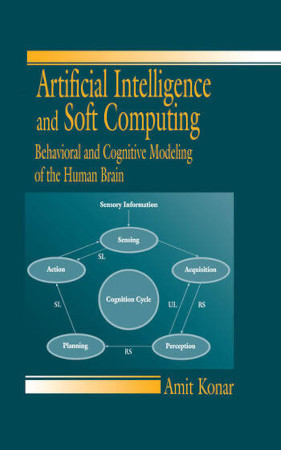
Artificial Intelligence and Soft Computing Behavioral and Cognitive Modeling of the Human Brain First Edition by Amit Konar ISBN 0849313851 978-0849313851


Original price was: $50.00.$35.00Current price is: $35.00.
Artificial Intelligence and Soft Computing Behavioral and Cognitive Modeling of the Human Brain First Edition by Amit Konar- Ebook PDF Instant Download/Delivery: 0849313851, 978-0849313851
Full download Artificial Intelligence and Soft Computing Behavioral and Cognitive Modeling of the Human Brain First Edition after payment
Product details:
ISBN 10: 0849313851
ISBN 13: 978-0849313851
Author: Amit Konar
With all the material available in the field of artificial intelligence (AI) and soft computing-texts, monographs, and journal articles-there remains a serious gap in the literature. Until now, there has been no comprehensive resource accessible to a broad audience yet containing a depth and breadth of information that enables the reader to fully understand and readily apply AI and soft computing concepts. Artificial Intelligence and Soft Computing fills this gap. It presents both the traditional and the modern aspects of AI and soft computing in a clear, insightful, and highly comprehensive style. It provides an in-depth analysis of mathematical models and algorithms and demonstrates their applications in real world problems. Beginning with the behavioral perspective of “human cognition,” the text covers the tools and techniques required for its intelligent realization on machines. The author addresses the classical aspects-search, symbolic logic, planning, and machine learning-in detail and includes the latest research in these areas. He introduces the modern aspects of soft computing from first principles and discusses them in a manner that enables a beginner to grasp the subject. He also covers a number of other leading aspects of AI research, including nonmonotonic and spatio-temporal reasoning, knowledge acquisition, and much more. Artificial Intelligence and Soft Computing: Behavioral and Cognitive Modeling of the Human Brain is unique for its diverse content, clear presentation, and overall completeness. It provides a practical, detailed introduction that will prove valuable to computer science practitioners and students as well as to researchers migrating to the subject from other disciplines.
Table of contents:
1 INTRODUCTION TO AI AND SOFT COMPUTING
2 Evolution of Computing
3 Defining AI
4 General Problem Solving Approaches in AI
5 The Disciplines of AI
6 A Brief History of AI
7 Characteristic Requirement for the Realization of Intelligent Systems
8 Programming Languages for AI
9 Architecture for AI Machines
10 Objective and Scope of the Book
11 Summary
12 THE PSYCHOLOGICAL PERSPECTIVE OF COGNITION
13 Introduction
14 The Cognitive Perspective of Pattern Recognition
15 Cognitive Models of Memory
16 Mental Imagery
17 Understanding a Problem
18 A Cybernetic View to Cognition
19 Scope of Realization of Cognition in AI
20 Summary
21 PRODUCTION SYSTEMS
22 Introduction
23 Production Rules
24 The Working Memory
25 The Control Unit / Interpreter
26 Conflict Resolution Strategies
27 An Alternative Approach for Conflict Resolution
28 An Illustrative Production System
29 The RETE Match Algorithm
30 Types of Production Systems
31 Forward versus Backward Production Systems
32 General Merits of a Production System
33 Knowledge Base Optimization in a Production System
34 Conclusions
35 PROBLEM SOLVING BY INTELLIGENT SEARCH
36 Introduction
37 General Problem Solving Approaches
38 Heuristic Search
39 Adversary Search
40 Conclusions
41 THE LOGIC OF PROPOSITIONS AND PREDICATES
42 Introduction
43 Formal Definitions
44 Tautologies in Propositional Logic
45 Theorem Proving by Propositional Logic
46 Resolution in Propositional Logic
47 Soundness and Completeness of Propositional Logic
48 Predicate Logic
49 Writing a Sentence into Clause Forms
50 Unification of Predicates
51 Robinson’s Inference Rule
52 Different Types of Resolution
53 Semi-Decidability
54 Soundness and Completeness of Predicate Logic
55 Conclusions
56 PRINCIPLES OF LOGIC PROGRAMMING
57 Introduction to PROLOG Programming
58 Logic Programs – A Formal Definition
59 A Scene Interpretation Program
60 Illustrating Backtracking by flow of Satisfaction Diagrams
61 The SLD Resolution
62 Controlling Backtracking by CUT
63 The NOT Predicate
64 Negation as a Failure in Extended Logic Programs
65 Fixed Points in Non-Horn Clause Based Programs
66 Constraint Logic Programming
67 Conclusions
68 DEFAULT AND NON-MONOTONIC REASONING
69 Introduction
70 Monotonic versus Non-Monotonic Logic
71 Non-Monotonic Resoning Using NML-I
72 Fixed Points in Non-Monotonic Reasoning
73 Non-Monotonic Resoning Using NML-II
74 Truth Maintenance System
75 Default Reasoning
76 The Closed World Assumption
77 Circumscription
78 Auto-Epistemic Logic
79 Conclusions
80 STRUCTURED APPROACH TO KNOWLEDGE REPRESENTATION
81 Introduction
82 Semantic Nets
83 Inheritance in Semantic Nets
84 Manipulating Monotonic and Default Inheritance in Semantic Nets
85 Defeasible Reasoning in Semantic Nets
86 Frames
87 Inheritance in Tangled Frames
88 Petri nets
89 Conceptual Dependency
90 Scripts
91 Conclusions
92 DEALING WITH IMPRECISION AND UNCERTAINTY
93 Introduction
94 Probabilistic Reasoning
95 Certainty Factor Based Reasoning
96 Fuzzy Reasoning
97 Comparison of the Proposed Models
98 STRUCTURED APPROACH TO FUZZY REASONING
99 Introduction
100 Structural Model of Fuzzy FPN and Reachability Analysis
101 Behavioral Model of FPN and Stability Analysis
102 Forward Reasoning in FPN
103 Backward Reasoning in FPN
104 Bi-directional IFF Type Reasoning and Reciprocity
105 Fuzzy Modus Tollens and Duality
106 Non-Monotonic Reasoning in an FPN
107 Conclusions
108 REASONING WITH SPACE AND TIME
109 Introduction
110 Spatial Reasoning
111 Spatial Relationships among Components of an Object
112 Fuzzy Spatial Relationships among Objects
113 Temporal Reasoning by Situation Calculus
114 Propositional Temporal Logic
115 Interval Temporal Logic
116 Reasoning with Both Space and Time
117 Conclusions
118 INTELLIGENT PLANNING
119 Introduction
120 Planning with If-Add-Delete Operators
121 Least Commitment Planning
122 Hierarchical Task Network Planning
123 Multi-agent Planning
124 The Flowshop Scheduling Problem
125 Summary
126 MACHINE LEARNING TECHNIQUES
127 Introduction
128 Supervised Learning
129 Unsupervised Learning
130 Reinforcement Learning
131 Learning by Inductive Logic Programming
132 Computational Learning Theory
133 Summary
134 MACHINE LEARNING USING NEURAL NETS
135 Biological Neural Nets
136 Artificial Neural Nets
137 Topology of Artificial Neural Nets
138 Learning Using Neural Nets
139 The Back-Propagation Training Algorithm
140 Widrow-Hoff’s Multi-Layers ADALINE Models
141 Hopfield Neural Net
142 Associative Memory
143 Fuzzy Neural Nets
144 Self-Organizing Neural Net
145 Adaptive Resonance Theory (ART)
146 Applications of Artificial Neural Nets
147 GENETIC ALGORITHMS
148 Introduction
149 Deterministic Explanation of Holland’s Observation
150 Stochastic Explanation of GA
151 The Markov Model for Convergence Analysis
152 Application of GA in Optimization Problems
153 Application of GA in Machine Learning
154 Applications of GA in Intelligent Search
155 Genetic Programming
156 Conclusions
157 REALIZING COGNITION USING FUZZY NEURAL NETS
158 Cognitive Maps
159 Learning by a Cognitive Map
160 The Recall in a Cognitive Map
161 Stability Analysis
162 Cognitive Learning with FPN
163 Applications in Autopilots
164 Generation of Control Commands by a Cognitive Map
165 Task Planning and Coordination
166 Putting it all Together
167 Conclusions and Future Directions
168 VISUAL PERCEPTION
169 Introduction
170 Low level Vision
171 Medium Level Vision
172 High Level Vision
173 Conclusions
174 LINGUISTIC PERCEPTION
175 Introduction
176 Syntactic Analysis
177 Augmented Transition Network Parsers
178 Semantic Interpretation by Case Grammar and Type Hierarchy
179 Discourse and Pragmatic Analysis
180 Applications of Natural Language Understanding
181 PROBLEM SOLVING BY CONSTRAINT SATISFACTION
182 Introduction
183 Formal Definitions
184 Constraint Propagation in Networks
185 Determining Satisfiability of CSP
186 Constraint Logic Programming
187 Geometric Constraint Satisfaction
188 Conclusions
189 ACQUISITION OF KNOWLEDGE
190 Introduction
191 Manual Approach for Knowledge Acquisition
192 Knowledge Fusion from Multiple Experts
193 Machine Learning Approach for Knowledge Acquisition
194 Knowledge Refinement by Hebbian Learning
195 Conclusions
196 VALIDATION, VERIFICATION AND MAINTENANCE ISSUES
197 Introduction
198 Validation of Expert Systems
199 Verification of Knowledge Based System
200 Maintenance of Knowledge Based Systems
201 Conclusions
202 PARALLEL AND DISTRIBUTED ARCHITECTURE FOR INTELLIGENT SYSTEMS
203 Introduction
204 Salient Features of AI Machines
205 Parallelism in Heuristic Search
206 Parallelism at Knowledge Representational Level
207 Parallel Architecture for Logic Programming
208 Conclusions
209 CASE STUDY I: BUILDING A SYSTEM FOR CRIMINAL INVESTIGATION
210 An Overview of the Proposed Scheme
211 Introduction to Image Matching
212 Fingerprint Classification and Matching
213 Identification of the Suspects from Voice
214 Identification of the Suspects from Incidental Descriptions
215 Conclusions
216 CASE STUDY II: REALIZATION OF COGNITION FOR MOBILE ROBOTS
217 Mobile Robots
218 Scope of Realization of Cognition on Mobile Robots
219 Knowing the Robot’s World
220 Types of Navigational Planning Problems
221 Offline Planning by Generalized Voronoi Diagram (GVD)
222 Path Traversal Optimization Problem
223 Self-Organizing Map (SOM)
224 Online Navigation by Modular Back-Propagation Neural Nets
225 Coordination among Sub-Modules in a Mobile Robot
226 An Application in a Soccer Playing Robot
227 The Expectations from the Readers
People also search for:
artificial intelligence and software engineering
behavioral artificial intelligence
applied behavior analysis and artificial intelligence
artificial intelligence simulates human thinking and behavior
artificial intelligence is best described as
Tags:
Amit Konar,Artificial Intelligence,Soft Computing,Cognitive Modeling