
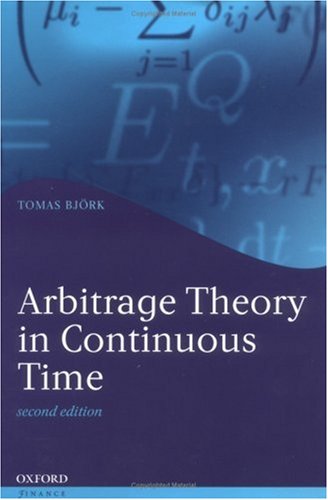
(Ebook PDF) Arbitrage theory in continuous time 2nd Edition by Tomas Björk ISBN 0199271267 9780199271269 Full chapter


Original price was: $50.00.$35.00Current price is: $35.00.
Arbitrage theory in continuous time 2nd Edition by Tomas Björk – Ebook PDF Instant Download/Delivery: 0199271267, 978-0199271269
Full dowload Arbitrage theory in continuous time 2nd Edition after payment
Product details:
ISBN 10: 0199271267
ISBN 13: 978-0199271269
Author: Tomas Björk
Arbitrage theory in continuous time 2nd Table of contents:
1. Introduction
1.1 Overview of Financial Markets and Arbitrage
1.2 The Role of Continuous Time in Financial Modeling
1.3 Basic Definitions and Assumptions
1.4 Structure of the Book
2. Mathematical Preliminaries
2.1 Probability Theory
2.2 Stochastic Processes
2.3 Brownian Motion and Wiener Process
2.4 Stochastic Calculus and Itô’s Lemma
2.5 Martingales and Stochastic Integrals
2.6 The Girsanov Theorem and Change of Measure
3. The Arbitrage-Free Market
3.1 The Concept of Arbitrage
3.2 No-Arbitrage Conditions in Financial Markets
3.3 The Fundamental Theorem of Asset Pricing
3.4 State Prices and Arrow-Debreu Securities
3.5 Replicating Portfolios and Hedging
3.6 The Role of Market Completeness
4. Pricing and Hedging Derivatives
4.1 Derivative Securities: Options, Futures, and Forwards
4.2 The Black-Scholes Model and the Option Pricing Formula
4.3 Hedging Strategies and the Delta-Hedging Argument
4.4 The Arbitrage Pricing Theory (APT)
4.5 Risk-Neutral Valuation and Risk-Free Asset
4.6 Multi-Asset Derivatives and Portfolio Pricing
5. Stochastic Processes in Arbitrage Pricing
5.1 Geometric Brownian Motion and Asset Dynamics
5.2 Stochastic Differential Equations (SDEs)
5.3 The Fokker-Planck Equation and Probability Densities
5.4 Jump Diffusions and Levy Processes
5.5 The Cox-Ross-Rubinstein Model
5.6 Volatility Models: GARCH and Stochastic Volatility
6. Optimal Portfolio Selection
6.1 The Mean-Variance Optimization
6.2 The CAPM (Capital Asset Pricing Model)
6.3 Portfolio Theory in Continuous Time
6.4 Dynamic Portfolio Optimization
6.5 Utility Maximization and Risk Preferences
6.6 The Merton Problem and Consumption-Savings Models
7. Interest Rate Models
7.1 The Term Structure of Interest Rates
7.2 The Vasicek Model and Its Extensions
7.3 The Cox-Ingersoll-Ross Model
7.4 The Heath-Jarrow-Morton Framework
7.5 The Libor Market Model and Short-Term Rates
7.6 Calibration and Empirical Estimation of Interest Rate Models
8. The Black-Scholes and Related Models
8.1 Derivation of the Black-Scholes Equation
8.2 European and American Options in Continuous Time
8.3 Implied Volatility and Volatility Smile
8.4 The Heston Model and Stochastic Volatility
8.5 Exotic Options: Barrier, Asian, and Lookback Options
8.6 Numerical Methods for Option Pricing
9. Arbitrage and Market Microstructure
9.1 The Structure of Financial Markets and Liquidity
9.2 Bid-Ask Spreads and Market Impact
9.3 High-Frequency Trading and Arbitrage Opportunities
9.4 Order Flow and Price Formation
9.5 The Role of Transaction Costs in Arbitrage
10. Continuous-Time Models in Asset Pricing
10.1 Models for Asset Prices under Different Assumptions
10.2 Stochastic Volatility and Random Walks
10.3 The Role of Leverage and Correlation in Pricing
10.4 Multi-Asset Models and Correlation
10.5 The Impact of External Shocks and News
10.6 Market Jumps and Stochastic Volatility Models
11. Advanced Topics in Arbitrage Theory
11.1 Term Structure Models and Arbitrage-Free Pricing
11.2 Derivatives on Interest Rates, Commodities, and Foreign Exchange
11.3 The Role of Credit Risk in Pricing Derivatives
11.4 Arbitrage in Non-Markovian and Non-Linear Models
11.5 The Use of Lévy Processes in Asset Pricing
11.6 Forward-Backward Stochastic Differential Equations (FBSDEs)
12. Numerical Methods in Arbitrage Pricing
12.1 Monte Carlo Simulation for Option Pricing
12.2 Finite Difference Methods and Grid-Based Solutions
12.3 Tree Methods for Pricing American Options
12.4 Stochastic Process Simulation and Calibration
12.5 Numerical Methods for Interest Rate Models
12.6 Solving Partial Differential Equations in Finance
13. The Black-Scholes Model and Its Limitations
13.1 The Assumptions of the Black-Scholes Model
13.2 Volatility Assumptions and Real-World Deviations
13.3 The Impact of Jumps and Non-Normal Returns
13.4 Deviations from the Black-Scholes Framework
13.5 Extensions and Modifications of the Model
14. Applications and Empirical Evidence
14.1 Empirical Tests of the Black-Scholes Model
14.2 The Role of Arbitrage in Real Markets
14.3 Testing Arbitrage-Free Conditions in Financial Markets
14.4 Empirical Analysis of Interest Rate Models
14.5 Applications to Risk Management and Hedging
14.6 The Real-World Performance of Arbitrage Strategies
15. Conclusion
15.1 Summary of Key Concepts in Continuous-Time Arbitrage Theory
15.2 Practical Implications for Financial Practitioners
15.3 The Future of Arbitrage Theory and Financial Engineering
People also search for Arbitrage theory in continuous time 2nd:
tomas bjork arbitrage theory in continuous time solutions
t bjork arbitrage theory in continuous time. pdf
arbitrage theory in discrete and continuous time
stochastic calculus and arbitrage theory in continuous time
time arbitrage meaning
Tags:
Tomas Björk,Arbitrage,theory,continuous time 2nd