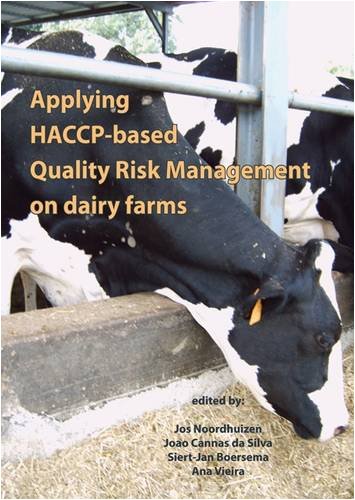
Applying HACCP based Quality Risk Management on dairy farms 1st Edition by Jos Noordhuizen, Joao Cannas da Silva, Siert-Jan Boersema, Ana Vieira – Ebook PDF Instant Download/Delivery: 9086860524, 978-9086860524
Full download Applying HACCP based Quality Risk Management on dairy farms 1st Edition after payment

Product details:
ISBN 10: 9086860524
ISBN 13: 978-9086860524
Author: Jos Noordhuizen, Joao Cannas da Silva, Siert-Jan Boersema, Ana Vieira
“Quality is a keyword in animal production. Next to product quality, process quality has also become relevant for dairy farmers. Issues like food safety, public health, animal health and welfare are determined by the conditions of the production process. To address these, he EU has issued the General Food Law (178-2002) and the Hygiene directives (EC 852/853/854-2004) dealing with the forenamed domains with the aim to protect consumers. The suggestion was also made by the EU that farmers apply a HACCP-like plan to meet these new quality demands. Key issues are structure, organisation, planning, formalisation and demonstrability, which can also be found in the HACCP concept.This book addresses Quality Risk Management through applying the HACCP-like concept. First, the assessment of strong and weak points on a dairy farm are dealt with, which is useful for farm inspection and herd health programmes. Then, the 12-steps for developing a HACCP plan are followed through the various chapters. Many examples and elaborations are given. An example farm, FX, is introduced to show how the different elements may look in reality. At the end of the book characteristics of entrepreneur-like dairy farmers are given and compared to strong and weak points of cattle practitioners. Practitioners may conclude how to better serve this type of farmer. Communication plays a paramount role. Finally, several general issues are addressed: economics, integrating classical herd health with quality risk management programmes.The aim of this book is to give practical guidelines and examples for dairy farmers, cattle practitioners and extension people, who desire to jointly develop and implement a HACCP-based quality risk management programme.’This book is well written with many practical flow charts and “”Good Practice”” advice. I would recommend it to any veterinarian involved in producing risk management programs or “”Standard Operating Procedure”” type documents for dairy farms. The chapters on good communication and marketing would be useful for most veterinarians.’ David S. Beggs, book review editor ‘The Australian Cattle Veterinarian’ Volume 50, p. 34-35, March ’09”
Table of contents:
1 Preliminary Material
2 List of abbreviations
3 Preface
4 Introduction
5 Assessment of strengths and weaknesses
6 Good dairy farming codes of practice
7 The HACCP-concept, the 7 principles and 12 steps (general issues)
8 Flow diagrams of the production process
9 Identification of hazards and evaluation of risks
10 Critical Control Points (CCP) and Points of Particular Attention (POPA): their standards and tolerances or targets, their monitoring, and corrective measures
11 Support programmes in a HACCP-based Quality Risk Management programme
12 Documentation in HACCP-like Quality Risk Management programmes
13 Validation & verification of the HACCP-based Quality Risk Management programme
14 Application of the HACCP principles to multifunctional farms open to the general public
15 Applications of the HACCP principles to milking goat farms in France
16 Veterinary advice to entrepreneur-like dairy farmers regarding Quality Risk Management
17 Communication in the veterinary advisory practice: practical application of behavioural economics and communication skills
18 Final remarks
19 Literature references
20 Acknowledgements
21 Keyword index
People also search for:
applying haccp based quality
haccp quality assurance
haccp principles & application guidelines
appropriate haccp verification activities
haccp-based sops
Tags:
Jos Noordhuizen,Joao Cannas da Silva,Siert-Jan Boersema,Ana Vieira,Applying HACCP,Qualty Risk Management