
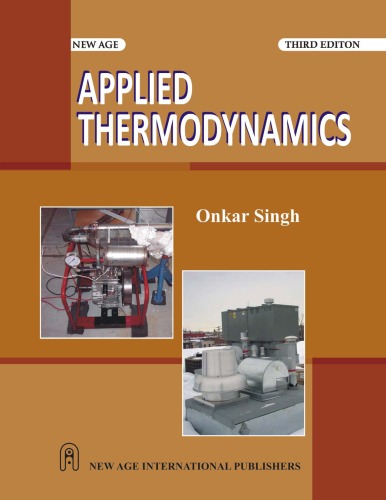
Applied Thermodynamics 3rd Edition by Onkar Singh ISBN 978-8122425833 8122425836


Original price was: $50.00.$35.00Current price is: $35.00.
Applied Thermodynamics 3rd Edition by Onkar Singh – Ebook PDF Instant Download/Delivery: 978-8122425833, 8122425836
Full download Applied Thermodynamics 3rd Edition after payment
Product details:
ISBN 10: 8122425836
ISBN 13: 978-8122425833
Author: Onkar Singh
Reading books is a kind of enjoyment. Reading books is a good habit. We bring you a different kinds of books. You can carry this book where ever you want. It is easy to carry. It can be an ideal gift to yourself and to your loved ones. Care instruction keep away from fire.
Table of contents:
Chapter 1
Fundamental Concepts and Definitions
1.1 Introduction and definition of thermodynamics
1.2 Dimensions and units
1.3 Concept of continuum
1.4 Systems, surroundings and universe
1.5 Properties and state
1.6 Thermodynamic path, process and cycle
1.7 Thermodynamic equilibrium
1.8 Reversibility and irreversibility
1.9 Quasi-static process
1.10 Some thermodynamic properties
1.11 Energy and its forms
1.12 Heat and work
1.13 Gas laws
1.14 Ideal gas
1.15 Dalton’s law, Amagat’s law and property of mixture of gases
1.16 Real gas
1.17 Vander Waals and other equations of state for real gas Examples
Exercises
Chapter 2
Zeroth Law of Thermodynamics
2.1 Introduction
2.2 Principle of temperature measurement and Zeroth law of thermodynamics
2.3 Temperature scales
2.4 Temperature measurement Examples
Exercises
Chapter 3
First Law of Thermodynamics
3.1 Introduction
3.2 Thermodynamic processes and calculation of work
3.3 Non-flow work and flow work
3.4 First law of thermodynamics
3.5 Internal energy and enthalpy
3.6 Specific heats and their relation with internal energy and enthalpy
3.7 First law of thermodynamics applied to open systems
3.8 Steady flow systems and their analysis
3.9 First law applied to engineering systems
3.10 Unsteady flow systems and their analysis
3.11 Limitations of first law of thermodynamics Examples Exercises
Chapter 4
Second Law of Thermodynamics
4.1 Introduction
4.2 Heat reservoir
4.3 Heat engine
4.4 Heat pump and refrigerator
4.5 Statements for IInd law of thermodynamics
4.6 Equivalence of Kelvin-Planck and Clausius statements of IInd law of thermodynamics
4.7 Reversible and irreversible processes
4.8 Carnot cycle and Carnot engine
4.9 Carnot theorem and its corollaries
4.10 Thermodynamic temperature scale Examples Exercises
Chapter 5
Entropy
5.1 Introduction
5.2 Clausius inequality
5.3 Entropy A property of system
5.4 Principle of entropy increase
5.5 Entropy change during different thermodynamic processes
5.6 Entropy and its relevance
5.7 Thermodynamic property relationship
5.8 Third law of thermodynamics
Examples
Exercises
Chapter 6 Thermodynamic Properties of Pure Substance
6.1 Introduction
6.2 Properties and important definitions
6.3 Phase transformation process
6.4 Graphical representation of pressure, volume and temperature
6.5 Thermodynamic relations involving entropy
6.6 Properties of steam
6.7 Steam tables and mollier diagram
6.8 Dryness fraction measurement
Examples
Exercises
Chapter 7
Availability and General Thermodynamic Relations
7.1 Introduction
7.2 Availability or exergy
7.3 Availability associated with heat and work
7.4 Effectiveness or second law efficiency
7.5 Second law analysis of steady flow systems
7.6 General thermodynamic relations
Examples
Exercises
Chapter 8
Vapour Power Cycles
8.1 Introduction
8.2 Performance parameters
8.3 Carnot vapour power cycle
8.4 Rankine cycle
8.5 Desired thermodynamic properties of working fluid
8.6 Parametric analysis for performance improvement in Rankine cycle
8.7 Reheat cycle
8.8 Regenerative cycle
8.9 Binary vapour cycle
8.10 Combined Cycle
8.11 Combined Heat and Power
8.12 Different steam turbine arrangements
Examples
Exercises
Chapter 9
Gas Power Cycles
9.1 Introduction
9.2 Air-standard cycles
9.3 Brayton cycle
9.4 Regenerative gas turbine cycle
9.5 Reheat gas turbine cycle
9.6 Gas turbine cycle with intercooling
9.7 Gas turbine cycle with reheat and regeneration
9.8 Gas turbine cycle with reheat and intercooling
9.9 Gas turbine cycle with regeneration, reheat and intercooling
9.10 Gas turbine irreversibilites and losses
9.11 Compressor and turbine efficiencies
9.12 Ericsson cycle
9.13 Stirling cycle
Examples
Exercises
Chapter 10 Fuel and Combustion
10.1 Introduction
10.2 Types of fuels
10.3 Calorific value of fuel
People also search for:
basic and applied thermodynamics
r yadav applied thermodynamics pdf
applied thermodynamics subject
applied thermodynamics sppu pdf
applied thermodynamics sppu question paper
Tags: Onkar Singh, Applied Thermodynamics