
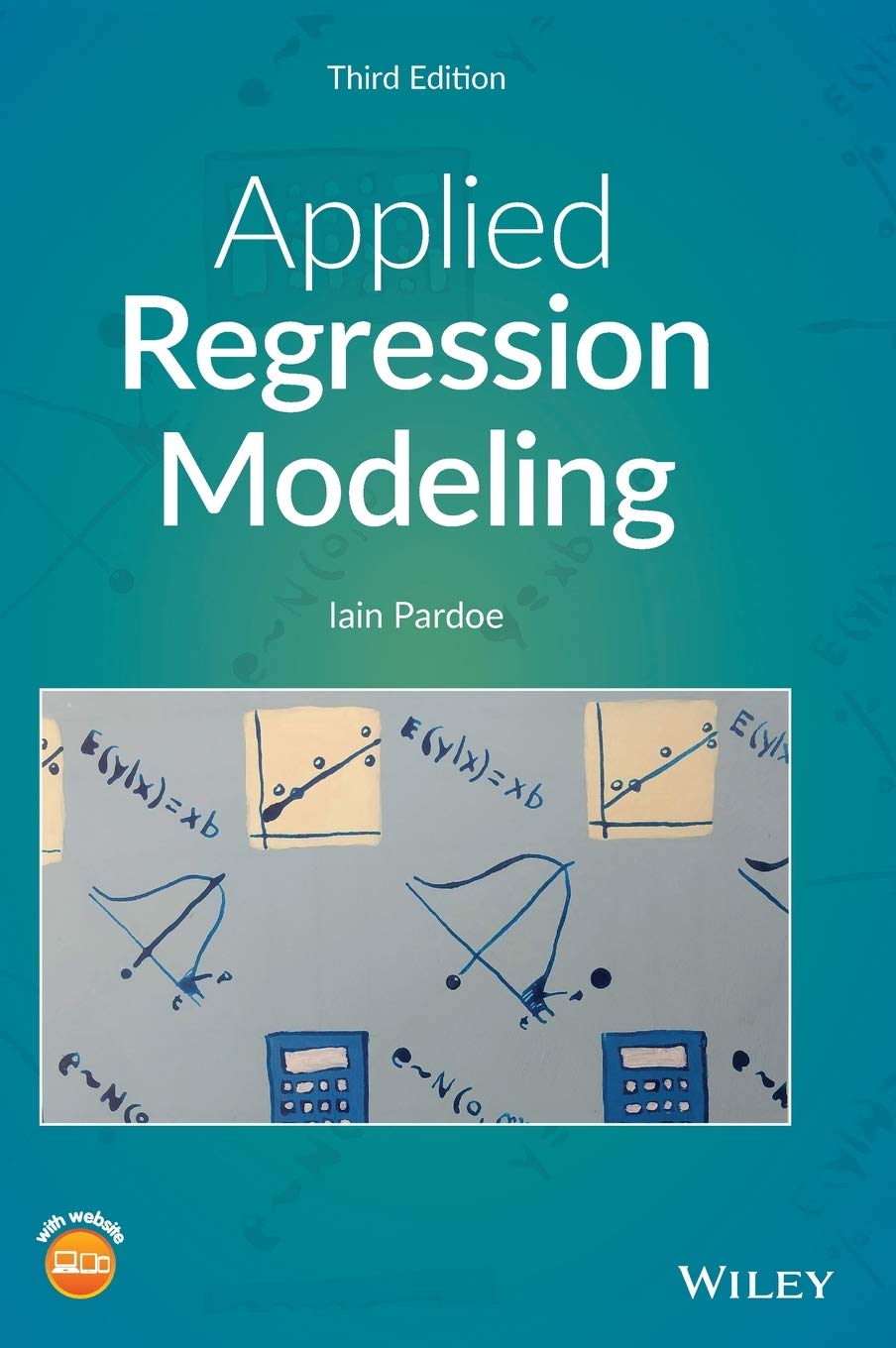
Applied Regression Modeling 3rd Edition by Iain Pardoe ISBN 978-1119615866 1119615860
Original price was: $50.00.$35.00Current price is: $35.00.
Applied Regression Modeling 3rd Edition by Iain Pardoe – Ebook PDF Instant Download/Delivery: 978-1119615866, 1119615860
Full download Applied Regression Modeling 3rd Edition after payment
Product details:
ISBN 10: 1119615860
ISBN 13: 978-1119615866
Author: Iain Pardoe
Master the fundamentals of regression without learning calculus with this one-stop resource
The newly and thoroughly revised 3rd Edition of Applied Regression Modeling delivers a concise but comprehensive treatment of the application of statistical regression analysis for those with little or no background in calculus. Accomplished instructor and author Dr. Iain Pardoe has reworked many of the more challenging topics, included learning outcomes and additional end-of-chapter exercises, and added coverage of several brand-new topics including multiple linear regression using matrices.
The methods described in the text are clearly illustrated with multi-format datasets available on the book’s supplementary website. In addition to a fulsome explanation of foundational regression techniques, the book introduces modeling extensions that illustrate advanced regression strategies, including model building, logistic regression, Poisson regression, discrete choice models, multilevel models, Bayesian modeling, and time series forecasting. Illustrations, graphs, and computer software output appear throughout the book to assist readers in understanding and retaining the more complex content. Applied Regression Modeling covers a wide variety of topics, like:
Simple linear regression models, including the least squares criterion, how to evaluate model fit, and estimation/prediction
Multiple linear regression, including testing regression parameters, checking model assumptions graphically, and testing model assumptions numerically
Regression model building, including predictor and response variable transformations, qualitative predictors, and regression pitfalls
Three fully described case studies, including one each on home prices, vehicle fuel efficiency, and pharmaceutical patches
Perfect for students of any undergraduate statistics course in which regression analysis is a main focus, Applied Regression Modeling also belongs on the bookshelves of non-statistics graduate students, including MBAs, and for students of vocational, professional, and applied courses like data science and machine learning.
Table of contents:
I.1 Statistics in Practice
I.2 Learning Statistics
About the Companion Website
1 Foundations
1.1 Identifying and Summarizing Data
1.2 Population Distributions
1.3 Selecting Individuals at Random—Probability
1.4 Random Sampling
1.4.1 Central limit theorem—normal version
1.4.2 Central limit theorem—t-version
1.5 Interval Estimation
1.6 Hypothesis Testing
1.6.1 The rejection region method
1.6.2 The p-value method
1.6.3 Hypothesis test errors
1.7 Random Errors and Prediction
1.8 Chapter Summary
Problems
2 Simple Linear Regression
2.1 Probability Model for X and Y
2.2 Least Squares Criterion
2.3 Model Evaluation
2.3.1 Regression standard error
2.3.2 Coefficient of determination—R2
2.3.3 Slope parameter
2.4 Model Assumptions
2.4.1 Checking the model assumptions
2.4.2 Testing the model assumptions
2.5 Model Interpretation
2.6 Estimation and Prediction
2.6.1 Confidence interval for the population mean, E(Y)
2.6.2 Prediction interval for an individual Y -value
2.7 Chapter Summary
2.7.1 Review example
Problems
3 Multiple Linear Regression
3.1 Probability Model for (X1, X2, . . .) and Y
3.2 Least Squares Criterion
3.3 Model Evaluation
3.3.1 Regression standard error
3.3.2 Coefficient of determination—R2
3.3.3 Regression parameters—global usefulness test
3.3.4 Regression parameters—nested model test
3.3.5 Regression parameters—individual tests
3.4 Model Assumptions
3.4.1 Checking the model assumptions
3.4.2 Testing the model assumptions
3.5 Model Interpretation
3.6 Estimation and Prediction
3.6.1 Confidence interval for the population mean, E(Y )
3.6.2 Prediction interval for an individual Y -value
3.7 Chapter Summary
Problems
4 Regression Model Building I
4.1 Transformations
4.1.1 Natural logarithm transformation for predictors
4.1.2 Polynomial transformation for predictors
4.1.3 Reciprocal transformation for predictors
4.1.4 Natural logarithm transformation for the response
4.1.5 Transformations for the response and predictors
4.2 Interactions
4.3 Qualitative Predictors
4.3.1 Qualitative predictors with two levels
4.3.2 Qualitative predictors with three or more levels
4.4 Chapter Summary
Problems
5 Regression Model Building II
5.1 Influential Points
5.1.1 Outliers
5.1.2 Leverage
5.1.3 Cook’s distance
5.2 Regression Pitfalls
5.2.1 Nonconstant variance
5.2.2 Autocorrelation
5.2.3 Multicollinearity
5.2.4 Excluding important predictor variables
5.2.5 Overfitting
5.2.6 Extrapolation
5.2.7 Missing data
5.2.8 Power and sample size
5.3 Model Building Guidelines
5.4 Model Selection
5.5 Model Interpretation Using Graphics
5.6 Chapter Summary
Problems
Notation and Formulas
Univariate Data
Simple Linear Regression
Multiple Linear Regression
Bibliography
Glossary
Index
6 Case studies
6.1 Home prices
6.1.1 Data description
6.1.2 Exploratory data analysis
6.1.3 Regression model building
6.1.4 Results and conclusions
6.1.5 Further questions
6.2 Vehicle fuel efficiency
6.2.1 Data description
6.2.2 Exploratory data analysis
6.2.3 Regression model building
6.2.4 Results and conclusions
6.2.5 Further questions
6.3 Pharmaceutical patches
6.3.1 Data description
6.3.2 Exploratory data analysis
6.3.3 Regression model building
6.3.4 Model diagnostics
6.3.5 Results and conclusions
6.3.6 Further questions
7 Extensions
7.1 Generalized linear models
7.1.1 Logistic regression
7.1.2 Poisson regression
7.2 Discrete choice models
7.3 Multilevel models
7.4 Bayesian modeling
7.4.1 Frequentist inference
7.4.2 Bayesian inference
Problems
A Computer software help
Problems
B Critical values for t-distributions
C Notation and formulas
C.1 Univariate data
C.2 Simple linear regression
C.3 Multiple linear regression
D Mathematics refresher
D.1 The natural logarithm and exponential functions
D.2 Rounding and accuracy
E Multiple Linear Regression Using Matrices
E.1 Vectors and matrices
E.2 Matrix multiplication
E.3 Matrix addition
E.4 Transpose of a matrix
E.5 Inverse of a matrix
E.6 Estimated multiple linear regression model equation
E.7 Least squares regression parameter estimates
E.8 Predicted or fitted values
E.9 Residuals and the regression standard error
E.10 Coefficient of determination
E.11 Regression parameter standard errors and t-statistics
E.12 Estimation and prediction
E.13 Leverages, standardized and studentized residuals, and Cook’s distances
F Answers for selected problems
People also search for:
applied regression modeling 3rd edition pdf
applied regression modeling iain pardoe pdf
applied regression modeling iain pardoe
what is applied regression analysis
when to use regression models