
5.1 Introduction
5.2 General Properties of Latent Roots and Latent Vectors
5.3 Latent Roots and Latent Vectors of Matrices of Special Type
5.3.1 Symmetric Matrices
5.3.2 Symmetric Positive Definite (Grammian) Matrices
5.3.3 Grammian Association Matrices
5.3.4 Projection (Idempotent) Matrices
5.3.5 Matrices Associated with Time Series
5.3.6 Frobenius Matrices
5.4 Left and Right Latent Vectors
5.4.1 Square Nonsymmetric Matrices
5.4.2 Rectangular Matrices
5.5 Simultaneous Decomposition of Two Symmetric Matrices
5.6 Matrix Norms and Limits for Latent Roots
5.6.1 The Rayleigh Quotient
5.6.2 Matrix Norms
5.6.3 Limits for Latent Roots
5.7 Several Statistical Applications
5.7.1 Principal-Components Analysis
5.7.2 Multidimensional Scaling
5.7.3 Estimating Parameters of Functional Relations
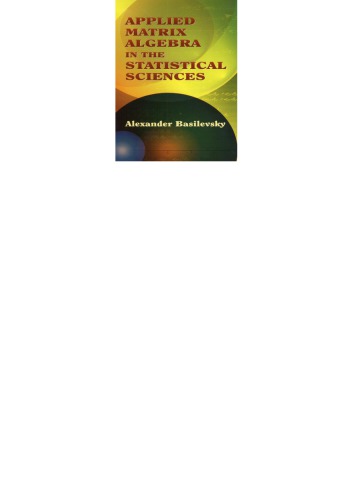
Applied Matrix Algebra in the Statistical Sciences 1st Edition by Alexander Basilevsky ISBN 0486445380 978-0486445380
Original price was: $50.00.$35.00Current price is: $35.00.
Applied Matrix Algebra in the Statistical Sciences 1st Edition by Alexander Basilevsky – Ebook PDF Instant Download/Delivery: 0486445380, 978-0486445380
Full download Applied Matrix Algebra in the Statistical Sciences 1st Edition after payment
Product details:
ISBN 10: 0486445380
ISBN 13: 978-0486445380
Author: Alexander Basilevsky
This comprehensive text covers both applied and theoretical branches of matrix algebra in the statistical sciences. It also provides a bridge between linear algebra and statistical models. Appropriate for advanced undergraduate and graduate students, the self-contained treatment also constitutes a handy reference for researchers. The only mathematical background necessary is a sound knowledge of high school mathematics and a first course in statistics.
Consisting of two interrelated parts, this volume begins with the basic structure of vectors and vector spaces. The latter part emphasizes the diverse properties of matrices and their associated linear transformations–and how these, in turn, depend upon results derived from linear vector spaces. An overview of introductory concepts leads to more advanced topics such as latent roots and vectors, generalized inverses, and nonnegative matrices. Each chapter concludes with a section on real-world statistical applications, plus exercises that offer concrete examples of the applications of matrix algebra.
Table of contents:
Chapter 1 – Vectors
1.1 Introduction
1.2 Vector Operations
1.2.1 Vector Equality
1.2.2 Addition
1.2.3 Scalar Multiplication
1.2.4 Distributive Laws
1.3 Coordinates of a Vector
1.4 The Inner Product of Two Vectors
1.4.1 The Pythagorean Theorem
1.4.2 Length of a Vector and Distance Between Two Vectors
1.4.3 The Inner Product and Norm of a Vector
1.5 The Dimension of a Vector: Unit Vectors
1.6 Direction Cosines
1.7 The Centroid of Vectors
1.8 Metric and Normed Spaces
1.8.1 Minkowski Distance
1.8.2 Nonmetric Spaces
1.9 Statistical Applications
1.9.1 The Mean Vector
1.9.2 Measures of Similarity
Chapter 2 – Vector Spaces
2.1 Introduction
2.2 Vector Spaces
2.3 The Dimension of a Vector Space
2.4 The Sum and Direct Sum of a Vector Space
2.5 Orthogonal Basis Vectors
2.6 The Orthogonal Projection of a Vector
2.6.1 Gram–Schmidt Orthogonalization
2.6.2 The Area of a Parallelogram
2.6.3 Curve Fitting by Ordinary Least Squares
2.7 Transformation of Coordinates
2.7.1 Orthogonal Rotation of Axes
2.7.2 Oblique Rotation of Axes
2.7.3 Curve Fitting by Rotating Axes
Chapter 3 – Matrices and Systems of Linear Equations
3.1 Introduction
3.2 General Types of Matrices
3.2.1 Diagonal Matrix
3.2.2 Scalar and Unit Matrices
3.2.3 Incidence Matrix
3.2.4 Triangular Matrix
3.2.5 Symmetric and Transposed Matrices
3.3 Matrix Operations
3.3.1 Addition
3.3.2 Multiplication
3.3.3 Matrix Transposition and Matrix Products
3.3.4 The Kronecker and Hadamard Products
3.4 Matrix Scalar Functions
3.4.1 The Permanent
3.4.2 The Determinant
3.4.3 The Determinant as Volume
3.4.4 The Trace
3.4.5 Matrix Rank
3.5 Matrix Inversion
3.5.1 The Inverse of a Square Matrix
3.5.2 The Inverses of a Rectangular Matrix
3.6 Elementary Matrices and Matrix Equivalence
3.7 Linear Transformations and Systems of Linear Equations
3.7.1 Linear Transformations
3.7.2 Systems of Linear Equations
Chapter 4 – Matrices of Special Type
4.1 Symmetric Matrices
4.2 Skew-Symmetric Matrices
4.3 Positive Definite Matrices and Quadratic Forms
4.4 Differentiation Involving Vectors and Matrices
4.4.1 Scalar Derivatives of Vectors
4.4.2 Vector Derivatives of Vectors
4.4.3 Extrema of Quadratic Forms
5.7.4 Discriminant Analysis and Orthogonal Regression
5.7.5 Analysis of Time Series
Chapter 6 – Generalized Matrix Inverses
6.1 Introduction
6.2 Consistent Linear Equations
6.2.1 Nonreflexive Generalized Inverses
6.2.2 Reflexive Generalized Inverses
6.2.3 Minimum-Norm Solution Generalized Inverses
6.3 Inconsistent Linear Equations
6.3.1 Nonreflexive Least-Squares Inverses
6.3.2 Reflexive Least-Squares Inverses
6.4 The Unique Generalized Inverse
6.5 Statistical Applications
6.5.1 The General Linear Model of Less Than Full Rank
6.5.2 The General Linear Model and Multicollinearity
6.5.3 Recursive Least Squares
Chapter 7 – Nonnegative and Diagonally Dominant Matrices
7.1 Introduction
7.2 Nonnegative Matrices
7.2.1 Irreducible Matrices
7.2.2 Primitive and Cyclic Matrices
7.2.3 Reducible Matrices
7.3 Graphs and Nonnegative Matrices
7.3.1 Boolean Matrices
7.3.2 Graphs
7.3.3 Matrices Associated with Graphs
7.4 Dominant Diagonal Matrices: Input–Output Analysis
7.5 Statistical Applications
7.5.1 Finite Homogeneous Markov Chains
7.5.2 Extensions of the Markov Model
7.5.3 Latent Vectors of Boolean Incidence Matrices
People also search for:
applied matrix algebra in the statistical sciences pdf
matrix analysis and applied linear algebra
matrix analysis and applied linear algebra by carl d meyer
matrix analysis and applied linear algebra second edition
matrix analysis and applied linear algebra book and solutions manual
Tags: Alexander Basilevsky, Applied Matrix, Statistical Sciences