
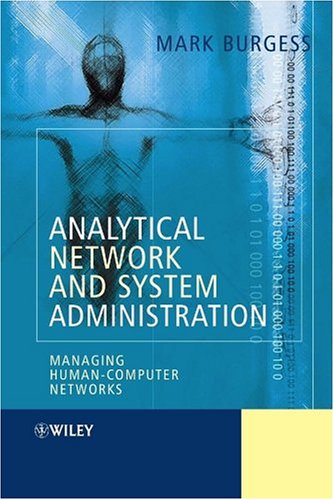
Analytical Network and System Administration Managing Human Computer Systems 1st Edition by Mark Burgess ISBN 978-0470861004 0470861002


Original price was: $50.00.$35.00Current price is: $35.00.
Analytical Network and System Administration Managing Human Computer Systems 1st Edition by Mark Burgess – Ebook PDF Instant Download/Delivery: 978-0470861004, 0470861002
Full download Analytical Network and System Administration Managing Human Computer Systems 1st Edition after payment
Product details:
ISBN 10: 0470861002
ISBN 13: 978-0470861004
Author: Mark Burgess
Network and system administration usually refers to the skill of keeping computers and networks running properly. But in truth, the skill needed is that of managing complexity. This book describes the science behind these complex systems, independent of the actual operating systems they work on.
It provides a theoretical approach to systems administration that:
saves time in performing common system administration tasks.
allows safe utilization of untrained and trained help in maintaining mission-critical systems.
allows efficient and safe centralized network administration.
Managing Human-Computer Networks:
Will show how to make informed analyses and decisions about systems, how to diagnose faults and weaknesses
Gives advice/guidance as to how to determine optimal policies for system management
Includes exercises that illustrate the key points of the book
The book provides a unique approach to an old problem and will become a classic for researchers and graduate students in Networking and Computer Science, as well as practicing system managers and system administrators.
Table of contents:
1 Introduction
1.1 What is system administration?
1.2 What is a system?
1.3 What is administration?
1.4 Studying systems
1.5 What’s in a theory?
1.6 How to use the text
1.7 Some notation used
2 Science and its methods
2.1 The aim of science
2.2 Causality, superposition and dependency
2.3 Controversies and philosophies of science
2.4 Technology
2.5 Hypotheses
2.6 The science of technology
2.7 Evaluating a system—dependencies
2.8 Abuses of science
3 Experiment and observation
3.1 Data plots and time series
3.2 Constancy of environment during measurement
3.3 Experimental design
3.4 Stochastic (random) variables
3.5 Actual values or characteristic values
3.6 Observational errors
3.7 The mean and standard deviation
3.8 Probability distributions and measurement
3.8.1 Scatter and jitter
3.8.2 The ‘normal’ distribution
3.8.3 Standard error of the mean
3.8.4 Other distributions
3.9 Uncertainty in general formulae
3.10 Fourier analysis and periodic behaviour
3.11 Local averaging procedures
3.12 Reminder
4 Simple systems
4.1 The concept of a system
4.2 Data structures and processes
4.3 Representation of variables
4.4 The simplest dynamical systems
4.5 More complex systems
4.6 Freedoms and constraints
4.7 Symmetries
4.8 Algorithms, protocols and standard ‘methods’
4.9 Currencies and value systems
4.9.1 Energy and power
4.9.2 Money
4.9.3 Social currency and the notion of responsibility
4.10 Open and closed systems: the environment
4.11 Reliable and unreliable systems
5 Sets, states and logic
5.1 Sets
5.2 A system as a set of sets
5.3 Addresses and mappings
5.4 Chains and states
5.5 Configurations and macrostates
5.6 Continuum approximation
5.7 Theory of computation and machine language
5.7.1 Automata or State Machines
5.7.2 Operators and operands
5.7.3 Pattern matching and operational grammars
5.7.4 Pathway analysis and distributed algorithms
5.8 A policy-defined state
6 Diagrammatical representations
6.1 Diagrams as systems
6.2 The concept of a graph
6.3 Connectivity
6.4 Centrality: maxima and minima in graphs
6.5 Ranking in directed graphs
6.6 Applied diagrammatical methods
7 System variables
7.1 Information systems
7.2 Addresses, labels, keys and other resource locators
7.3 Continuous relationships
7.4 Digital comparison
8 Change in systems
8.1 Renditions of change
8.2 Determinism and predictability
8.3 Oscillations and fluctuations
8.4 Rate of change
8.5 Applications of the continuum approximation
8.6 Uncertainty in the continuum approximation
9 Information
9.1 What is information?
9.2 Transmission
9.3 Information and control
9.4 Classification and resolution
9.5 Statistical uncertainty and entropy
9.6 Properties of the entropy
9.7 Uncertainty in communication
9.8 A geometrical interpretation of information
9.9 Compressibility and size of information
9.10 Information and state
9.11 Maximum entropy principle
9.12 Fluctuation spectra
10 Stability
10.1 Basic notions
10.2 Types of stability
10.3 Constancy
10.4 Convergence of behaviour
10.5 Maxima and minima
10.6 Regions of stability in a graph
10.7 Graph stability under random node removal
10.8 Dynamical equilibria: compromise
10.9 Statistical stability
10.10 Scaling stability
10.11 Maximum entropy distributions
10.12 Eigenstates
10.13 Fixed points of maps
10.14 Metastable alternatives and adaptability
10.15 Final remarks
11 Resource networks
11.1 What is a system resource?
11.2 Representation of resources
11.3 Resource currency relationships
11.4 Resource allocation, consumption and conservation
11.5 Where to attach resources?
11.6 Access to resources
11.7 Methods of resource allocation
11.7.1 Logical regions of systems
11.7.2 Using centrality to identify resource bottlenecks
11.8 Directed resources: flow asymmetries
12 Task management and services
12.1 Task list scheduling
12.2 Deterministic and non-deterministic schedules
12.3 Human–computer scheduling
12.4 Service provision and policy
12.5 Queue processing
12.6 Models
12.7 The prototype queue M/M/1
12.8 Queue relationships or basic ‘laws’
12.9 Expediting tasks with multiple servers M/M/k
12.10 Maximum entropy input events in periodic systems
12.11 Miscellaneous issues in scheduling
13 System architectures
13.1 Policy for organization
13.2 Informative and procedural flows
13.3 Structured systems and ad hoc systems
13.4 Dependence policy
13.5 System design strategy
13.6 Event-driven systems and functional systems
13.7 The organization of human resources
13.8 Principle of minimal dependency
13.9 Decision-making within a system
13.9.1 Layered systems: Managers and workers
13.9.2 Efficiency
13.10 Prediction, verification and their limitations
13.11 Graphical methods
14 System normalization
14.1 Dependency
14.2 The database model
14.3 Normalized forms
15 System integrity
15.1 System administration as communication?
15.2 Extensive or strategic instruction
15.3 Stochastic semi-groups and martingales
15.4 Characterizing probable or average error
15.5 Correcting errors of propagation
15.6 Gaussian continuum approximation formula
16 Policy and maintenance
16.1 What is maintenance?
16.2 Average changes in configuration
16.3 The reason for random fluctuations
16.4 Huge fluctuations
16.5 Equivalent configurations and policy
16.6 Policy
16.7 Convergent maintenance
16.8 The maintenance theorem
16.9 Theory of back-up and error correction
17 Knowledge, learning and training
17.1 Information and knowledge
17.2 Knowledge as classification
17.3 Bayes’ theorem
17.4 Belief versus truth
17.5 Decisions based on expert knowledge
17.6 Knowledge out of date
17.7 Convergence of the learning process
18 Policy transgressions and fault modelling
18.1 Faults and failures
18.2 Deterministic system approximation
18.3 Stochastic system models
18.4 Approximate information flow reliability
18.5 Fault correction by monitoring and instruction
18.6 Policy maintenance architectures
18.7 Diagnostic cause trees
18.8 Probabilistic fault trees
19 Decision and strategy
19.1 Causal analysis
19.2 Decision-making
19.3 Game theory
19.4 The strategic form of a game
19.5 The extensive form of a game
19.6 Solving zero-sum games
19.7 Dominated strategies
19.8 Nash equilibria
19.9 A security game
19.9.1 Zero-sum approximation
19.9.2 Non-zero sum approximation
19.10 The garbage collection game
19.11 A social engineering game
19.12 Human elements of policy decision
19.13 Coda: extensive versus strategic configuration management
20 Conclusions
A Some Boolean formulae
A.1 Conditional probability
A.2 Boolean algebra and logic
B Statistical and scaling properties of time-series data
B.1 Local averaging procedure
B.2 Scaling and self-similarity
B.3 Scaling of continuous functions
C Percolation conditions
C.1 Random graph condition
C.2 Bi-partite form
C.3 Small-graph corrections
People also search for:
analytical network process software
analytical network process example
network analysis and synthesis
network analysis arcgis pro
network analysis arcgis
Tags: Mark Burgess, Analytical Network, System Administration, Managing Human