
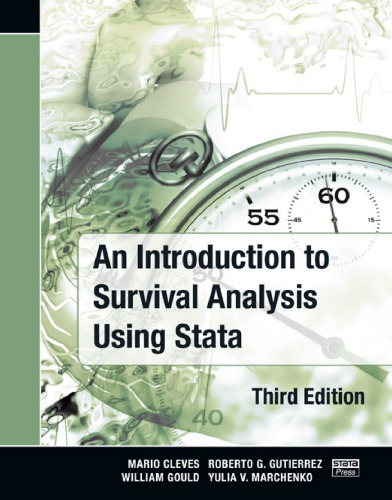
An Introduction to Survival Analysis Using Stata 3rd Edition by Mario Cleves, William Gould, Roberto Gutierrez, Yulia Marchenko ISBN 978-1597180740 1597180742


Original price was: $50.00.$35.00Current price is: $35.00.
An Introduction to Survival Analysis Using Stata 3rd Edition by Mario Cleves, William Gould, Roberto Gutierrez, Yulia Marchenko- Ebook PDF Instant Download/Delivery: 978-1597180740, 1597180742
Full download An Introduction to Survival Analysis Using Stata 3rd Edition after payment
Product details:
ISBN 10: 1597180742
ISBN 13: 978-1597180740
Author: Mario Cleves, William Gould, Roberto Gutierrez, Yulia Marchenko
An Introduction to Survival Analysis Using Stata, Third Edition provides the foundation to understand various approaches for analyzing time-to-event data. It is not only a tutorial for learning survival analysis but also a valuable reference for using Stata to analyze survival data. Although the book assumes knowledge of statistical principles, simple probability, and basic Stata, it takes a practical, rather than mathematical, approach to the subject.
This updated third edition highlights new features of Stata 11, including competing-risks analysis and the treatment of missing values via multiple imputation. Other additions include new diagnostic measures after Cox regression, Stata’s new treatment of categorical variables and interactions, and a new syntax for obtaining prediction and diagnostics after Cox regression.
After reading this book, you will understand the formulas and gain intuition about how various survival analysis estimators work and what information they exploit. You will also acquire deeper, more comprehensive knowledge of the syntax, features, and underpinnings of Stata’s survival analysis routines.
Table of contents:
1. Notation and Typography
2. The Problem of Survival Analysis
2.1 Parametric modeling
2.2 Semiparametric modeling
2.3 Nonparametric analysis
2.4 Linking the three approaches
3. Describing the Distribution of Failure Times
3.1 The survivor and hazard functions
3.2 The quantile function
3.3 Interpreting the cumulative hazard and hazard rate
3.3.1 Interpreting the cumulative hazard
3.3.2 Interpreting the hazard rate
3.4 Means and medians
4. Hazard Models
4.1 Parametric models
4.2 Semiparametric models
4.3 Analysis time (time at risk)
5. Censoring and Truncation
5.1 Censoring
5.1.1 Right-censoring
5.1.2 Interval-censoring
5.1.3 Left-censoring
5.2 Truncation
5.2.1 Left-truncation (delayed entry)
5.2.2 Interval-truncation (gaps)
5.2.3 Right-truncation
6. Recording Survival Data
6.1 The desired format
6.2 Other formats
6.3 Example: Wide-form snapshot data
7. Using stset
7.1 A short lesson on dates
7.2 Purposes of the stset command
7.3 Syntax of the stset command
7.3.1 Specifying analysis time
7.3.2 Variables defined by stset
7.3.3 Specifying what constitutes failure
7.3.4 Specifying when subjects exit from the analysis
7.3.5 Specifying when subjects enter the analysis
7.3.6 Specifying the subject-ID variable
7.3.7 Specifying the begin-of-span variable
7.3.8 Convenience options
7.4 After stset
7.4.1 Look at stset’s output
7.4.2 List some of your data
7.4.3 Use stdescribe
7.4.4 Use stvary
7.4.5 Perhaps use stfill
7.4.6 Example: Hip fracture data
8. Nonparametric Analysis
8.1 Inadequacies of standard univariate methods
8.2 The Kaplan-Meier estimator
8.2.1 Calculation
8.2.2 Censoring
8.2.3 Left-truncation (delayed entry)
8.2.4 Interval-truncation (gaps)
8.2.5 Relationship to the empirical distribution function
8.2.6 Other uses of sts list
8.2.7 Graphing the Kaplan-Meier estimate
8.3 The Nelson-Aalen estimator
8.4 Estimating the hazard function
8.5 Estimating mean and median survival times
8.6 Tests of hypothesis
8.6.1 The log-rank test
8.6.2 The Wilcoxon test
8.6.3 Other tests
8.6.4 Stratified tests
9. The Cox Proportional Hazards Model
9.1 Using stcox
9.1.1 The Cox model has no intercept
9.1.2 Interpreting coefficients
9.1.3 The effect of units on coefficients
9.1.4 Estimating the baseline cumulative hazard and survivor functions
9.1.5 Estimating the baseline hazard function
9.1.6 The effect of units on the baseline functions
9.2 Likelihood calculations
9.2.1 No tied failures
9.2.2 Tied failures
- The marginal calculation
- The partial calculation
- The Breslow approximation
- The Efron approximation
9.2.3 Summary
9.3 Stratified analysis
9.3.1 Obtaining coefficient estimates
9.3.2 Obtaining estimates of baseline functions
9.4 Cox models with shared frailty
9.4.1 Parameter estimation
9.4.2 Obtaining estimates of baseline functions
9.5 Cox models with survey data
9.5.1 Declaring survey characteristics
9.5.2 Fitting a Cox model with survey data
9.5.3 Some caveats of analyzing survival data from complex survey designs
9.6 Cox model with missing data-multiple imputation
9.6.1 Imputing missing values
9.6.2 Multiple-imputation inference
10. Model Building Using stcox
10.1 Indicator variables
10.2 Categorical variables
10.3 Continuous variables
10.3.1 Fractional polynomials
10.4 Interactions
10.5 Time-varying variables
10.5.1 Using stcox, tve() texp()
10.5.2 Using stsplit
10.6 Modeling group effects: fixed-effects, random-effects, stratification, and clustering
11. The Cox Model: Diagnostics
11.1 Testing the proportional-hazards assumption
11.1.1 Tests based on reestimation
11.1.2 Test based on Schoenfeld residuals
11.1.3 Graphical methods
11.2 Residuals and diagnostic measures
11.2.1 Determining functional form
11.2.2 Goodness of fit
11.2.3 Outliers and influential points
- Reye’s syndrome data
12. Parametric Models
12.1 Motivation
12.2 Classes of parametric models
12.2.1 Parametric proportional hazards models
12.2.2 Accelerated failure-time models
12.2.3 Comparing the two parameterizations
13. A Survey of Parametric Regression Models in Stata
13.1 The exponential model
13.1.1 Exponential regression in the PH metric
13.1.2 Exponential regression in the AFT metric
13.2 Weibull regression
13.2.1 Weibull regression in the PH metric Fitting null models
13.2.2 Weibull regression in the AFT metric
13.3 Gompertz regression (PH metric)
13.4 Lognormal regression (AFT metric)
13.5 Loglogistic regression (AFT metric)
13.6 Generalized gamma regression (AFT metric)
13.7 Choosing among parametric models
13.7.1 Nested models
13.7.2 Nonnested models
14. Postestimation Commands for Parametric Models
14.1 Use of predict after streg
14.1.1 Predicting the time of failure
14.1.2 Predicting the hazard and related functions
14.1.3 Calculating residuals
14.2 Using stcurve
15. Generalizing the Parametric Regression Model
15.1 Using the ancillary() option
15.2 Stratified models
15.3 Frailty models
15.3.1 Unshared frailty models
15.3.2 Example: Kidney data
15.3.3 Testing for heterogeneity
15.3.4 Shared frailty models
16. Power and Sample-Size Determination for Survival Analysis
16.1 Estimating sample size
16.1.1 Multiple-myeloma data
16.1.2 Comparing two survivor functions nonparametrically
16.1.3 Comparing two exponential survivor functions
16.1.4 Cox regression models
16.2 Accounting for withdrawal and accrual of subjects
16.2.1 The effect of withdrawal or loss to follow-up
16.2.2 The effect of accrual
16.2.3 Examples
16.3 Estimating power and effect size
16.4 Tabulating or graphing results
17. Competing Risks
17.1 Cause-specific hazards
17.2 Cumulative incidence functions
17.3 Nonparametric analysis
17.3.1 Breast cancer data
17.3.2 Cause-specific hazards
17.3.3 Cumulative incidence functions
17.4 Semiparametric analysis
17.4.1 Cause-specific hazards
- Simultaneous regressions for cause-specific hazards
17.4.2 Cumulative incidence functions
- Using stcrreg
- Using stcox
17.5 Parametric analysis
18. References
19. Author Index
20. Subject Index
People also search for:
an introduction to survival analysis using stata revised edition
an introduction to survival statistics kaplan meier analysis
introduction to survival analysis pdf
an introduction to survival analysis using stata
introduction to survival analysis
Tags: Mario Cleves, William Gould, Roberto Gutierrez, Yulia Marchenko, An Introduction, Survival Analysis, Using Stata