
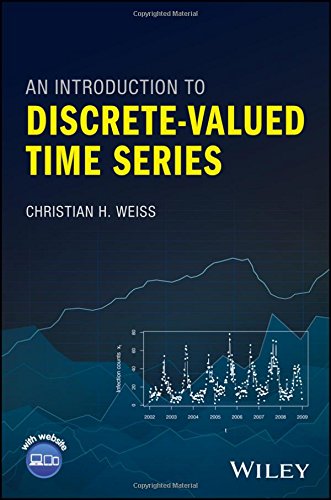
An Introduction to Discrete Valued Time Series 1st Edition by Christian Weiss ISBN 978-1119096962 1119096962
Original price was: $50.00.$35.00Current price is: $35.00.
An Introduction to Discrete Valued Time Series 1st Edition by Christian H. Weiss- Ebook PDF Instant Download/Delivery: 978-1119096962, 1119096962
Full download An Introduction to Discrete Valued Time Series 1st Edition after payment
Product details:
ISBN 10: 1119096962
ISBN 13: 978-1119096962
Author: Christian H. Weiss
A much-needed introduction to the field of discrete-valued time series, with a focus on count-data time series
Time series analysis is an essential tool in a wide array of fields, including business, economics, computer science, epidemiology, finance, manufacturing and meteorology, to name just a few. Despite growing interest in discrete-valued time series―especially those arising from counting specific objects or events at specified times―most books on time series give short shrift to that increasingly important subject area. This book seeks to rectify that state of affairs by providing a much needed introduction to discrete-valued time series, with particular focus on count-data time series.
The main focus of this book is on modeling. Throughout numerous examples are provided illustrating models currently used in discrete-valued time series applications. Statistical process control, including various control charts (such as cumulative sum control charts), and performance evaluation are treated at length. Classic approaches like ARMA models and the Box-Jenkins program are also featured with the basics of these approaches summarized in an Appendix. In addition, data examples, with all relevant R code, are available on a companion website.
Provides a balanced presentation of theory and practice, exploring both categorical and integer-valued series
Covers common models for time series of counts as well as for categorical time series,
and works out their most important stochastic properties
Addresses statistical approaches for analyzing discrete-valued time series and illustrates their implementation with numerous data examples
Covers classical approaches such as ARMA models, Box-Jenkins program and how to generate functions
Includes dataset examples with all necessary R code provided on a companion website
An Introduction to Discrete-Valued Time Series is a valuable working resource for researchers and practitioners in a broad range of fields, including statistics, data science, machine learning, and engineering. It will also be of interest to postgraduate students in statistics, mathematics and economics.
Table of contents:
1 Introduction
Part I Count Time Series
2 A First Approach for Modeling Time Series of Counts: The Thinning-based INAR(1) Model
2.0 Preliminaries: Notation and Characteristics of Count Distributions
2.1 The INAR(1) Model for Time-dependent Counts
2.1.1 Definition and Basic Properties
2.1.2 The Poisson INAR(1) Model
2.1.3 INAR(1) Models with More General Innovations
2.2 Approaches for Parameter Estimation
2.2.1 Method of Moments
2.2.2 Maximum Likelihood Estimation
2.3 Model Identification
2.4 Checking for Model Adequacy
2.5 A Real-data Example
2.6 Forecasting of INAR(1) Processes
3 Further Thinning-based Models for Count Time Series
3.1 Higher-order INARMA Models
3.2 Alternative Thinning Concepts
3.3 The Binomial AR Model
3.4 Multivariate INARMA Models
4 INGARCH Models for Count Time Series
4.1 Poisson Autoregression
4.2 Further Types of INGARCH Models
4.3 Multivariate INGARCH Models
5 Further Models for Count Time Series
5.1 Regression Models
5.2 Hidden-Markov Models
5.3 Discrete ARMA Models
Part II Categorical Time Series
6 Analyzing Categorical Time Series
6.1 Introduction to Categorical Time Series Analysis
6.2 Marginal Properties of Categorical Time Series
6.3 Serial Dependence of Categorical Time Series
7 Models for Categorical Time Series
7.1 Parsimoniously Parametrized Markov Models
7.2 Discrete ARMA Models
7.3 Hidden-Markov Models
7.4 Regression Models
Part III Monitoring Discrete-Valued Processes
8 Control Charts for Count Processes
8.1 Introduction to Statistical Process Control
8.2 Shewhart Charts for Count Processes
8.2.1 Shewhart Charts for i.i.d. Counts
8.2.2 Shewhart Charts for Markov-Dependent Counts
8.3 Advanced Control Charts for Count Processes
8.3.1 CUSUM Charts for i.i.d. Counts
8.3.2 CUSUM Charts for Markov-dependent Counts
8.3.3 EWMA Charts for Count Processes
9 Control Charts for Categorical Processes
9.1 Sample-based Monitoring of Categorical Processes
9.1.1 Sample-based Monitoring: Binary Case
9.1.2 Sample-based Monitoring: Categorical Case
9.2 Continuously Monitoring Categorical Processes
9.2.1 Continuous Monitoring: Binary Case
9.2.2 Continuous Monitoring: Categorical Case
Part IV Appendices
A Examples of Count Distributions
A.1 Count Models for an Infinite Range
A.2 Count Models for a Finite Range
A.3 Multivariate Count Models
B Basics about Stochastic Processes and Time Series
B.1 Stochastic Processes: Basic Terms and Concepts
B.2 Discrete-Valued Markov Chains
B.2.1 Basic Terms and Concepts
B.2.2 Stationary Markov Chains
B.3 ARMA Models: Definition and Properties
B.4 Further Selected Models for Continuous-valued Time Series
B.4.1 GARCH Models
B.4.2 VARMA Models
C Computational Aspects
C.1 Some Comments about the Use of R
C.2 List of R Codes
C.3 List of Datasets
People also search for:
an introduction to discrete mathematics steven roman
discrete mathematics an introduction to mathematical reasoning
an introduction to dynamical systems continuous and discrete
an active introduction to discrete mathematics and algorithms
discrete mathematics an introduction to proofs and combinatorics
Tags: Christian Weiss, An Introduction, Discrete Valued