
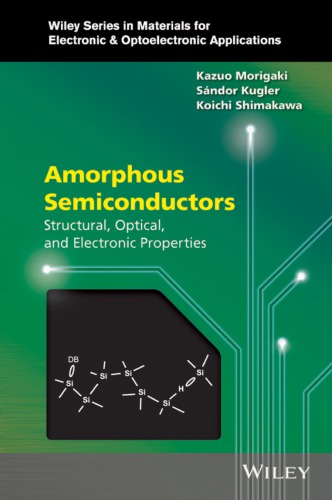
Amorphous Semiconductors 1st Edition by Kazuo Morigaki, Sandor Kugler, Koichi Shimakawa ISBN 978-1118758236 1118758236


Original price was: $50.00.$35.00Current price is: $35.00.
Amorphous Semiconductors 1st Edition by Kazuo Morigaki, Sandor Kugler, Koichi Shimakawa – Ebook PDF Instant Download/Delivery: 978-1118758236, 1118758236
Full download Amorphous Semiconductors 1st Edition after payment
Product details:
ISBN 10: 1118758236
ISBN 13: 978-1118758236
Author: Kazuo Morigaki, Sandor Kugler, Koichi Shimakawa
Amorphous semiconductors are subtances in the amorphous solid state that have the properties of a semiconductor and which are either covalent or tetrahedrally bonded amorphous semiconductors or chelcogenide glasses.
Developed from both a theoretical and experimental viewpoint
Deals with, amongst others, preparation techniques, structural, optical and electronic properties, and light induced phenomena
Explores different types of amorphous semiconductors including amorphous silicon, amorphous semiconducting oxides and chalcogenide glasses
Applications include solar cells, thin film transistors, sensors, optical memory devices and flat screen devices including televisions
Table of contents:
Chapter 1: Introduction
-
General Aspects of Amorphous Semiconductors
-
Chalcogenide Glasses
-
Applications of Amorphous Semiconductors
Chapter 2: Preparation Techniques
-
Growth of a‐Si:H Films
-
PECVD Technique
-
HWCVD Technique
-
-
Growth of Amorphous Chalcogenides
Chapter 3: Structural Properties of Amorphous Silicon and Amorphous Chalcogenides
-
Definitions of Crystalline and Noncrystalline
-
Optical Spectroscopy
-
Raman Scattering
-
Infrared Absorption
-
-
Neutron Diffraction
-
Studies on a-Si, a-Si:H, a-Ge, a-Se
-
-
Computer Simulations
-
Monte Carlo Methods
-
Atomic Interactions
-
Reverse Monte Carlo
-
Molecular Dynamics
-
Car and Parrinello Method
-
Chapter 4: Electronic Structure of Amorphous Semiconductors
-
Bonding Structures (Group IV and VI Elements)
-
Electronic Structure
-
Fermi Energy
-
Differences Between Amorphous and Crystalline Semiconductors
-
Charge Distribution and Density of States
-
Dangling Bonds
-
Doping
Chapter 5: Electronic and Optical Properties of Amorphous Silicon
-
Band Tails and Structural Defects
-
Recombination Processes
-
Electrical Properties
-
DC and AC Conduction
-
Hall Effect
-
Thermoelectric Power
-
Doping Effect
-
-
Optical Properties
-
Optical Absorption
-
Photoluminescence
-
Photoconductivity
-
-
Electron Magnetic Resonance and Spin‐Dependent Properties
-
Light‐Induced Phenomena and Defect Creation
Chapter 6: Electronic and Optical Properties of Amorphous Chalcogenides
-
Historical Overview and Applications
-
Basic Glass Science
-
Formation and Transition
-
Crystallization
-
-
Electrical Properties
-
Electronic and Ionic Transport
-
-
Optical Properties
-
Absorption, Photoluminescence, Photoconductivity
-
-
Defects and Defect Spectroscopy
-
Light‐Induced Effects
Chapter 7: Other Amorphous Material Systems
-
Amorphous Carbon
-
Structure, Techniques, Applications
-
-
Amorphous Oxide Semiconductors
-
Preparation, Optical and Electronic Properties, Applications
-
-
Metal‐Containing Amorphous Chalcogenides
-
Structure, Photodoping, Applications
-
Chapter 8: Applications
-
Devices Using a‐Si:H
-
Photovoltaics
-
Thin‐Film Transistors
-
-
Devices Using Amorphous Chalcogenides
-
Phase‐Change Materials
-
X‐ray Image Sensors
-
Avalanche Rushing Amorphous Semiconductor Vidicon
-
Optical Fibers and Waveguides
-
People also search for:
amorphous semiconductors
optical constants of crystalline and amorphous semiconductors
optical properties of crystalline and amorphous semiconductors
optical properties of amorphous semiconductors
weak absorption tails in amorphous semiconductors
Tags: Kazuo Morigaki, Sandor Kugler, Koichi Shimakawa, Amorphous Semiconductors