
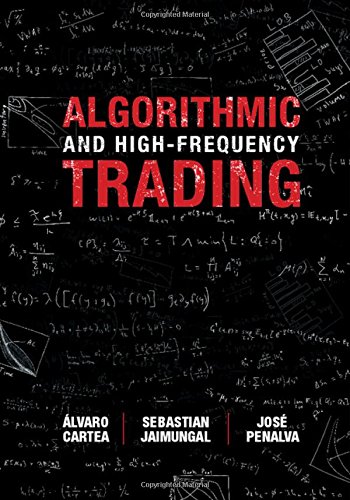
Algorithmic and High Frequency Trading 1st Edition by Álvaro Cartea, Sebastian Jaimungal, José Penalva ISBN 978-1107091146 1107091146

Original price was: $50.00.$35.00Current price is: $35.00.
Algorithmic and High Frequency Trading 1st Edition by Álvaro Cartea, Sebastian Jaimungal, José Penalva – Ebook PDF Instant Download/Delivery: 978-1107091146, 1107091146
Full download Algorithmic and High Frequency Trading 1st Edition after payment
Product details:
ISBN 10: 1107091146
ISBN 13: 978-1107091146
Author: Álvaro Cartea, Sebastian Jaimungal, José Penalva
The design of trading algorithms requires sophisticated mathematical models backed up by reliable data. In this textbook, the authors develop models for algorithmic trading in contexts such as executing large orders, market making, targeting VWAP and other schedules, trading pairs or collection of assets, and executing in dark pools. These models are grounded on how the exchanges work, whether the algorithm is trading with better informed traders (adverse selection), and the type of information available to market participants at both ultra-high and low frequency. Algorithmic and High-Frequency Trading is the first book that combines sophisticated mathematical modelling, empirical facts and financial economics, taking the reader from basic ideas to cutting-edge research and practice. If you need to understand how modern electronic markets operate, what information provides a trading edge, and how other market participants may affect the profitability of the algorithms, then this is the book for you.
Table of contents:
Part I
Microstructure and Empirical Facts
Introduction to Part I
1 Electronic Markets and the Limit Order Book
1.1 Electronic markets and how they function
1.2 Classifying Market Participants
1.3 Trading in Electronic Markets
1.3.1 Orders and the Exchange
1.3.2 Alternate Exchange Structures
1.3.3 Colocation
1.3.4 Extended Order Types
1.3.5 Exchange Fees
1.4 The Limit Order Book
1.5 Bibliography and Selected Readings
2 A Primer on the Microstructure of Financial Markets
2.1 Market Making
2.1.1 Grossman Miller Market Making Model
2.1.2 Trading Costs
2.1.3 Measuring Liquidity
2.1.4 Market Making using Limit Orders
2.2 Trading on an Informational Advantage
2.3 Market Making with an Informational Disadvantage
2.3.1 Price Dynamics
2.3.2 Price Sensitive Liquidity Traders
2.4 Bibliography and Selected Readings
3 Empirical and Statistical Evidence: Prices and Returns
3.1 Introduction
3.1.1 The Data
3.1.2 Daily Asset Prices and Returns
3.1.3 Daily Trading Activity
3.1.4 Daily Price Predictability
3.2 Asset Prices and Returns Intraday
3.3 Interarrival Times
3.4 Latency and Tick Size
3.5 Non-Markovian Nature of Price Changes
3.6 Market Fragmentation
3.7 Empirics of Pairs Trading
3.8 Bibliography andStatistical Selected Readings
4 Empirical and Evidence: Activity and Market Quality
4.1 Daily Volume and Volatility
4.2 Intraday Activity
4.2.1 Intraday Volume Patterns
4.2.2 Intrasecond Volume Patterns
4.2.3 Price Patterns
4.3 Trading and Market Quality
4.3.1 Spreads
4.3.2 Volatility
4.3.3 Market Depth and Trade Size
4.3.4 Price Impact
4.3.5 Walking the LOB and Permanent Price Impact
4.4 Messages and Cancellation Activity
4.5 Hidden Orders
4.6 Bibliography and Selected Readings
Part II
5 Mathematical Tools
Introduction to Part II
Stochastic Optimal Control and Stopping
5.1 Introduction
5.2 Examples of Control Problems in Finance
5.2.1 The Merton Problem
5.2.2 The Optimal Liquidation Problem
5.2.3 Optimal Limit Order Placement
5.3 Control for Diffusion Processes
5.3.1 The Dynamic Programming Principle
5.3.2 Dynamic Programming Equation / Hamilton-Jacobi-Bellman Equation
5.3.3 Verification
5.4 Control for Counting Processes
5.4.1 The Dynamic Programming Principle
5.4.2 Dynamic Programming Equation / Hamilton-Jacobi-Bellman Equation
5.4.3 Combined Diffusion and Jumps
5.5 Optimal Stopping
5.5.1 The Dynamic Programming Principle
5.5.2 Dynamic Programming Equation
5.6 Combined Stopping and Control
5.7 Bibliography and Selected Readings
Algorithmic and High-Frequency Trading
Introduction to Part III
6 Optimal Execution with Continuous Trading I
6.1 Introduction
6.2 The Model
6.3 Liquidation without Penalties only Temporary Impact
6.4 Optimal Acquisition with Terminal Penalty and Temporary Impact
6.5 Liquidation with Permanent Price Impact
6.6 Execution with Exponential Utility Maximiser
6.7 Non-Linear Temporary Price Impact
6.8 Bibliography and Selected Readings
6.9 Exercises
7 Optimal Execution with Continuous Trading II
7.1 Introduction
7.2 Optimal Acquisition with a Price Limiter
7.3 Incorporating Order Flow
7.3.1 Probabilistic Interpretation
7.4 Optimal Liquidation in Lit and Dark Markets
7.4.1 Explicit Solution when Dark Pool Executes in Full
7.5 Bibliography and Selected Readings
7.6 Exercises
8 Optimal Execution with Limit and Market Orders
8.1 Introduction
8.2 Liquidation with Only Limit Orders
8.3 Liquidation with Exponential Utility Maximiser
8.4 Liquidation with Limit and Market Orders
8.5 Liquidation with Limit and Market Orders Targeting Schedules
8.6 Bibliography and Selected Readings
8.7 Exercises
9 Targeting Volume
9.1 Introduction
9.2 Targeting Percentage of Market’s Speed of Trading
9.2.1 Solving the DPE when Targeting Rate of Trading
9.2.2 Stochastic Mean-Reverting Trading Rate
9.2.3 Probabilistic Representation
9.2.4 Simulations
9.3 Percentage of Cumulative Volume
9.3.1 Compound Poisson Model of Volume
9.3.2 Stochastic Mean-Reverting Volume Rate
9.3.3 Probabilistic Representation
9.4 Including Impact of Other Traders
9.4.1 Probabilistic Representation
9.4.2 Example: Stochastic Mean-Reverting Volume
9.5 Utility Maximizer
9.5.1 Solving the DPE with Deterministic Volume
9.6 Bibliography and Selected Readings
9.7 Exercises
10 Market Making
10.1 Introduction
10.2 Market Making
10.2.1 Market Making with no Inventory Restrictions
10.2.2 Market Making At-The-Touch
10.2.3 Market Making Optimising Volume
10.3 Utility Maximising Market Maker
10.4 Market Making with Adverse Selection
10.4.1 Impact of Market Orders on Midprice
10.4.2 Short-Term-Alpha and Adverse Selection
10.5 Bibliography and Selected Readings
10.6 Exercises
11 Pairs Trading and Statistical Arbitrage Strategies
11.1 Introduction
11.2 Ad Hoc Bands
11.3 Optimal Band Selection
11.3.1 The Optimal Exit Problem
11.3.2 The Optimal Entry Problem
11.3.3 Double-Sided Optimal Entry-Exit
11.4 Co-integrated Log Prices with Short-Term-Alpha
11.4.1 Model Setup
11.4.2 The Agent’s Optimisation Problem
11.4.3 Solving the DPE
11.4.4 Numerical Experiments
11.5 Bibliography and Selected Readings
12 Order Imbalance
12.1 Introduction
12.2 Intraday Features
12.2.1 A Markov Chain Model
12.2.2 Jointly Modelling Market Orders
12.2.3 Modelling Price Jumps
12.3 Daily Features
12.4 Optimal Liquidation
12.4.1 Optimisation Problem
12.5 Bibliography and Selected Readings
12.6 Exercises
Appendix A
Stochastic Calculus for Finance
A.1 Diffusion Processes
A.1.1 Brownian Motion.
A.1.2 Stochastic Integrals
A.2 Jump Processes
A.3 Doubly Stochastic Poisson Processes
A.4 Feynman-Kac and PDES
A.5 Bibliography and Selected Readings
Bibliography
Glossary
Subject index
People also search for:
algorithmic and high frequency trading pdf github
algorithmic and high frequency trading alvaro cartea
algorithmic and high frequency trading an overview
algorithmic and high frequency trading alvaro
algorithmic and high frequency trading strategies a literature review
Tags: Álvaro Cartea, Sebastian Jaimungal, José Penalva, Algorithmic and High, Frequency Trading