
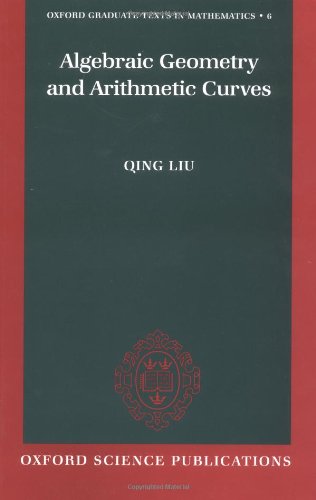
Algebraic Geometry and Arithmetic Curves 1st Edition by Qing Liu ISBN 978-0198502845 0198502842
Original price was: $50.00.$35.00Current price is: $35.00.
Algebraic Geometry and Arithmetic Curves 1st Edition by Qing Liu- Ebook PDF Instant Download/Delivery: 978-0198502845, 0198502842
Full download Algebraic Geometry and Arithmetic Curves 1st Edition after payment
Product details:
ISBN 10: 0198502842
ISBN 13: 978-0198502845
Author: Qing Liu
This book is a general introduction to the theory of schemes, followed by applications to arithmetic surfaces and to the theory of reduction of algebraic curves. The first part introduces basic objects such as schemes, morphisms, base change, local properties (normality, regularity, Zariski’s Main Theorem). This is followed by the more global aspect: coherent sheaves and a finiteness theorem for their cohomology groups. Then follows a chapter on sheaves of differentials, dualizing sheaves, and grothendieck’s duality theory. The first part ends with the theorem of Riemann-Roch and its application to the study of smooth projective curves over a field. Singular curves are treated through a detailed study of the Picard group. The second part starts with blowing-ups and desingularization (embedded or not) of fibered surfaces over a Dedekind ring that leads on to intersection theory on arithmetic surfaces. Castelnuovo’s criterion is proved and also the existence of the minimal regular model. This leads to the study of reduction of algebraic curves. The case of elliptic curves is studied in detail. The book concludes with the fundamental theorem of stable reduction of Deligne-Mumford. The book is essentially self-contained, including the necessary material on commutative algebra. The prerequisites are therefore few, and the book should suit a graduate student. It contains many examples and nearly 600 exercises.
Table of contents:
1 Some topics in commutative algebra
1.1 Tensor products
1.1.1 Tensor product of modules
1.1.2 Right-exactness of the tensor product
1.1.3 Tensor product of algebras
1.2 Flatness
1.2.1 Left-exactness: flatness
1.2.2 Local nature of flatness
1.2.3 Faithful flatness
1.3 Formal completion
1.3.1 Inverse limits and completions
1.3.2 The Artin-Rees lemma and applications
1.3.3 The case of Noetherian local rings
General properties of schemes
2 Spectrum of a ring 2.1
2.1.1 Zariski topology
2.1.2 Algebraic sets
2.2 Ringed topological spaces
2.2.1 Sheaves
2.2.2 Ringed topological spaces
2.3 Schemes
2.3.1 Definition of schemes and examples
2.3.2 Morphisms of schemes
2.3.3 Projective schemes
2.3.4 Noetherian schemes, algebraic varieties
2.4 Reduced schemes and integral schemes
2.4.1 Reduced schemes
2.4.2 Irreducible components
2.4.3 Integral schemes
2.5 Dimension
2.5.1 Dimension of schemes
2.5.2 The case of Noetherian schemes
2.5.3 Dimension of algebraic varieties
3 Morphisms and base change
3.1 The technique of base change
3.1.1 Fibered product
3.1.2 Base change
3.2 Applications to algebraic varieties
3.2.1 Morphisms of finite type
3.2.2 Algebraic varieties and extension of the base field
3.2.3 Points with values in an extension of the base field
3.2.4 Frobenius
3.3 Some global properties of morphisms
3.3.1 Separated morphisms
3.3.2 Proper morphisms
3.3.3 Projective morphisms
4 Some local properties
4.1 Normal schemes
4.1.1 Normal schemes and extensions of regular functions
4.1.2 Normalization
4.2 Regular schemes
4.2.1 Tangent space to a scheme
4.2.2 Regular schemes and the Jacobian criterion
4.3 Flat morphisms and smooth morphisms
4.3.1 Flat morphisms
4.3.2 Spread morphisms
4.3.3 Smooth morphisms
4.4 Zariski’s ‘Main Theorem’ and applications
5 Coherent sheaves and Čech cohomology
5.1 Coherent sheaves on a scheme
5.1.1 Sheaves of modules
5.1.2 Quasi-coherent sheaves on an affine scheme
5.1.3 Coherent sheaves
5.1.4 Quasi-coherent sheaves on a projective scheme
Contents
5.2 Czech cohomology
5.2.1 Differential modules and cohomology with values in a sheaf
5.2.2 Czech cohomology on a separated scheme
5.2.3 Higher direct image and flat base change
5.3 Cohomology of projective schemes
5.3.1 Direct image theorem
5.3.2 Connectedness principle
5.3.3 Cohomology of the fibers
6 Sheaves of differentials
6.1 Kähler differentials
6.1.1 Modules of relative differential forms
6.1.2 Sheaves of relative differentials (of degree 1)
6.2 Differential study of smooth morphisms
6.2.1 Smoothness criteria
6.2.2 Local structure and lifting of sections
6.3 Local complete intersection
6.3.1 Regular immersions
6.3.2 Local complete intersections
6.4 Duality theory
6.4.1 Determinant
6.4.2 Canonical sheaf
6.4.3 Grothendieck duality
7 Divisors and applications to curves
7.1 Cartier divisors
7.1.1 Meromorphic functions
7.1.2 Cartier divisors
7.1.3 Inverse image of Cartier divisors
7.2 Weil divisors
7.2.1 Cycles of codimension 1
7.2.2 Van der Waerden’s purity theorem
7.3 Riemann-Roch theorem
7.3.1 Degree of a divisor
7.3.2 Riemann-Roch for projective curves
7.4 Algebraic curves
7.4.1 Classification of curves of small genus
7.4.2 Hurwitz formula
7.4.3 Hyperelliptic curves
7.4.4 Group schemes and Picard varieties
7.5 Singular curves, structure of Pic (X)
8 Birational geometry of surfaces
8.1 Blowing-ups
8.1.1 Definition and elementary properties
8.1.2 Universal property of blowing-up
8.1.3 Blowing-ups and birational morphisms
8.1.4 Normalization of curves by blowing-up points
8.2 Excellent schemes
8.2.1 Universally catenary schemes and the dimension formula
8.2.2 Cohen-Macaulay rings
8.2.3 Excellent schemes
8.3 Fibered surfaces
8.3.1 Properties of the fibers
8.3.2 Valuations and birational classes of fibered surfaces
8.3.3 Contraction
8.3.4 Desingularization
9 Regular surfaces
9.1 Intersection theory on a regular surface
9.1.1 Local intersection
9.1.2 Intersection on a fibered surface
9.1.3 Intersection with a horizontal divisor, adjunction formula
9.2 Intersection and morphisms
9.2.1 Factorization theorem
9.2.2 Projection formula
9.2.3 Birational morphisms and Picard groups
9.2.4 Embedded resolutions
9.3 Minimal surfaces
9.3.1 Exceptional divisors and Castelnuovo’s criterion
9.3.2 Relatively minimal surfaces
9.3.3 Existence of the minimal regular model
9.3.4 Minimal desingularization and minimal embedded resolution
9.4 Applications to contraction; canonical model
9.4.1 Artin’s contractability criterion
9.4.2 Determination of the tangent spaces
9.4.3 Canonical models
9.4.4 Weierstrass models and regular models of elliptic curves
10 Reduction of algebraic curves
10.1 Models and reductions
10.1.1 Models of algebraic curves
10.1.2 Reduction
10.1.3 Reduction map
10.1.4 Graphs
10.2 Reduction of elliptic curves
10.2.1 Reduction of the minimal regular model
10.2.2 Néron models of elliptic curves
10.2.3 Potential semi-stable reduction
10.3 Stable reduction of algebraic curves
10.3.1 Stable curves
10.3.2 Stable reduction
10.3.3 Some sufficient conditions for the existence of the stable model
10.4 Deligne-Mumford theorem
10.4.1 Simplifications on the base scheme
10.4.2 Proof of Artin-Winters
10.4.3 Examples of computations of the potential stable reduction
People also search for:
q liu algebraic geometry and arithmetic curves pdf
algebraic geometry and arithmetic curves oxford graduate texts in mathematics
algebraic geometry and arithmetic curves solutions
how to learn algebraic geometry
algebraic geometry examples