
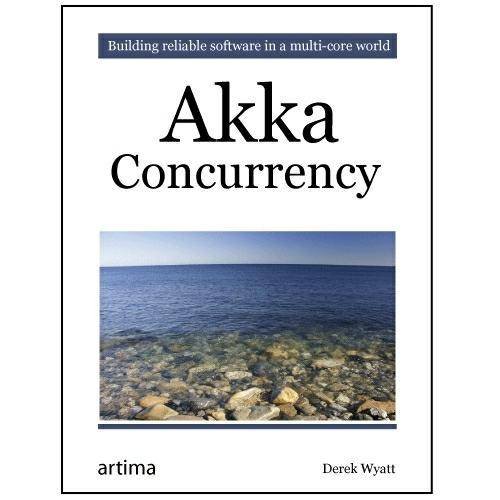

Akka Concurrency 1st Edition by Derek Wyatt – Ebook PDF Instant Download/Delivery: 0981531660, 978-0981531663
Full download Akka Concurrency 1st Edition after payment
Product details:
ISBN 10: 0981531660
ISBN 13: 978-0981531663
Author: Derek Wyatt
The Akka Toolkit takes the sting out of coding for multiple cores, multiple processors, and even multiple machines. Akka Concurrency will show you what it means to design and write software in the paradigm of Akka. You’ll learn how to think about your software in new and exciting ways that will allow you to express your designs naturally, allowing you to focus on the business of your software more than on the concurrency of it. This book picks up where the Akka documentation leaves off, exploring the how and the why of Akka, in a way that will empower you to grow your applications to new levels of scalability, responsiveness, and performance.
Table of contents:
1 Why Akka?
1.1 Concurrent challenges
1.2 Akka is concurrency
1.3 Concurrency methodologies
1.4 The Akka concurrency toolkit
1.5 So, why Akka?
2 Concurrency and Parallelism
2.1 Parallelism versus concurrency
2.2 A critical look at shared-state concurrency
2.3 Immutability
2.4 Conclusion
3 Setting Up Akka
3.1 Installation using the Typesafe stack
3.2 That’s it?
4 Akka Does Concurrency
4.1 The actor
4.2 The future
4.3 The other stuff
4.4 You grabbed the right toolkit
5. Actors
5.1 Components of an Actor
5.2 Attributes of an Actor
5.3 How to Communicate with an Actor
5.4 Creating an Actor
5.5 Actors on the Cloud
5.6 Linking Them Together
5.7 How to Send Activity Messages
5.8 ActorSystem Managing the Program
5.9 Conclusion
6. Akka Testing
6.1 Modifying sbt
6.2 A Bit of Refactoring
6.3 Testing EventSource
6.4 Interaction Between ImplicitSender and testActor
6.5 TestKit, ActorSystem, and ScalaTest
6.6 Testing the Altimeter
6.7 Other Testing Tools in Akka
6.8 About Test Probe and testActor
6.9 Chapter Summary
7. Systems, Contexts, Paths, and Locations
7.1 ActorSystem
7.2 Actor Paths
7.3 Aircraft Layout
7.4 ActorContext
7.5 Linking Paths, Context, and System
7.6 Chapter Summary
8. Supervision and Death Watch
8.1 What Causes an Actor to Fail?
8.2 Actor Lifecycle
8.3 What is a Supervisor?
8.4 Monitoring Death Events
8.5 The Self-Healing Aircraft
8.6 The Fallen Pilot
8.7 Chapter Summary
9. Being Stateful
9.1 Changing Behavior
9.2 Stateful Flight Attendants
9.3 Better Passengers
9.4 Playful Pilots
9.5 Some Challenges
9.6 Testing FSM
9.7 Testing Pilots
9.8 Chapter Summary
10. Routing Messages
10.1 A Router is Not an Actor
10.2 Akka’s Standard Routers
10.3 Routers and Child Actors
10.4 Routers on the Aircraft
10.5 The Magic Appearance of Flight Attendants
10.6 Flight Attendant Territory Partitioning
10.7 Things You Can Do with Routers
10.8 With That Said…
10.9 Chapter Summary
11. Dispatchers and Mailboxes
11.1 Dispatcher
11.2 Tuning the Dispatcher
11.3 Mailbox
11.4 When to Choose a Dispatching Method
11.5 Chapter Summary
12. Coding in the Future
12.1 What is the Future?
12.2 Don’t Wait for the Future
12.3 Promises and Futures
12.4 Functional Futures
12.5 Side Effects
12.6 Futures and Actors
12.7 Aircraft Futures…
12.8 Chapter Summary
13. Networking with IO
13.1 The Airplane’s Telnet Server
13.2 Iteratees
13.3 Chapter Summary
14. Going Multi-Node with Remote Actors
14.1 Many Actors, Many Stages
14.2 Simple Build Tool (sbt)
14.3 Remote Airport
14.4 Going Remote
14.5 Flying to the Airport
14.6 Programmatic Remote Deployment
14.7 Configured Remote Deployment
14.8 Routers Across Multiple Nodes
14.9 Serialization
14.10 Remote System Events
14.11 On the Topic of Lost Messages
14.12 Clustering
14.13 Chapter Summary
15. Sharing Data with Agents
15.1 sbt
15.2 Agents as Counters
15.3 Working with Agents
15.4 API
15.5 Chapter Summary
16. Concurrency Details with Dataflow
16.1 Warning
16.2 With That Said…
16.3 Bringing Dataflow into the Build
16.4 Dataflow Values
16.5 Streams
16.6 Another Way to Retrieve Tool State
16.7 When to Use Dataflow
16.8 Chapter Summary
17. Patterns for Akka Programming
17.1 Composing Behavior
17.2 Isolated and Parallel Testing
17.3 Request/Response Deployment Strategies
17.4 Handling Undefined Startup States
17.5 Circuit Breaker
17.6 Splitting Long-Running Algorithms into Multiple Steps
17.7 Running in Parallel
17.8 Actor EventBus
17.9 Message Transformation
17.10 Retry Behavior
17.11 Shutting Down When All Actors Complete
17.12 Load Balancing Across Remote Nodes
17.13 Chapter Summary
18. Anti-Patterns in Akka Programming
18.1 Mutability in Messages
18.2 Loosely Typed Messages
18.3 Closing Actor Data
18.4 Violating the Single Responsibility Principle
18.5 Inappropriate Relationships
18.6 Too Many actorFor Calls
18.7 Insufficient Configuration
18.8 Unnecessary Future Plumbing
18.9 Too Many ActorSystems
18.10 Not Delegating Risky Behavior to Children
18.11 Blocking for Too Long
18.12 Synchronizing Asynchronous Code
18.13 Not Reading the Documentation
18.14 Chapter Summary
19. Developing Your Application with Additional Modules
19.1 Extensions
19.2 Working with Software Transactional Memory
19.3 ZeroMQ
19.4 Microkernel
19.5 Camel
19.6 Durable Mailbox
19.7 Clustering
19. Developing Your Application with Additional Modules (continued)
19.8 HTTP
19.9 Event Sources
19.10 Monitoring
19.11 Chapter Summary
20. Using Akka from Java
20.1 Immutability
20.2 Overall Differences
20.3 Glue Code
20.4 akka.japi.Procedure
20.5 Messages
20.6 Untyped Actors
20.7 Futures
20.8 Working with Agents
20.9 Finite State Machines
20.10 Dataflow
20.11 Chapter Summary
21. Now You Are an Akka Programmer
21.1 akka.io
21.2 Mailing Lists
21.3 Have Fun!
People also search for:
akka.net concurrency
akka conflate
akka config
akka concurrency model
akka concurrency in java
akka async
Tags:
Derek Wyatt,Akka Concurrency