
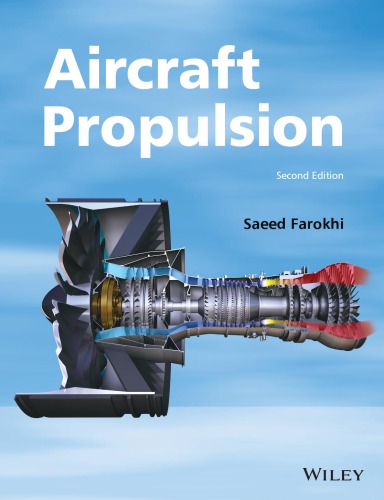
Aircraft Propulsion 2nd Edition by Saeed Farokhi ISBN 9781118806777 978-1118806777


Original price was: $50.00.$35.00Current price is: $35.00.
Aircraft Propulsion 2nd Edition by Saeed Farokhi – Ebook PDF Instant Download/Delivery: 9781118806777 ,978-1118806777
Full download Aircraft Propulsion 2nd Edition after payment
Product details:
ISBN 10: 9781118806777
ISBN 13: 978-1118806777
Author: Saeed Farokhi
New edition of the successful textbook updated to include new material on UAVs, design guidelines in aircraft engine component systems and additional end of chapter problems
Aircraft Propulsion, Second Edition follows the successful first edition textbook with comprehensive treatment of the subjects in airbreathing propulsion, from the basic principles to more advanced treatments in engine components and system integration.
This new edition has been extensively updated to include a number of new and important topics. A chapter is now included on General Aviation and Uninhabited Aerial Vehicle (UAV) Propulsion Systems that includes a discussion on electric and hybrid propulsion. Propeller theory is added to the presentation of turboprop engines. A new section in cycle analysis treats Ultra-High Bypass (UHB) and Geared Turbofan engines. New material on drop-in biofuels and design for sustainability is added to refl ect the FAA’s 2025 Vision.
In addition, the design guidelines in aircraft engine components are expanded to make the book user friendly for engine designers. Extensive review material and derivations are included to help the reader navigate through the subject with ease.
Key features:
General Aviation and UAV Propulsion Systems are presented in a new chapter
Discusses Ultra-High Bypass and Geared Turbofan engines
Presents alternative drop-in jet fuels
Expands on engine components’ design guidelines
The end-of-chapter problem sets have been increased by nearly 50% and solutions are available on a companion website
Presents a new section on engine performance testing and instrumentation
Includes a new 10-Minute Quiz appendix (with 45 quizzes) that can be used as a continuous assessment and improvement tool in teaching/learning propulsion principles and concepts
Includes a new appendix on Rules of Thumb and Trends in aircraft propulsion
Aircraft Propulsion, Second Edition is a must-have textbook for graduate and undergraduate students, and is also an excellent source of information for researchers and practitioners in the aerospace and power industry.
Table of contents:
1 Introduction
1.1 History of the Airbreathing Jet Engine, a Twentieth-Century Invention—The Beginning
1.2 Innovations in Aircraft Gas Turbine Engines
1.3 New Engine Concepts
1.4 New Vehicles
1.5 Summary
1.6 Roadmap for the Second Edition
References
Problems
2 Compressible Flow with Friction and Heat: A Review
2.1 Introduction
2.2 A Brief Review of Thermodynamics
2.3 Isentropic Process and Isentropic Flow
2.4 Conservation Principles for Systems and Control Volumes
2.5 Speed of Sound & Mach Number
2.6 Stagnation State
2.7 Quasi-One-Dimensional Flow
2.8 Area–Mach Number Relationship
2.9 Sonic Throat
2.10 Waves in Supersonic Flow
2.11 Normal Shocks
2.12 Oblique Shocks
2.13 Conical Shocks
2.14 Expansion Waves
2.15 Frictionless, Constant-Area Duct Flow with Heat Transfer
2.16 Adiabatic Flow of a Calorically Perfect Gas in a Constant-Area Duct with Friction
2.17 Friction (Drag) Coefficient Cf and D’Arcy Friction Factor fD
2.18 Dimensionless Parameters
2.19 Fluid Impulse
2.20 Summary of Fluid Impulse
References
Problems
3 Engine Thrust and Performance Parameters
3.1 Introduction
3.2 Installed Thrust—Some Bookkeeping Issues on Thrust and Drag
3.3 Engine Thrust Based on the Sum of Component Impulse
3.4 Rocket Thrust
3.5 Airbreathing Engine Performance Parameters
3.6 Modern Engines, Their Architecture and Some Performance Characteristics
3.7 Summary
References
Problems
4 Gas Turbine Engine Cycle Analysis
4.1 Introduction
4.2 The Gas Generator
4.3 Aircraft Gas Turbine Engines
4.4 Analysis of a Mixed-Exhaust Turbofan Engine with an Afterburner
4.5 The Turboprop Engine
4.6 Summary
References
Problems
5 General Aviation and Uninhabited Aerial Vehicle Propulsion System
5.1 Introduction
5.2 Cycle Analysis
5.3 Power and Efficiency
5.4 Engine Components and Classifications
5.5 Scaling of Aircraft Reciprocating Engines
5.6 Aircraft Engine Systems
5.7 Electric Engines
5.8 Propellers and Reduction Gears
References
Problems
Notes
6 Aircraft Engine Inlets and Nozzles
6.1 Introduction
6.2 The Flight Mach Number and Its Impact on Inlet Duct Geometry
6.3 Diffusers
6.4 An Ideal Diffuser
6.5 Real Diffusers and Their Stall Characteristics
6.6 Subsonic Diffuser Performance
6.7 Subsonic Cruise Inlet
6.8 Transition Ducts
6.9 An Interim Summary for Subsonic Inlets
6.10 Supersonic Inlets
6.11 Normal Shock Inlets
6.12 External Compression Inlets
6.13 Variable Geometry—External Compression Inlets
6.14 Mixed-Compression Inlets
6.15 Supersonic Inlet Types and Their Performance—A Review
6.16 Standards for Supersonic Inlet Recovery
6.17 Exhaust Nozzle
6.18 Gross Thrust
6.19 Nozzle Adiabatic Efficiency
6.20 Nozzle Total Pressure Ratio
6.21 Nozzle Pressure Ratio (NPR) and Critical Nozzle Pressure Ratio (NPRcrit.)
6.22 Relation Between Nozzle Figures of Merit, ηn and πn
6.23 A Convergent Nozzle or a De Laval?
6.24 The Effect of Boundary Layer Formation on Nozzle Internal Performance
6.25 Nozzle Exit Flow Velocity Coefficient
6.26 Effect of Flow Angularity on Gross Thrust
6.27 Nozzle Gross Thrust Coefficient Cfg
6.28 Overexpanded Nozzle Flow—Shock Losses
6.29 Nozzle Area Scheduling, A8 and A9/A8
6.30 Nozzle Exit Area Scheduling, A9/A8
6.31 Nozzle Cooling
6.32 Thrust Reverser and Thrust Vectoring
6.33 Hypersonic Nozzle
6.34 Exhaust Mixer and Gross Thrust Gain in a Mixed-Flow Turbofan Engine
6.35 Noise
6.36 Nozzle-Turbine (Structural) Integration
6.37 Summary of Exhaust Systems
References
Problems
7 Combustion Chambers and Afterburners
7.1 Introduction
7.2 Laws Governing Mixture of Gases
7.3 Chemical Reaction and Flame Temperature
7.4 Chemical Equilibrium and Chemical Composition
7.5 Chemical Kinetics
7.6 Combustion Chamber
7.7 Combustion-Generated Pollutants
7.8 Aviation Fuels
7.9 Alternative “Drop-In” Jet Fuels (AJFs)
7.10 Combustion Instability: Screech and Rumble
7.11 Summary
References
Problems
8 Axial Compressor Aerodynamics
8.1 Introduction
8.2 The Geometry
8.3 Rotor and Stator Frames of Reference
8.4 The Euler Turbine Equation
8.5 Axial-Flow Versus Radial-Flow Machines
8.6 Axial-Flow Compressors and Fans
8.7 Compressor Performance Map
8.8 Compressor Instability – Stall and Surge
8.9 Multistage Compressors and Their Operating Line
8.10 Multistage Compressor Stalling Pressure Rise and Stall Margin
8.11 Multistage Compressor Starting Problem
8.12 The Effect of Inlet Flow Condition on Compressor Performance
8.13 Isometric and Cutaway Views of Axial-Flow Compressor Hardware
8.14 Compressor Design Parameters and Principles
8.15 Summary
References
Problems
9 Centrifugal Compressor Aerodynamics
9.1 Introduction
9.2 Centrifugal Compressors
9.3 Radial Diffuser
9.4 Inducer
9.5 Inlet Guide Vanes (IGVs) and Inducer-Less Impellers
9.6 Impeller Exit Flow and Blockage Effects
9.7 Efficiency and Performance
9.8 Summary
References
Problems
10 Aerothermo-dynamics of Gas Turbines
10.1 Introduction
10.2 Axial-Flow Turbines
10.3 Turbine Performance Map
10.4 The Effect of Cooling on Turbine Efficiency
10.5 Turbine Blade Profile Design
10.6 Stresses in Turbine Blades and Disks and Useful Life Estimation
10.7 Axial-Flow Turbine Design and Practices
10.8 Gas Turbine Design Summary
10.9 Summary
References
Problems
11 Aircraft Engine Component Matching and Off-Design Analysis
11.1 Introduction
11.2 Engine (Steady-State) Component Matching
11.3 Engine Off-Design Analysis
11.4 Unchoked Nozzles and Other Off-Design Iteration Strategies
11.5 Principles of Engine Performance Testing
11.6 Summary
References
Problems
12 Chemical Rocket and Hypersonic Propulsion
12.1 Introduction
12.2 From Takeoff to Earth Orbit
12.3 Chemical Rockets
12.4 Chemical Rocket Applications
12.5 New Parameters in Rocket Propulsion
12.6 Thrust Coefficient, CF
12.7 Characteristic Velocity, c*
12.8 Flight Performance
12.9 Multistage Rockets
12.10 Propulsive and Overall Efficiencies
12.11 Chemical Rocket Combustion Chamber
12.12 Thrust Chamber Cooling
12.13 Combustor Volume and Shape
12.14 Rocket Nozzles
12.15 High-Speed Airbreathing Engines
12.16 Rocket-Based Airbreathing Propulsion
12.17 Summary
References
Problems
A. U.S. Standard Atmosphere
U.S. Standard Atmosphere U.S. Units
U.S. Standard Atmosphere SI Units
B. Isentropic Table
Isentropic Table γ = 1.4
Isentropic Table γ = 1.3
C. Normal Shock Table
Normal Shock Table γ = 1.4
Normal Shock Table γ = 1.3
D. Rayleigh Flow
Rayleigh Flow γ = 1.4
Rayleigh Flow γ = 1.3
E. Fanno Flow
Fanno Flow γ = 1.4
Fanno Flow γ = 1.3
F. Prandtl–Meyer Function and Mach Angle
G. Oblique Shock Charts
Oblique Shock Charts γ = 1.4
H. Conical Shock Charts
Conical Shock Charts γ = 1.4
I. Cascade Data
NACA-65 Series Cascade Data
Cascade Data
J. Websites
K. 10-Minute Quiz: Closed books and notes
Quiz No. 1
Quiz No. 2
Quiz No. 3
Quiz No. 4
Quiz No. 5
Quiz No. 6
Quiz No. 7
Quiz No. 8
Quiz No. 9
Quiz No. 10
Quiz No. 11
Quiz No. 12
Quiz No. 13
Quiz No. 14
Quiz No. 15
Quiz No. 16
Quiz No. 17
Quiz No. 18
Quiz No. 19
Quiz No. 20
Quiz No. 21
Quiz No. 22
Quiz No. 23
Quiz No. 24
Quiz No. 25
Quiz No. 26
Quiz No. 27
Quiz No. 28
Quiz No. 29
Quiz No. 30
Quiz No. 31
Quiz No. 32
Quiz No. 33
Quiz No. 34
Quiz No. 35
Quiz No. 36
Quiz No. 37
Quiz No. 38
Quiz No. 39
Quiz No. 40
Quiz No. 41
Quiz No. 42
Quiz No. 43
Quiz No. 44
Quiz No. 45
People also search for:
aircraft engine for sale
aircraft propeller for sale
jet propulsion for boats
propulsion for aircraft
jet propulsion in animals
Tags:
Saeed Farokhi,Aircraft Propulsion