
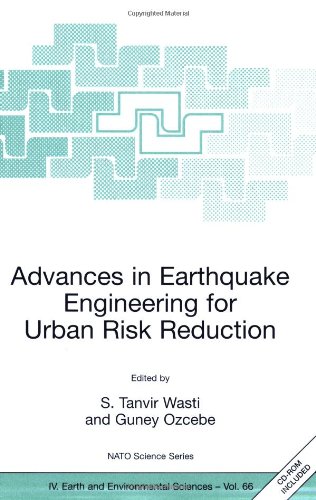
Advances in Earthquake Engineering for Urban Risk Reduction 1st Edition by S Tanvir Wasti, Guney Ozcebe ISBN 1402045719 9781402045714

Original price was: $50.00.$35.00Current price is: $35.00.
Advances in Earthquake Engineering for Urban Risk Reduction 1st Edition by S. Tanvir Wasti, Guney Ozcebe – Ebook PDF Instant Download/Delivery: 1402045719, 9781402045714
Full download Advances in Earthquake Engineering for Urban Risk Reduction 1st Edition after payment
Product details:
ISBN 10: 1402045719
ISBN 13: 9781402045714
Author: S. Tanvir Wasti, Guney Ozcebe
Earthquakes affecting urban areas can lead to catastrophic situations and hazard mitigation requires preparatory measures at all levels. Structural assessment is the diagnosis of the seismic health of buildings. Assessment is the prelude to decisions about rehabilitation or even demolition. The scale of the problem in dense urban settings brings about a need for macro seismic appraisal procedures because large numbers of existing buildings do not conform to the increased requirements of new earthquake codes and specifications or have other deficiencies. It is the vulnerable buildings – liable to cause damage and loss of life – that need immediate attention and urgent appraisal in order to decide if structural rehabilitation and upgrading are feasible. Current economic, efficient and occupant-friendly rehabilitation techniques vary widely and include the application either of precast concrete panels or layers, strips and patches of fiber reinforced polymers (FRP) in strategic locations. The papers in this book, many by renowned authorities in earthquake engineering, chart new and vital directions of research and application in the assessment and rehabilitation of buildings in seismic regions. While several papers discuss the probabilistic prediction and quantification of structural damage, others present approaches related with the in-situ and occupant friendly upgrading of buildings and propose both economical and practical techniques to address the problem.
Table of contents:
1: Contributing Authors
2: Preface
3: Foreword
4: From Duzce to the City
5: Recent Advances in the Seismic Rehabilitation of Reinforced Concrete Buildings in Japan
6: Concrete or FRP Jacketing of Concrete Columns for Seismic Retrofitting
7: In Service Seismic Strengthening of RC Framed Buildings
8: An Equivalent Linearization Procedure for Displacement-Based Seismic Assessment of Vulnerable RC Buildings
9: A Displacement-Based Adaptive Pushover for Assessment of Buildings and Bridges
10: In Defence of Zeytinburnu
11: Automated Post-Earthquake Damage Assessment of Instrumented Buildings
12: A Detailed Seismic Performance Assessment Procedure for RC Frame Buildings
13: Assessment of Seismic Fragility Curves for Low- and Mid-Rise Reinforced Concrete Frame Buildings Using Duzce Field Database
14: Seismic Rehabilitation of Low-Rise Precast Industrial Buildings in Turkey
15: Seismic Risk Mitigation through Retrofitting Non-Ductile Concrete Frame Systems
16: Hyde-Systems for Earthquake Protection of Residential Buildings
17: Learning from Earthquakes to Improve Rehabilitation Guidelines for Reinforced Concrete Buildings
18: Seismic Risk Scenarios for an Efficient Seismic Risk Management: The Case of Thessaloniki
19: The Multi-Axial Full-Scale Sub-Structured Testing and Simulation (Must-Sim) Facility at the University of Illinois at Urbana-Champaign
20: Recent Experimental Evidence on the Seismic Performance of Rehabilitation Techniques in Mexico
21: CFRP Overlays in Strengthening of Frames with Column Rebar Lap Splice Problem
22: Seismic Retrofit of Infilled Reinforced Concrete Frames with CFRP Composites
23: Axial Behavior of RC Columns Retrofitted with FRP Composites
24: Collapse of Lightly Confined Reinforced Concrete Frames during Earthquakes
25: Evaluation of Approximate Nonlinear Procedures for Observed Response of a Shear Wall Structure
26: Assessment and Retrofit of Full-Scale Models of Existing RC Frames
27: Development of Internet-Based Seismic Vulnerability Assessment Tools
28: A Comparative Study of Displacement, Force and Pushover Approaches for Design of Continuous Span Bridges
29: Seismic Rehabilitation Using Infill Wall Systems
30: Shake Table Experiment on One-Story RC Structure with and without Masonry Infill
31: Opportunities and Challenges of Modern Concrete Technology in Earthquake Hazard Mitigation
32: Shaking Table Tests of Scaled RC Frame Models for Investigation of Validity and Applicability of Different Retrofitting Techniques
33: Analysis of Infilled Reinforced Concrete Frames Strengthened with FRPs
34: Tensile Capacities of CFRP Anchors
35: Using a Displacement-Based Approach for Earthquake Loss Estimation
36: Nonlinear Drift Demands on Moment-Resisting Stiff Frames
37: The Seismic Well-Being of Buildings: Diagnostics and Remedies
38: Envoi
39: Acknowledgements
People also search for:
earthquake research advances
advances in earthquake engineering
earthquake engineering trends
earthquake engineering and resilience
advances in environmental and engineering research impact factor
Tags: S Tanvir Wasti, Guney Ozcebe, Advances, Earthquake Engineering, Urban Risk Reduction