
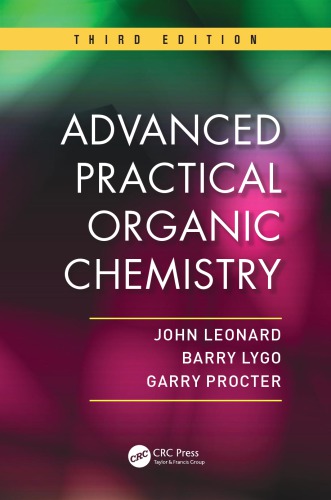
Advanced Practical Organic Chemistry Third Edition by Barry Lygo, John Leonard, Garry Procter ISBN 978-1439860977 1439860971
Original price was: $50.00.$35.00Current price is: $35.00.
Advanced Practical Organic Chemistry Third Edition by Barry Lygo, John Leonard, Garry Procter – Ebook PDF Instant Download/Delivery: 978-1439860977, 1439860971
Full download Advanced Practical Organic Chemistry Third Edition after payment
Product details:
ISBN 10: 1439860971
ISBN 13: 978-1439860977
Author: Barry Lygo, John Leonard, Garry Procter
are not commercially available, will at some time require the synthesis of such compounds. Therefore, organic synthesis is important in many areas of both applied and academic research, from chemistry to biology, biochemistry, and materials science. The third edition of a bestseller, Advanced Practical Organic Chemistry is a guide that explains the basic techniques of organic chemistry, presenting the necessary information for readers to carry out widely used modern organic synthesis reactions.
This book is written for advanced undergraduate and graduate students as well as industrial organic chemists, particularly those involved in pharmaceutical, agrochemical, and other areas of fine chemical research. It provides the novice or nonspecialist with the often difficult-to-find information on reagent properties needed to perform general techniques. With over 80 years combined experience training and developing organic research chemists in industry and academia, the authors offer sufficient guidance for researchers to perform reactions under conditions that give the highest chance of success, including the appropriate precautions to take and proper experimental protocols. The text also covers the following topics:
Record keeping and equipment
Solvent purification and reagent preparation
Using gases and working with vacuum pumps
Purification, including crystallization and distillation
Small-scale and large-scale reactions
Characterization, including NMR spectra, melting point and boiling point, and microanalysis
Efficient ways to find information in the chemical literature
With fully updated text and all newly drawn figures, the third edition provides a powerful tool for building the knowledge on the most up-to-date techniques commonly used in organic synthesis.
Table of contents:
1. General Introduction
Safety
2. Safety
3. Safety Is Your Primary Responsibility
4. Safe Working Practice
5. Safety Risk Assessments
6. Common Hazards
7. Accident and Emergency Procedures
8. Bibliography
Keeping Records of Laboratory Work
9. Introduction
10. The Laboratory Notebook
11. Keeping Records of Data
12. Some Tips on Report and Thesis Preparation
13. References
Equipping the Laboratory and the Bench
14. Introduction
15. Setting Up the Laboratory
16. General Laboratory Equipment
17. The Individual Bench
18. Equipment for Parallel Experiments
19. Equipment for Controlled Experimentation
Purification and Drying of Solvents
20. Introduction
21. Purification of Solvents
22. Drying Agents
23. Drying of Solvents
24. References
Reagents: Preparation, Purification, and Handling
25. Introduction
26. Classification of Reagents for Handling
27. Techniques for Obtaining Pure and Dry Reagents
28. Techniques for Handling and Measuring Reagents
29. Preparation and Titration of Simple Organometallic Reagents and Lithium Amide Bases
30. Preparation of Diazomethane
31. References
Gases
32. Introduction
33. Use of Gas Cylinders
34. Handling Gases
35. Measurement of Gases
36. Inert Gases
37. Reagent Gases
38. References
Vacuum Pumps
39. Introduction
40. House Vacuum Systems (Low Vacuum)
41. Medium Vacuum Pumps
42. High Vacuum Pumps
43. Pressure Measurement and Regulation
Carrying Out the Reaction
44. Introduction
45. Reactions with Air-Sensitive Reagents
46. Reaction Monitoring
47. Reactions at Other than Room Temperature
48. Driving Equilibria
49. Agitation
50. Use of Controlled Reactor Systems
51. References
Working Up the Reaction
52. Introduction
53. Quenching the Reaction
54. Isolation of the Crude Product
55. Data to Be Collected on the Crude Product Prior to Purification
Purification
56. Introduction
57. Crystallization
58. Distillation
59. Sublimation
60. Flash Chromatography
61. Dry-Column Flash Chromatography
62. Preparative TLC
63. Medium Pressure and Prepacked Chromatography Systems
64. Preparative HPLC
65. References
Small-Scale Reactions
66. Introduction
67. Reactions at or Below Room Temperature
68. Reactions Above Room Temperature
69. Reactions in NMR Tubes
70. Purification of Materials
Large-Scale Reactions
71. Introduction
72. Carrying Out the Reaction
73. Workup and Product Isolation
74. Purification of the Products
Special Procedures
75. Introduction
76. Catalytic Hydrogenation
77. Photolysis
78. Ozonolysis
79. Flash Vacuum Pyrolysis (FVP)
80. Liquid Ammonia Reactions
81. Microwave Reactions
82. References
Characterization
83. Introduction
84. NMR Spectra
85. IR Spectra
86. UV Spectroscopy
87. Mass Spectrometry
88. Melting Point and Boiling Point
89. Optical Rotation
90. Microanalysis
91. Keeping the Data
Troubleshooting
92. Troubleshooting: What to Do When Things Don’t Work
The Chemical Literature
93. The Chemical Literature
94. The Structure of the Chemical Literature
95. Paper-Based Sources of Chemical Information
96. Electronic-Based Sources of Chemical Information
97. How to Find Chemical Information
98. Current Awareness
99. References
People also search for:
advanced practical organic chemistry by nk vishnoi pdf
advanced practical organic chemistry o.p. agarwal pdf
advanced practical organic chemistry pdf free download
advanced practical organic chemistry by nk vishnoi pdf download
advanced practical organic chemistry op agarwal
Tags: Barry Lygo, John Leonard, Garry Procter