
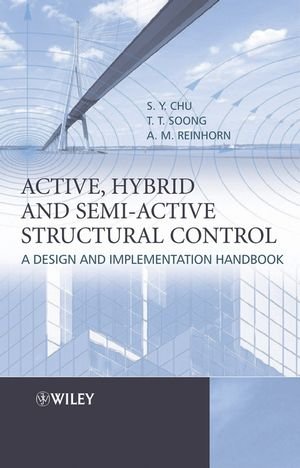
Active Hybrid and Semi active Structural Control A Design and Implementation Handbook 1st Edition by Chu, Soong, Reinhorn ISBN 978-0470013526 0470013526

Original price was: $50.00.$35.00Current price is: $35.00.
Active Hybrid and Semi active Structural Control A Design and Implementation Handbook 1st Edition by S. Y. Chu, T. T. Soong, A. M. Reinhorn – Ebook PDF Instant Download/Delivery: 978-0470013526, 0470013526
Full download Active Hybrid and Semi active Structural Control A Design and Implementation Handbook 1st Edition after payment
Product details:
ISBN 10: 0470013526
ISBN 13: 978-0470013526
Author: S. Y. Chu, T. T. Soong, A. M. Reinhorn
This comprehensive handbook is designed to provide the reader with the knowledge needed to successfully implement an active, hybrid or semi-active control system to a structure, safeguarding it against environmental forces such as wind or earthquakes. Written by leading experts in structural control, this book:
- Emphasises fail-safe techniques and validates their implementation through simulations.
- Examines the implicit issues between theoretical development and actual implementation of systems.
- Identifies important hardware and software safety features.
- Describes a PC-based system simulator, which simulates the real-time response of structure and control hardware.
Active, Hybrid and Semi-active Structural Control is a must have reference for researchers, practitioners and design engineers working in civil, aerospace, automotive and mechanical engineering. It is undoubtedly the key resource for all postgraduate students in this rapidly growing area of research interest and development.
Table of contents:
1. Introduction
1.1 General
1.2 Basic Principles
1.3 State-of-the-Practice
1.3.1 Hybrid Mass Damper Systems
1.3.2 Active Mass Damper Systems
1.3.3 Semi-active Damper Systems
1.3.4 Semi-active Controllable Fluid Dampers
1.4 Implementation-Related Issues
1.4.1 An Overview
1.5 Organization
2. Hardware Description
2.1 Introduction
2.2 Active Control Force Generation System
2.2.1 General
2.2.2 Electrical Power Driven Mechanism
2.2.3 Hydraulic Power Driven Mechanism
2.3 Measuring Equipment
2.3.1 General
2.3.2 Position Transducers
2.3.3 Velocity Transducers – Tachometers
2.3.4 Accelerometers
2.3.5 Force Transducers
2.4 Signal Interface System
2.4.1 General
2.4.2 Conditioning System
2.4.3 Filtering System
2.4.4 Monitoring System
2.4.5 Fail-Safe Limitation Detection System
2.4.6 Signal Communication and the Remote Activation System
2.5 Digital Control System
2.5.1 General
2.5.2 Data Acquisition/Conversion System
2.5.3 Control Command Calculator
2.6 Case Study
2.6.1 Hydraulic Devices with a Control Console
2.6.2 Measuring Equipment
2.6.3 Custom-Designed Interface Drawer
2.6.4 Digital Control System
2.6.5 Integration Issues
3. Control Software Implementation
3.1 Introduction
3.2 Practical Considerations
3.2.1 General
3.2.2 Modeling Errors and Spillover Effects
3.2.3 Time Delay and Time Lag
3.2.4 Structural Nonlinearities
3.2.5 Uncertainties in Structural Parameters
3.2.6 Limited Number of Sensors and Controllers
3.2.7 Discrete-Time Control Features
3.2.8 Reliability
3.3 Digital Control System (Software)
3.3.1 General
3.3.2 Quantization Issues
3.3.3 Sampling Issues
3.3.4 Access to Hardware Issues
3.3.5 Saturating and Scaling Issues and the Overflow Effect
3.3.6 Digital Control with a DSP
3.4 Appropriate Design Morphology
3.4.1 General
3.4.2 Interactive Configuration Module
3.4.3 System Clock Set-up Module
3.4.4 Analog I/O Module
3.4.5 Real-Time Adjustment Module
3.4.6 Channel On/Off Identification Module
3.4.7 Error Detection and the Correction Module
3.4.8 Measurement Manipulation Module
3.4.9 Engineering Unit Scaling Module
3.4.10 Control Algorithm Module
3.4.11 System Response Monitoring and the Reporting Module
3.4.12 Data Storage and the Communication Module
3.4.13 Fail-Safe Multi-protection Module
3.4.14 Smooth Start-Up/Shut-Down Module
3.4.15 Remote Control Module
3.5 Case Study
3.5.1 Interactive Configuration Group
3.5.2 Signal Processing Group
3.5.3 Control Algorithm Group
3.5.4 Fail-Safe Protection Group
4. Theoretical and Practical Control Techniques
4.1 General
4.2 Continuous-Time Optimal Direct Output Feedback
4.3 Effect of Time Delay
4.3.1 System Stability Analysis
4.3.2 Time Delay Effect
4.4 Discrete-Time Control Analysis and Design
4.4.1 Discrete-Time Systems
4.4.2 Time Delay Effect
4.4.3 Optimal Direct Output Feedback Control Gains
4.4.4 Frequency Domain Analysis Issues
4.4.5 Time Domain Analysis Issues
4.5 Analytical Simulations of Discrete-Time Control
4.5.1 General
4.5.2 Optimal Direct Output Feedback Control Gains
4.5.3 Stability Analysis and Time Delay Compensation
4.5.4 Time Domain Simulation Using Earthquake Input
4.6 Case Study
4.6.1 Analytical Model
4.6.2 Optimal Control Gains and Stability Analysis
4.6.3 Time Domain Verification Using Wind Excitation
5. Control Performance Verification
5.1 Introduction
5.2 Real-Time Structural Simulator
5.2.1 Theoretical Background
5.2.2 Hardware and Software Set-up
5.2.3 Calibration and Validation Processes
5.3 Real-Time Control Verification of the Hybrid/Active Mass Damper Model
5.3.1 Experimental Set-up
5.3.2 Calibration of the Sampling Period
5.3.3 Identification of the Delay Time
5.3.4 Experimental Verification of the Integrated System
5.4 Case Study
5.4.1 Calibration of the Sampling Period
5.4.2 Identification of the Delay Time
5.4.3 Experimental Verification of the Integrated System
6. Summary
6.1 Directions of Future Development
People also search for:
difference between active and semi active suspension
what is an active hybrid car
active hybrid bmw
an active
active hybrid meaning
Tags: Chu, Soong, Reinhorn, Active Hybrid, Semi active Structural, A Design