
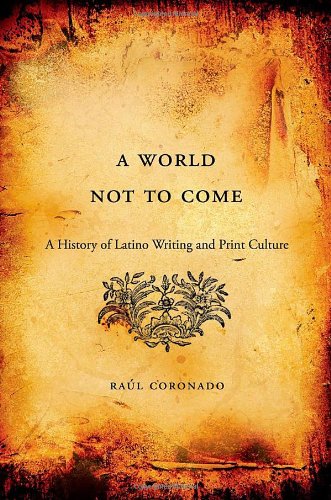
A World Not to Come A History of Latino Writing and Print Culture 1st Edition by Raúl Coronado ISBN 978-0674072619 0674072618


Original price was: $50.00.$35.00Current price is: $35.00.
A World Not to Come A History of Latino Writing and Print Culture 1St Edition by Raúl Coronado – Ebook PDF Instant Download/Delivery: 978-0674072619, 0674072618
Full download A World Not to Come A History of Latino Writing and Print Culture 1St Edition after payment
Product details:
ISBN 10: 0674072618
ISBN 13: 978-0674072619
Author: Raúl Coronado
A shift of global proportions occurred in May 1808. Napoleon Bonaparte invaded Spain and deposed the Spanish king. Overnight, the Hispanic world was transformed forever. Hispanics were forced to confront modernity, and to look beyond monarchy and religion for new sources of authority. A World Not to Come focuses on how Spanish Americans in Texas used writing as a means to establish new sources of authority, and how a Latino literary and intellectual life was born in the New World.
The geographic locale that became Texas changed sovereignty four times, from Spanish colony to Mexican republic to Texan republic and finally to a U.S. state. Following the trail of manifestos, correspondence, histories, petitions, and periodicals, Raúl Coronado goes to the writings of Texas Mexicans to explore how they began the slow process of viewing the world as no longer being a received order but a produced order. Through reconfigured publics, they debated how best to remake the social fabric even as they were caught up in a whirlwind of wars, social upheaval, and political transformations.
Yet, while imagining a new world, Texas Mexicans were undergoing a transformation from an elite community of “civilizing” conquerors to an embattled, pauperized, racialized group whose voices were annihilated by war. In the end, theirs was a world not to come. Coronado sees in this process of racialization the birth of an emergent Latino culture and literature.
Table of contents:
1 Introduction
2 Divergent Revolutionary Genealogies
3 The Traumatic Origins of the Modern World
4 A History of Latino Textuality
5 Disenchantment
6 Becoming Latino
7 A Spiral Historical Narrative
I Imagining New Futures
8 Anxiously Desiring the Nation: The Skepticism of Scholasticism
9 The Beginning of the End
10 Provincial Education
11 The Scholastic Episteme
12 Skepticism in the Eastern Interior Provinces of New Spain
13 Imagining the Nation
14 “Oh! How Much I Could Say!” Imagining What a Nation Could Do
15 Voyage to the United States
16 Seeing a New Country
17 Admiring the Well-Being of the Nation
18 Struggling to Articulate the Sublime
II Pursuing Reform and Revolution
19 Seeking the Pueblo’s Happiness: Reform and the Discourse of Political Economy
20 The Need to Reform the Monarchy
21 The Discourse of Political Economy as the Vehicle for Greater Happiness
22 The Shifting Ideologies of Mercantilism to Free-Trade Capitalism
23 The Commercial Interests of Philadelphia’s Early Spanish Diplomats
24 Early U.S. Hispanic Publications, the Critique of Mercantilism, and the Common Good
25 Epistemic Shift
26 From Reform to Revolution: Print Culture and Expanding Social Imaginaries
27 Communication Networks
28 Initial Ruptures
29 The Demise of the Hispanic Monarchy and the Birth of the Modern World
30 Print Culture and the Eruption of the Public Sphere
31 Reconfiguring Time and Space
III Revolutionizing the Catholic Past
32 Seduced by Papers: Revolution (as Reformation) in Spanish Texas
33 Modern Tempests
34 On the Spanish Texas-Louisiana Border
35 Revolution as End of the World
36 Revolution as Seduction
37 From Patriarchal Respect to Reciprocal Love
38 Alone with the Hurricane
39 “We the Pueblo of the Province of Texas”: The Philosophy and Brute Reality of Independence
40 Reading Revolutionary Broadsheets Aloud
41 The Broadsheet’s Content
42 Francisco Suárez and the Catholic Corpus Mysticum
43 Revolutionary Catholic Visions of the Modern Political World
44 Indigenous Literacies
45 Catholic Republican Government
46 War and Terror
IV The Entrance of Life into History
47 “To the Advocates of Enlightenment and Reason”: From Subjects to Citizens
48 From Spanish Defeat to Mexican Independence
49 Writing and the Word of the Sovereign
50 Printing and the Making of Citizens in Postindependence Texas
51 Caring for the Social Body
52 “Adhering to the New Order of Things”: Newspapers, Publishing, and the Making of a New Social Imaginary
53 Forced Peace
54 Interfacing with Writing and Print Culture
55 The Founding of Spanish-Language Newspapers
56 Producing a New Social Imaginary
57 Reconfigured Publics
58 A New Temporality
59 “The Natural Sympathies That Unite All of Our People”: Political Journalism and the Struggle against Racism
60 Putting Pen to Political Work
61 Xenophobia and Anti-Mexican Violence
62 Representing Tejano Interests in the 1856 Election
63 Texas and the Gulf of Mexico Network
64 Reconfigured Imagined Communities
65 Racialization and Colonization
66 Surrounding Oneself with the Beauty of Life
67 A History of Writing, a Search for Presence
Appendixes: Transcriptions and Translations
68 José Antonio Gutiérrez de Lara, “Americanos” (Proclamation, 1811; translation)
69 José Álvarez de Toledo, Jesús, María, y José (Philadelphia, 1811; translation)
70 Governing junta of Béxar, “We the Pueblo of the Province of Texas” (San Antonio, Texas, April 6, 1813; transcription and translation)
71 Anonymous, “Report of the Most Notable Things That Occurred in Béxar in the Year
People also search for:
a world not fit to live in
a world not desperate to explain itself
a world not neatly divided
a world not ours where to watch
a world not ours watch online
Tags: Raúl Coronado, A World, A History, Writing and Print