
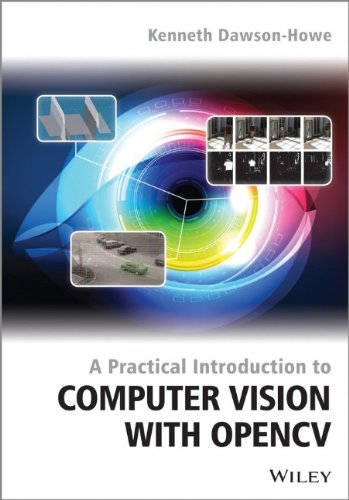
A Practical Introduction to Computer Vision with OpenCV 1st Edition by Kenneth Dawson-Howe ISBN 978-1118848456 1118848456

Original price was: $50.00.$35.00Current price is: $35.00.
A Practical Introduction to Computer Vision with OpenCV 1st Edition by Kenneth Dawson-Howe- Ebook PDF Instant Download/Delivery: 978-1118848456, 1118848456
Full download A Practical Introduction to Computer Vision with OpenCV 1st Edition after payment
Product details:
ISBN 10: 1118848456
ISBN 13: 978-1118848456
Author: Kenneth Dawson-Howe
Explains the theory behind basic computer vision and provides a bridge from the theory to practical implementation using the industry standard OpenCV libraries
Computer Vision is a rapidly expanding area and it is becoming progressively easier for developers to make use of this field due to the ready availability of high quality libraries (such as OpenCV 2). This text is intended to facilitate the practical use of computer vision with the goal being to bridge the gap between the theory and the practical implementation of computer vision. The book will explain how to use the relevant OpenCV library routines and will be accompanied by a full working program including the code snippets from the text. This textbook is a heavily illustrated, practical introduction to an exciting field, the applications of which are becoming almost ubiquitous. We are now surrounded by cameras, for example cameras on computers & tablets/ cameras built into our mobile phones/ cameras in games consoles; cameras imaging difficult modalities (such as ultrasound, X-ray, MRI) in hospitals, and surveillance cameras. This book is concerned with helping the next generation of computer developers to make use of all these images in order to develop systems which are more intuitive and interact with us in more intelligent ways.
Explains the theory behind basic computer vision and provides a bridge from the theory to practical implementation using the industry standard OpenCV libraries
Offers an introduction to computer vision, with enough theory to make clear how the various algorithms work but with an emphasis on practical programming issues
Provides enough material for a one semester course in computer vision at senior undergraduate and Masters levels
Includes the basics of cameras and images and image processing to remove noise, before moving on to topics such as image histogramming; binary imaging; video processing to detect and model moving objects; geometric operations & camera models; edge detection; features detection; recognition in images
Contains a large number of vision application problems to provide students with the opportunity to solve real problems. Images or videos for these problems are provided in the resources associated with this book which include an enhanced eBook
Table of contents:
1. Introduction
1.1 A Difficult Problem
1.2 The Human Vision System
1.3 Practical Applications of Computer Vision
1.4 The Future of Computer Vision
1.5 Material in This Textbook
1.6 Going Further with Computer Vision
2. Images
2.1 Cameras
2.1.1 The Simple Pinhole Camera Model
2.2 Images
2.2.1 Sampling
2.2.2 Quantisation
2.3 Colour Images
2.3.1 Red–Green–Blue (RGB) Images
2.3.2 Cyan–Magenta–Yellow (CMY) Images
2.3.3 YUV Images
2.3.4 Hue Luminance Saturation (HLS) Images
2.3.5 Other Colour Spaces
2.3.6 Some Colour Applications
2.4 Noise
2.4.1 Types of Noise
2.4.2 Noise Models
2.4.3 Noise Generation
2.4.4 Noise Evaluation
2.5 Smoothing
2.5.1 Image Averaging
2.5.2 Local Averaging and Gaussian Smoothing
2.5.3 Rotating Mask
2.5.4 Median Filter
3. Histograms
3.1 1D Histograms
3.1.1 Histogram Smoothing
3.1.2 Colour Histograms
3.2 3D Histograms
3.3 Histogram/Image Equalisation
3.4 Histogram Comparison
3.5 Back-projection
3.6 k-means Clustering
4. Binary Vision
4.1 Thresholding
4.1.1 Thresholding Problems
4.2 Threshold Detection Methods
4.2.1 Bimodal Histogram Analysis
4.2.2 Optimal Thresholding
4.2.3 Otsu Thresholding
4.3 Variations on Thresholding
4.3.1 Adaptive Thresholding
4.3.2 Band Thresholding
4.3.3 Semi-thresholding
4.3.4 Multispectral Thresholding
4.4 Mathematical Morphology
4.4.1 Dilation
4.4.2 Erosion
4.4.3 Opening and Closing
4.4.4 Grey-scale and Colour Morphology
4.5 Connectivity
4.5.1 Connectedness: Paradoxes and Solutions
4.5.2 Connected Components Analysis
5. Geometric Transformations
5.1 Problem Specification and Algorithm
5.2 Affine Transformations
5.2.1 Known Affine Transformations
5.2.2 Unknown Affine Transformations
5.3 Perspective Transformations
5.4 Specification of More Complex Transformations
5.5 Interpolation
5.5.1 Nearest Neighbour Interpolation
5.5.2 Bilinear Interpolation
5.5.3 Bi-Cubic Interpolation
5.6 Modelling and Removing Distortion from Cameras
5.6.1 Camera Distortions
5.6.2 Camera Calibration and Removing Distortion
6. Edges
6.1 Edge Detection
6.1.1 First Derivative Edge Detectors
6.1.2 Second Derivative Edge Detectors
6.1.3 Multispectral Edge Detection
6.1.4 Image Sharpening
6.2 Contour Segmentation
6.2.1 Basic Representations of Edge Data
6.2.2 Border Detection
6.2.3 Extracting Line Segment Representations of Edge Contours
6.3 Hough Transform
6.3.1 Hough for Lines
6.3.2 Hough for Circles
6.3.3 Generalised Hough
7. Features
7.1 Moravec Corner Detection
7.2 Harris Corner Detection
7.3 FAST Corner Detection
7.4 SIFT
7.4.1 Scale Space Extrema Detection
7.4.2 Accurate Keypoint Location
7.4.3 Keypoint Orientation Assignment
7.4.4 Keypoint Descriptor
7.4.5 Matching Keypoints
7.4.6 Recognition
7.5 Other Detectors
7.5.1 Minimum Eigenvalues
7.5.2 SURF
8. Recognition
8.1 Template Matching
8.1.1 Applications
8.1.2 Template Matching Algorithm
8.1.3 Matching Metrics
8.1.4 Finding Local Maxima or Minima
8.1.5 Control Strategies for Matching
8.2 Chamfer Matching
8.2.1 Chamfering Algorithm
8.2.2 Chamfer Matching Algorithm
8.3 Statistical Pattern Recognition
8.3.1 Probability Review
8.3.2 Sample Features
8.3.3 Statistical Pattern Recognition Technique
8.4 Cascade of Haar Classifiers
8.4.1 Features
8.4.2 Training
8.4.3 Classifiers
8.4.4 Recognition
8.5 Other Recognition Techniques
8.5.1 Support Vector Machines (SVM)
8.5.2 Histogram of Oriented Gradients (HoG)
8.6 Performance
8.6.1 Image and Video Datasets
8.6.2 Ground Truth
8.6.3 Metrics for Assessing Classification Performance
8.6.4 Improving Computation Time
9. Video
9.1 Moving Object Detection
9.1.1 Object of Interest
9.1.2 Common Problems
9.1.3 Difference Images
9.1.4 Background Models
9.1.5 Shadow Detection
9.2 Tracking
9.2.1 Exhaustive Search
9.2.2 Mean Shift
9.2.3 Dense Optical Flow
9.2.4 Feature Based Optical Flow
9.3 Performance
9.3.1 Video Datasets (and Formats)
9.3.2 Metrics for Assessing Video Tracking Performance
10. Vision Problems
10.1 Baby Food
10.2 Labels on Glue
10.3 O-rings
10.4 Staying in Lane
10.5 Reading Notices
10.6 Mailboxes
10.7 Abandoned and Removed Object Detection
10.8 Surveillance
10.9 Traffic Lights
10.10 Real Time Face Tracking
10.11 Playing Pool
10.12 Open Windows
10.13 Modelling Doors
10.14 Determining the Time from Analogue Clocks
10.15 Which Page
10.16 Nut/Bolt/Washer Classification
10.17 Road Sign Recognition
10.18 License Plates
10.19 Counting Bicycles
10.20 Recognise Paintings
People also search for:
a practical introduction
management a practical introduction
density functional theory a practical introduction
data visualization a practical introduction
counselling children a practical introduction
Tags: Kenneth Dawson-Howe, A Practical, Computer Vision, Computer Vision