
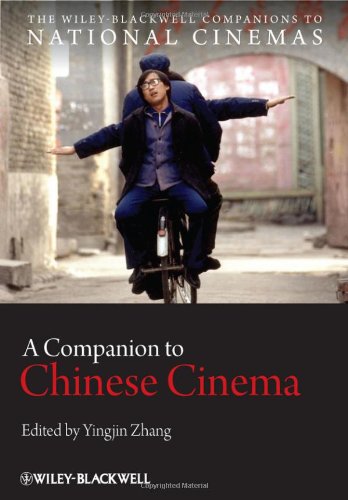
A Companion to Chinese Cinema 1st Edition by Yingjin Zhang ISBN 1444330292 978-1444330298

Original price was: $50.00.$35.00Current price is: $35.00.
A Companion to Chinese Cinema 1st Edition by Yingjin Zhang – Ebook PDF Instant Download/Delivery:1444330292 ,978-1444330298
Full download A Companion to Chinese Cinema 1st Edition after payment
Product details:
ISBN 10: 1444330292
ISBN 13: 978-1444330298
Author: Yingjin Zhang
“This outstanding anthology offers an encyclopedic coverage of Chinese cinema from multiple angles, and will be the standard reference in Chinese cinema studies in the years to come.”
Sheldon Lu, University of California, Davis
“Like its editor, this Companion is reliable, encyclopedic, and friendly. Traveling from silent melodramas to the urban generation, from Mainland China to Hong Kong and Taiwan, we now have the docent we need.”
Dudley Andrew, Yale University
“This stunning collection – a must-read for anyone interested in the complicated dynamics of Chinese cinema past and present – features state-of-the-art research by highly respected veteran scholars and brilliant newcomers.”
Paul G. Pickowicz, University of California, San Diego
A Companion to Chinese Cinema features a collection of original readings that offer a comprehensive overview of the evolution and current state of Chinese cinema. Essays consider Chinese cinema from a variety of historical and geopolitical centers – Shanghai, Hong Kong, and Taiwan – and offer a critical examination of major accomplishments of Chinese film studies in various categories: film history and geography, industry and institution, media and arts, genre and representation, and issues and debates.
This collaborative project brings together specialists across a range of disciplines to consider Chinese cinema from a variety of methodological approaches and theoretical frameworks. This interdisciplinary approach allows for an unprecedented breadth of innovative ideas that facilitate a better understanding of Chinese cinema as it relates to artistic projects, social practices, political institutions, and expanding international markets. A Companion to Chinese Cinema offers an important analysis of a growing force in international cinema.
Table of contents:
1 General Introduction
Part I: History and Geography
Part II: Industry and Institution
Part III: Genre and Representation
Part IV: Arts and Media
Part V: Issues and Debates
Looking Forward: Chinese Cinema in Comparative Film Studies
Part I: History and Geography
2 Transplanting Melodrama
Introduction: Retracing Chinese Melodrama
Lost and Found: Hou Yao and Shanghai Cinema
Griffith Fever and Vernacular Melodrama
Conclusion
3 Artists, Cadres, and Audiences
Continuity and Change: Crossing the 1949 Divide
New Rules and Directions
Expanding Studios and Audiences
Representative Works of Socialist Cinema
The Cultural Revolution: Disruption and Growth
Aftermath and Recovery
4 Directors, Aesthetics, Genres
Directors: Problems in a Generational Lineup
Aesthetics: Of Avant-Garde Experiment and International Reception
Genres: Between Critical Intervention and Commercial Repackaging
Conclusion: After Seismic Changes
5 Hong Kong Cinema Before 1980
Introduction
Periodization
Nationalization
Orientations
Prospects
6 The Hong Kong New Wave
Was There anything “New” about the Hong Kong New Wave?3
The Portrait of the Filmmaker as a Young (Wo)Man
Performing Women
The Return of the Sword
Queer Connections
The Return of the Real
The Hong Kong New Wave and the World
7 Gender Negotiation in Song Cunshou’s Story of Mother and Taiwan Cinema of the Early 1970s
8 Second Coming
Introducing Taiwan New Cinema
Xiangtu (Nativist) Style, Beyond Literary Adaptation
Censoring/Censuring New Cinema
Maturity and Mannerism in the 1990s
From Xiangtu to Bentu, Nativism to Localism
Cape No. 7: A New Era for Popular Taiwan Movies?
New Cinema’s Afterlife
Part II: Industry and Institution
9 Propaganda and Censorship in Chinese Cinema
Anti-Imperialism, Internationalization, and Mass Mobilization: The Rise of the Propaganda State
From Cold-War Culture Industries to Commercial “Soft Power”
Soft Power: Cultural Security and Global Economy
10 Chinese Media Capital in Global Context
Media Capital
Rise and Fall of the Chinese Movie Business
Transformation of the Television Industry
Western Competitors and Mainland Markets
Conclusion
11 Film and Society in China
An Overview of the Film Audience
The Increasing Importance of the Box Office in China
An Overview of Chinese Box-Office Data
Government Strategies in the Development of the Chinese Film Industry: State Initiatives and Societal Responses
Conclusion
12 Vulnerable Chinese Stars
Introduction
The Definition of Chinese Stars
Star Power versus Star Vulnerability
Stars as Xizi and Film Workers
Stars as Moral Victims
Stars as Political Subordinates
Chinese Stardom versus Hollywood-Oriented Star Theories
13 Ports of Entry
Writing Narratives of Chinese Cinema History
Constructing a New Narrative: Port City Film Festivals
Conclusion
Part III: Genre and Representation
14 In Search of Chinese Film Style(s) and Technique(s)
15 Film Genre and Chinese Cinema
Introduction: “Does Chinese production even have genres?”
Of Names and National Identity
Conclusion
16 Performing Documentation
17 Chinese Women’s Cinema
Initial Stage: Chinese Women’s Engagement with Filmmaking, 1920s–1940s
A New Beginning: Chinese Woman Directors in the 1950s
Development of Women’s Cinema in the 1960s and 1970s
Transformation and Reshaping of Chinese Women’s Cinema since the 1980s
Conclusion
18 From Urban Films to Urban Cinema
Urban Films: Major Themes and Concerns
Toward a Distinct Visual Idiom
The Emergence of Urban Cinema as a Subject of Discourse
Genre Trouble
The New Urban Cinema
Part IV: Arts and Media
19 The Intertwinement of Chinese Film and Literature
Scholarship on Adaptation Studies
What Literary Sources have been Preferred and Why
The “Fidelity” Issue and the Status of Film vis-à-vis Literature
Concluding Remarks: Writers’ Films?
20 Diary of a Homecoming
Cinema’s Undesirable Other: Theater, Medium-Specificity, and Intermediality
Under the Eaves of Chongqing: The Politics of Intermedial Reference
Disenchanted Homecoming: Homelessness, Entrapment, and Provincializing Shanghai
Diary of a Homecoming: The Ecstasy of Flying Vegetables
Conclusion
21 Cinema and the Visual Arts of China
22 From Mountain Songs to Silvery Moonlight
23 Cross-Fertilization in Chinese Cinema and Television
Introduction
Chinese Cinema and Television
China Film Group
CCTV-6
From Cross-Fertilization to Consolidation: Media Policy as Geostrategy
24 Chinese Cinema and Technology
Early Cinema and Laborer’s Love
Laborer’s Love: Fascination with Early Film Technology
The Sound Film and Street Angel
1940s Cinema, Fei Mu, and Spring in a Small Town
1949 and Beyond
Part V: Issues and Debates
25 Chinese Film Scholarship in Chinese
Pre-1949 Scholarship
Scholarship from 1949 to the Late 1970s
Scholarship from the Late 1970s through the 1990s
The New Century
Conclusion
26 Chinese Film Scholarship in English
Prehistory: Bilingual Scholars
1980s: Monolingual Readers
1990s: The Hegemony of Film Studies
Since 2000: The Transnational Turn and More
27 The Return of the Repressed
The Anxiety of Masculinity
Returning to History, Revising Historiography
Family Melodrama and the Search for Masculinity
Conclusion
28 Homosexuality and Queer Aesthetics
Introduction: The New Queer Chinese Cinema
Queer Mainstreaming
Queer Auteurs
Queer Docs
Conclusion
29 Alter-centering Chinese Cinema
Pre-World War II Diasporic Filmmakers Inside and Outside the Sinophone Area
World War II and Civil War Migration
Flexible Filmmaking: Hong Kong, China, and the Global Turn
Shuttling In-Between, Going Nonmainstream, and Creolizing the Sinophone
Conclusion
30 The Absent American
The [Chinese-]American Cometh: From Love on Lushan to The Herdsman
Prescription for Absence: Defining the Tropes
Left for America: Invisible Immigration in After Separation, Those Left Behind, and The Days
Departures and Returns
People also search for:
a companion to japanese cinema
a companion to the war film
chinese movie with chinese and english subtitles
early chinese cinema
Tags: Yingjin Zhang, A Companion, Chinese Cinema