
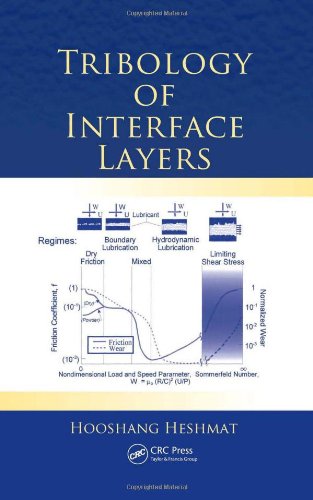
Tribology of Interface Layers 1st Edition by Hooshang Heshmat ISBN 0824758323 9780824758325


Original price was: $50.00.$35.00Current price is: $35.00.
Tribology of Interface Layers 1st Edition by Hooshang Heshmat – Ebook PDF Instant Download/Delivery: 0824758323, 9780824758325
Full download Tribology of Interface Layers 1st Edition after payment
Product details:
ISBN 10: 0824758323
ISBN 13: 9780824758325
Author: Hooshang Heshmat
To this point, the field of lubrication has been conceptualized using several noncontiguous modes of operation- boundary, fluid-film, and dry and solid lubrication. Engineers and analysts have long had to deal with old evidence that many tribological devices, such as flat surface and centrally pivoted sliders, can act as viable bearings- contradict
Tribology of Interface Layers 1st Table of contents:
Chapter 1 Historical Perspective
1.1 Prehistory to the Renaissance (5000 BC-1450 AD)
1.2 The Renaissance (1450-1600)
1.3 The Preindustrial and Industrial Eras (1600-1850)
1.3.1 The Preindustrial Era (1600-1750)
1.3.2 Industrial Revolution (1750-1850)
1.4 The Scientific Era (1850-1925)
1.4.1 The Formulation of a Lubricant Film
1.4.2 Lubricants and Materials
1.5 The Space Age (1945-2000)
1.5.1 Lubricant Additives
1.5.2 Process and Synthetic Fluids
1.5.3 Bearing Materials
1.5.4 The Lubricant Film
1.5.5 Materials
References
Chapter 2 The Rheology of Interface Layers
2.1 General Considerations
2.1.1 Classification
2.1.2 Stability Problems
2.2 Newtonian Fluids
2.2.1 Standard Conditions
2.2.2 Extreme Environments
2.3 Viscoelastic Substances
2.3.1 Shear-Thinning Fluids
2.3.2 Additives
2.3.3 Polymers
2.3.3.1 The Constitutive Equations
2.3.3.2 The Rheological Properties
2.3.4 Greases
2.3.4.1 Composition of Greases
2.3.4.2 The Rheology of Greases
2.4 Two-Phase Systems
2.4.1 Colloids and Slurries
2.4.1.1 Theoretical Expressions
2.4.1.2 Experimental Results
2.4.2 Bio-Rheodynamics
2.5 Powder Films
2.5.1 Characteristics of Triboparticulates
2.5.2 Rheological Properties
2.5.2.1 Bulk Density and Solids Fraction
2.5.2.2 Viscosity
2.5.2.3 Stress-Strain Relationship
2.5.2.4 Candidate Powder Materials
References
Chapter 3 The Phenomenology of Lubrication
3.1 Contradictions to Hydrodynamic Theory
3.1.1 Parallel Plate Sliders
3.1.2 Centrally Pivoted Pads
3.1.3 Mixed Lubrication
3.2 Triboparticulates as Lubricants
3.3 General Observations
References
Chapter 4 Direct Contact-Hydrodynamic Continuum
4.1 Dry Friction and Wear
4.1.1 Tests with a Spherical Pin
4.1.2 Tests with a Rotating Ring
4.2 Coatings and Dry Lubricants
4.2.1 General Nature of Coatings
4.2.2 Kinds and Characteristics of Coatings
4.3 Boundary Lubrication
4.3.1 The Nature of Boundary Lubrication
4.3.2 Experimental Results
4.3.3 Theoretical Analyses
4.4 Elastohydrodynamic Lubrication (EHL)
4.4.1 Results for Full EHL
4.4.2 Results for Partial EHL
4.5 Continuum Aspects
References
Chapter 5 Hydrodynamic-Solid Films Continuum
5.1 Hydrodynamic Films
5.1.1 Incompressible Lubrication
5.1.1.1 Basic Equations
5.1.1.2 Boundary Conditions
5.1.2 Compressible Lubrication
5.1.2.1 Rigid Surfaces
5.1.3 Compliant Surface Foil Bearings (CSFB)
5.2 Rheodynamic Lubricants
5.2.1 Greases
5.2.1.1 Rheology of Greases
5.2.1.2 Grease-Lubricated (Rheodynamic) Bearings
5.2.2 Slurries
5.2.2.1 Viscosity of Slurries
5.3 Triboparticulate Layers
5.3.1 Powder Morphology
5.3.2 Tribological Wear
5.3.3 Powder as a Lubricant
5.3.3.1 Tests A
5.3.3.2 Tests B
5.3.3.3 Tests C
5.4 Granular Flow Layers
5.5 Continuum Aspects
References
Chapter 6 Experimental Performance of Powder Layers
6.1 The Morphology of Powders
6.1.1 Particle Size
6.1.2 Particle Shape
6.1.3 Triboparticulates
6.2 Thermodynamic Properties
6.2.1 Density
6.3 Rheological Characteristics
6.3.1 Effective Viscosity
6.3.2 Stress-Strain Relationship
6.3.2.1 Shear Stress versus Shear Strain
6.3.2.2 Shear Stress Rate versus Strain Rate
6.3.2.3 The Yield and Limiting Shear Stresses (τo and τℓ
6.3.3 Traction
6.3.3.1 Results for the NiO Powder
6.3.3.2 Results for the TiO2
6.3.3.3 Tests with ZnMoO2S2 Powder
6.3.3.4 Dry Contact and Lubricated Tests
6.3.3.5 Summary of Results
6.4 Powder Flow and Velocity
6.5 Tribological Qualities of Powders
6.5.1 Shear and Damping Characteristics
6.5.2 Pelletized Powder Lubricants
References
Chapter 7 Powder-Lubricated Devices
7.1 Sliders
7.1.1 Dry and Boundary-Lubrication Runs
7.1.2 Full Film (Flooded) Powder Lubrication
7.1.3 Effect of (B/L) Ratio
7.2 Journal Bearings
7.2.1 Three-Pad Bearing with MoS2 Powder
7.2.2 Three-Pad Bearings with WS2 Powder
7.2.3 Five-Pad Bearing with MoS2
7.3 Dampers
7.4 Piston Rings
References
Chapter 8 Theory of Powder Lubrication
8.1 Analysis
8.1.1 Basic Equations
8.1.2 Method of Solution
8.2 Slider Bearings
8.2.1 Solutions for No-Slip Conditions
8.2.2 Solutions with Slip at the Boundaries
8.3 Crowned Sliders
References
Chapter 9 Granular Films
9.1 Continuum Approach
9.1.1 Analysis
9.1.1.1 Granular Viscosity
9.1.1.2 Thermal Diffusivity Coefficient
9.1.1.3 Collisional Energy Sink
9.1.2 Experimental Results
9.1.3 Couette Flow
9.1.4 Slider Bearings
9.1.4.1 Results for Benchmark Slider
9.1.4.2 Parametric Variations
9.2 Discrete Particles Approach
9.2.1 Governing Relations
9.2.2 Parallel Plates
9.2.3 Sliders
References
Chapter 10 The Tribological Continuum
10.1 Historical Overview
10.2 Overlapping Tribological Regimes
10.3 The Tribological Continuum
10.3.1 General Concept
10.3.2 The Continuum Curve
References
People also search for Tribology of Interface Layers 1st:
tribology of interface layers
what is the interface between the 2 layers called
interface in layer
a layer of tissue
interface biogeography
Tags: Hooshang Heshmat, Tribology, Interface