
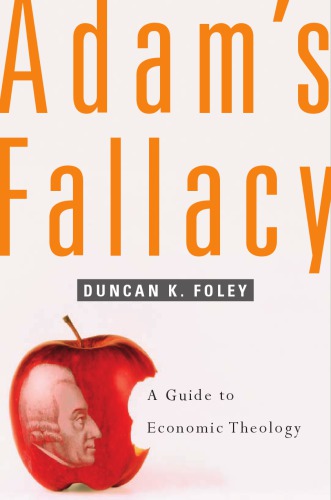
Adam s fallacy a guide to economic theology First Harvard University Press Paperback 1st Edition by Duncan Foley ISBN 0674023099 978-0674023093


Original price was: $50.00.$35.00Current price is: $35.00.
Adam s fallacy a guide to economic theology First Harvard University Press Paperback 1st Edition by Duncan K. Foley- Ebook PDF Instant Download/Delivery: 0674023099, 978-0674023093
Full download Adam s fallacy a guide to economic theology First Harvard University Press Paperback 1st Edition after payment
Product details:
ISBN 10: 0674023099
ISBN 13: 978-0674023093
Author: Duncan K. Foley
This book could be called “The Intelligent Person’s Guide to Economics.” Like Robert Heilbroner’s The Worldly Philosophers, it attempts to explain the core ideas of the great economists, beginning with Adam Smith and ending with Joseph Schumpeter. In between are chapters on Thomas Malthus, David Ricardo, Karl Marx, the marginalists, John Maynard Keynes, Friedrich Hayek, and Thorstein Veblen. The title expresses Duncan Foley’s belief that economics at its most abstract and interesting level is a speculative philosophical discourse, not a deductive or inductive science. Adam’s fallacy is the attempt to separate the economic sphere of life, in which the pursuit of self-interest is led by the invisible hand of the market to a socially beneficial outcome, from the rest of social life, in which the pursuit of self-interest is morally problematic and has to be weighed against other ends.
Smith and his successors argued that the market and the division of labor that is fostered by it result in tremendous gains in productivity, which lead to a higher standard of living. Yet the market does not address the problem of distribution—that is, how is the gain in wealth to be divided among the classes and members of society? Nor does it address such problems as the long-run well-being of the planet.
Adam’s Fallacy is beautifully written and contains interesting observations and insights on almost every page. It will engage the reader’s thoughts and feelings on the deepest level.
Table of contents:
-
Adam’s Vision
-
The Division of Labor
-
The Theory of Value
-
Capital Accumulation
-
The Invisible Hand and the State
-
Smith’s Theory of Money
-
Adam’s Fallacy Revisited
-
-
Gloomy Science
-
Second Thoughts
-
Malthus and Population
-
The Context of Malthus’s Essay
-
Malthus’s Postulates
-
Malthusian Logic
-
Population and Food since Malthus’s Time
-
Ricardo and the Limits to Growth
-
Ricardo’s Labor Theory of Value
-
Accumulation and the Stationary State
-
Ricardo’s Views on Machinery
-
The Political Economy of Poverty
-
-
The Severest Critic
-
Historical Materialism
-
The Commodity and the Theory of Value
-
Capitalist Exploitation
-
Accumulation and the Falling Rate of Profit
-
Primitive Accumulation
-
The Transition to Socialism
-
Marx and Proletarian Revolution
-
Marxist Theory and Social Change
-
-
On the Margins
-
Adam’s Fallacy Needs New Shoes
-
Marginalism
-
Where Do Prices Come From?
-
Marginalism and Social Welfare
-
Marginalism and Time
-
Veblen and Conspicuous Consumption
-
-
Voices in the Air
-
John Maynard Keynes
-
World Capitalism in Keynes’s Time
-
Say’s Law and Laissez-Faire
-
Labor Markets and Unemployment
-
Expectations and Money
-
The Fate of Capitalism
-
Complexity vs. Collectivism
-
The Prophet of Technology
-
-
Grand Illusions
-
Looking in the Mirror
-
Two-Armed Economists
-
Escaping Adam’s Fallacy
-
Face to Face with Adam’s Curse
-
Reading Further
-
People also search for:
adam’s fallacy a guide to economic theology summary
adam smith’s argument for the free market
identify the fallacious arguments economics quizlet
identify the fallacious arguments quizlet
adam’s fallacy review