
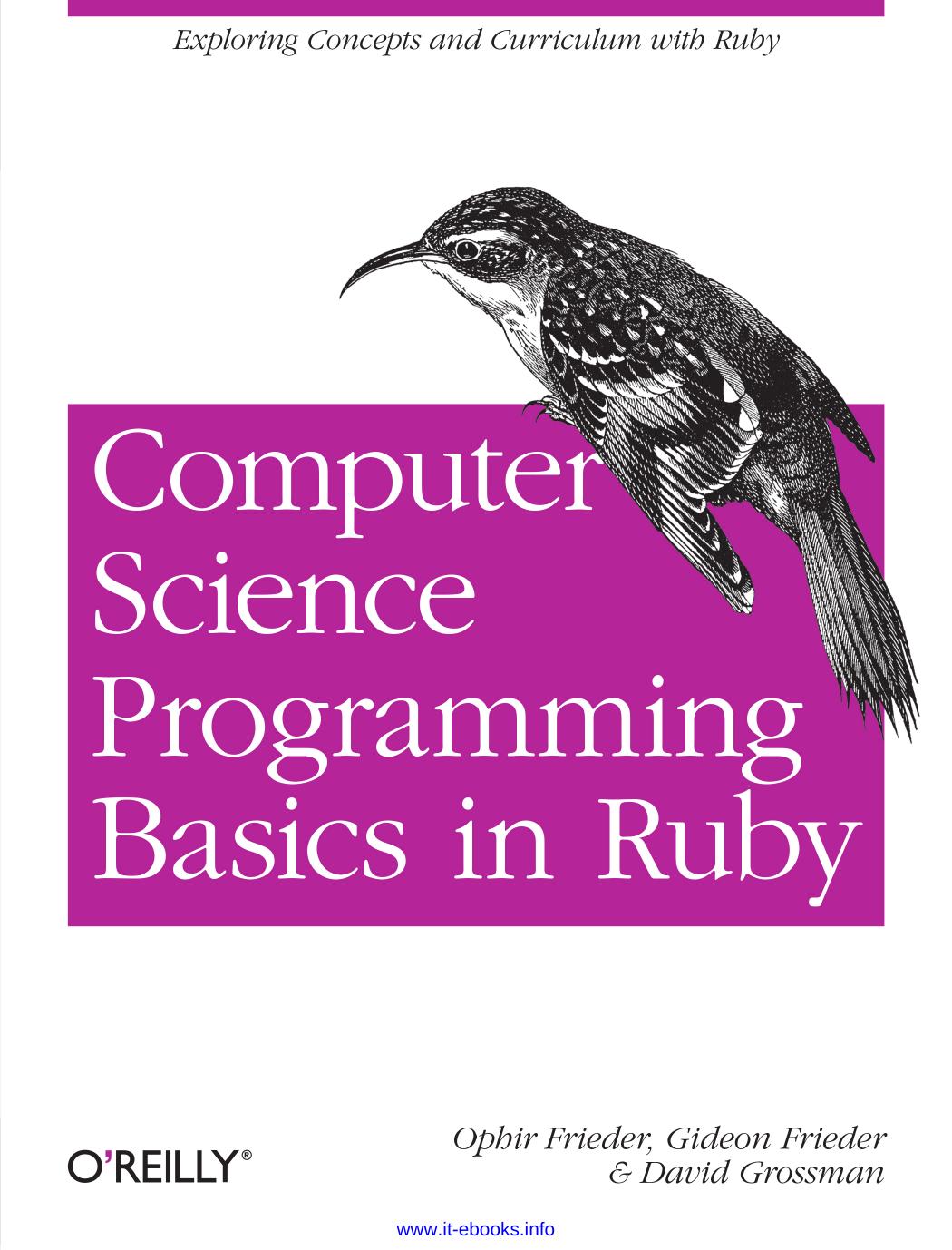
Computer Science Programming Basics in Ruby 1st Edition by Ophir Frieder, Gideon Frieder, David Grossman 1449355978 9781449355975
Original price was: $50.00.$35.00Current price is: $35.00.
Computer Science Programming Basics in Ruby 1st Edition by Ophir Frieder, Gideon Frieder, David Grossman – Ebook PDF Instant Download/Delivery: 1449355978, 978-1449355975
Full dowload Computer Science Programming Basics in Ruby 1st Edition after payment
Product details:
ISBN 10: 1449355978
ISBN 13: 978-1449355975
Author: Ophir Frieder, Gideon Frieder, David Grossman
If you know basic high-school math, you can quickly learn and apply the core concepts of computer science with this concise, hands-on book. Led by a team of experts, you’ll quickly understand the difference between computer science and computer programming, and you’ll learn how algorithms help you solve computing problems.
Each chapter builds on material introduced earlier in the book, so you can master one core building block before moving on to the next. You’ll explore fundamental topics such as loops, arrays, objects, and classes, using the easy-to-learn Ruby programming language. Then you’ll put everything together in the last chapter by programming a simple game of tic-tac-toe.
- Learn how to write algorithms to solve real-world problems
- Understand the basics of computer architecture
- Examine the basic tools of a programming language
- Explore sequential, conditional, and loop programming structures
- Understand how the array data structure organizes storage
- Use searching techniques and comparison-based sorting algorithms
- Learn about objects, including how to build your own
- Discover how objects can be created from other objects
- Manipulate files and use their data in your software
Computer Science Programming Basics in Ruby 1st Table of contents:
1. Introduction to Computer Science
1.1 Introduction
1.2 Application Development
- Step 1: Understand the Problem
- Step 2: Write Out the Solution in Plain Language
- Step 3: Translate the Language into Code
- Step 4: Test the Code in the Computer
1.3 Algorithms
1.3.1 Algorithm Efficiency
1.4 Summary
1.4.1 Key Concepts
1.4.2 Key Definitions
1.5 Exercises
2. How Does the Computer Really Work?
2.1 Introduction
2.2 Basic Nomenclature and Components of a Computer System
2.3 Scales of Magnitude
2.4 Instruction Execution—Speed and Timing Scales
2.5 Bit Strings and Their Meaning
2.6 The Interpreter Process and Ruby
2.7 Summary
2.7.1 Key Concepts
2.7.2 Key Definitions
2.8 Exercises
3. Core Programming Elements
3.1 Introduction
3.2 Getting Started
- How to Install Ruby
- How to Save Programs
3.3 What Is a Variable? - Constants: Variables That Never Change
- Data Types
- Integer
- Float
- Strings
- Booleans
3.4 Basic Arithmetic Operators
3.5 Input and Output
- Output Using Variables
- Display User Input
- Basic Programs
- Step 1: Understanding the Problem
- Step 2: Write Out the Problem in Plain Language
- Step 3: Rewrite the Plain Language into Code
- Step 4: Test the Code in the Computer
3.6 Common Programming Errors
- Syntax Errors
- Logic Errors
3.7 Mixing Data Types
3.8 Summary
3.8.1 Key Concepts
3.8.2 Key Definitions
3.9 Exercises
4. Conditional Structures
4.1 Introduction
4.2 Flow of Execution
- Logic Flow
4.3 Conditional Control - Control Flow
4.4 If-Then-Else Statements - Testing Conditional Flow
- Elsif Statements
4.5 Case Statements
4.6 Debugging
4.6.1 Alternative Styles of Debugging
4.7 Summary
4.7.1 Key Concepts
4.7.2 Key Definitions
4.8 Exercises
5. Loop Structures
5.1 Introduction
5.2 While Loops
5.3 Until Loops
5.4 For Loops and Nested Loops
- For Loops
- Nested Loops
5.5 Infinite Loops
5.6 Example: Finding Prime Numbers
5.7 Summary
5.7.1 Key Concepts
5.7.2 Key Definitions
5.8 Exercises
6. Arrays
6.1 Introduction
6.2 Array Types
- 6.2.1 One-Dimensional Arrays
- Example: Find the Max
- 6.2.2 Multidimensional Arrays
- Example: Find the Max—Modified
6.3 Hashes
- Example: Find the Max—Modified
- Example: Hash
- Example: Accessing a Hash
- Example: Find the Max—Hash
6.4 Summary
6.4.1 Key Concepts
6.4.2 Key Definitions
6.5 Exercises
7. Sorting and Searching
7.1 Introduction
- 7.1.1 Selection Sort
- 7.1.2 Insertion Sort
- 7.1.3 Bubble Sort
- 7.1.4 Radix Sort
7.2 Complexity Analysis
7.3 Searching - 7.3.1 Linear Search
- 7.3.2 Binary Search
7.4 Summary
7.4.1 Key Concepts
7.4.2 Key Definitions
7.5 Exercises
8. Using Objects
8.1 Introduction
8.2 Objects and Built-in Objects
- 8.2.1 Objects
- 8.2.2 Built-in Objects
- 8.2.3 Parameter Passing
8.3 Summary
8.3.1 Key Concepts
8.3.2 Key Definitions
8.4 Exercises
9. Defining Classes and Creating Objects
9.1 Introduction
9.2 Instantiating Objects from Classes
9.3 Data and Methods
- 9.3.1 Grouping Data and Methods
- 9.3.2 Implementing Methods
9.4 Summary
9.4.1 Key Concepts
9.4.2 Key Definitions
9.5 Exercises
10. Object Inheritance
10.1 Introduction
10.2 Inheritance
10.3 Basic Method Overriding
10.4 Accessing the Superclass
10.5 Applications
- 10.5.1 Person Database
- 10.5.2 Grocery Store
- 10.5.3 Video Games
10.6 Summary
10.6.1 Key Concepts
10.6.2 Key Definitions
10.7 Exercises
11. File Input/Output
11.1 Introduction
11.2 File Access: Reading and Writing
- 11.2.1 File Reader Class
- 11.2.2 FileWriter Class
- 11.2.3 File Reader/Writer Example
11.3 Summary
11.3.1 Key Concepts
11.3.2 Key Definitions
11.4 Exercises
12. Putting It All Together: Tic-Tac-Toe
12.1 Introduction
12.2 Programming Approach
12.3 Tic-Tac-Toe
12.4 Tic-Tac-Toe Revised
12.5 Summary
12.6 Exercises
People also search for Computer Science Programming Basics in Ruby 1st:
programming basics crash course computer science #12
computer science basics programming languages
what are the basics to learn computer science
introduction to programming and computer science – full course
a programmer’s guide to computer science pdf
Tags:
Ophir Frieder,Gideon Frieder,David Grossman,Computer,Science,Programming,Basics,Ruby 1st