
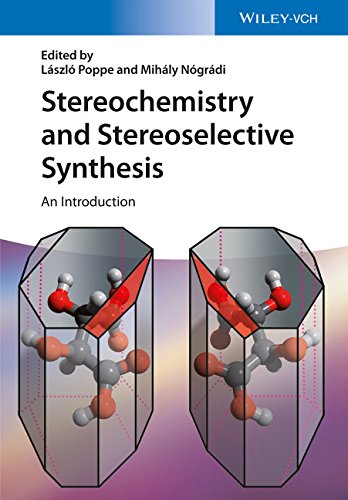
(Ebook PDF) Stereochemistry and Stereoselective Synthesis an Introduction 1st Edition by Mihaly Nogradi, Laszlo Poppe, Jozsef Nagy, Gabor Hornyanszky, Zoltan Boros 3527339019 9783527339013 Full chapter

Original price was: $50.00.$35.00Current price is: $35.00.
Stereochemistry and Stereoselective Synthesis an Introduction 1st Edition by Mihály Nógrádi, László Poppe, József Nagy, Gábor Hornyánszky, Zoltán Boros – Ebook PDF Instant Download/Delivery: 3527339019, 978-3527339013
Full dowload Stereochemistry and Stereoselective Synthesis an Introduction 1st Edition after payment
Product details:
ISBN 10: 3527339019
ISBN 13: 978-3527339013
Author: Mihály Nógrádi, László Poppe, József Nagy, Gábor Hornyánszky, Zoltán Boros
Written by a well-respected and experienced author, this textbook fills the gap for a concise introduction to the key concepts of organic stereochemistry and the most important classical and modern methods in stereoselective synthesis.
The concepts are extensively illustrated in color, with practical examples and question-answer sets to help consolidate the reader’s knowledge. In addition, animations are available from the Wiley website.
A must-have for students in chemistry, biochemistry, and life sciences, as well as researchers in pharmaceutical and agrochemical companies in need of a quick introduction to the field.
Stereochemistry and Stereoselective Synthesis an Introduction 1st Table of contents:
Part I: Basic Concepts at the Molecular Level
Chapter 1: Structure and Properties
- The Covalent Bond and the Octet Rule
- Representation of Chemical Structures
- Description of Chemical Structure
- Problems of Correlating Chemical Structure with Properties
- References
Chapter 2: Concepts of Stereochemistry
-
Elements and Groups of Symmetry
-
Classification of the Basic Concepts of Stereochemistry
-
Stereodescriptors
-
Prostereogenic Elements, Prochirality
-
References
-
Problems to Chapters 1 and 2
Part II: Properties at the Level of Material Assemblies
Chapter 3: Timescale, Conformational Changes
- Conformational Motion of Ethane and Its Optical Inactivity
- Conformations and Optical Inactivity of n-Butane and 1,2-Dichloroethane
- Biphenyl and Substituted Biphenyls, Atropisomerism
- References
Chapter 4: Absolute Configuration
- Methods to Determine Absolute Configuration
- Strategies to Determine Absolute Configuration by Chemical Correlation
- References
Chapter 5: Methods for the Determination of Enantiomeric Composition
- Chiroptical Methods
- NMR Methods Based on Diastereotopicity
- Chromatographic and Related Methods Based on Diastereomeric Interactions
- Kinetic Methods Based on Enantiomer Selectivity
- Fusion Methods
- Methods Based on Isotope Dilution
- Potentiometric Methods
- References
Chapter 6: Tautomerism
-
Types of Tautomerism
-
Prototropy
-
Methods for Studying Tautomerism
-
Nitrogen Inversion
-
References
-
Problems to Part II
Part III: General Characteristics of Stereoselective Reactions
Chapter 7: Types and Classification of Selectivities
- Main Types of Selectivity
- Classification of Selectivities
- References
Chapter 8: Stereoselective and Stereospecific Reactions
-
Stereospecificity
-
Stereoselectivity
-
Selective Syntheses of Enantiomers
-
Diastereomer Selectivity
-
Diastereotope Selectivity
-
Enantiomer Selectivity
-
Enantiotope Selectivity
-
Combination of More Than One Type of Selectivity
-
References
-
Problems to Part III
Part IV: Applications of Enantioselective Methods
Chapter 9: Stoichiometric Methods of Enantioselective Synthesis
- Diastereotope Selective Methods
- Enantiotope Selective Methods
Chapter 10: Catalytic Methods of Enantioselective Synthesis
- Chemical Catalysis
- Biocatalysis
People also search for Stereochemistry and Stereoselective Synthesis an Introduction 1st:
what is stereoselective synthesis
stereochemistry of natural products
why stereochemistry is important
history of stereochemistry
stereoselective alkene synthesis by the horner-emmons reaction
Tags:
Mihaly Nogradi,Laszlo Poppe,Jozsef Nagy,Gabor Hornyanszky,Zoltan Boros,Stereochemistry,Stereoselective,Synthesis,Introduction 1st