
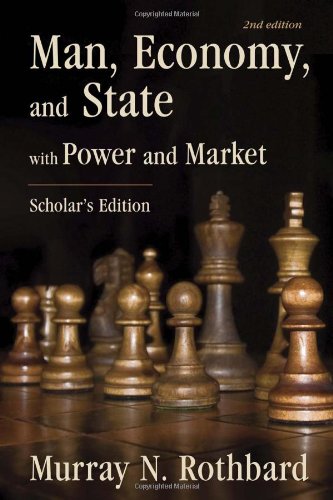
Man Economy and State with Power and Market Scholars 1st Edition by Murray Rothbard ISBN 978-1933550275 1933550279


Original price was: $50.00.$35.00Current price is: $35.00.
Man Economy and State with Power and Market Scholars 1st Edition by Murray N. Rothbard- Ebook PDF Instant Download/Delivery: 978-1933550275, 1933550279
Full download Man Economy and State with Power and Market Scholars 1st Edition after payment
Product details:
ISBN 10: 1933550279
ISBN 13: 978-1933550275
Author: Murray N. Rothbard
New Edition, with new introduction!
Murray N. Rothbard’s great treatise Man, Economy, and State and its complementary text Power and Market, are here combined into a single edition as they were written to be. It provides a sweeping presentation of Austrian economic theory, a reconstruction of many aspects of that theory, a rigorous criticism of alternative schools, and an inspiring look at a science of liberty that concerns nearly everything and should concern everyone.
The Mises Institute’s new edition of Man Economy, and State, united with its formerly sundered companion volume Power and Market, is a landmark in the history of the Institute. It takes this book out of the category of underground classic and raises it up to its proper status as one of the great economic treatises of all time, a book that is essential for anyone seeking a robust economic education.
This new edition will take your breath away with its beauty and quality. It’s remarkable that a book this thick could lay so flat and be so durable with super-solid binding. It somehow turns out not to be unweildy. Get it with the Study Guide and you will have what you need.
The captivating new introduction by Professor Joseph Salerno that frames up the Rothbardian contribution in a completely new way, and reassesses the place of this book in the history of economic thought. In Salerno’s view, Rothbard was not attempting to write a distinctively “Austrian” book but rather a comprehensive treatise on economics that eschewed the Keynesian and positivist corruptions. This is what accounts for its extraordinarily logical structure and depth. That it would later be called Austrian is only due to the long-lasting nature of the corruptions of economics that Rothbard tried to correct.
For years, the Mises Institute has kept it in print and sold thousands of copies in a nice paperback version. Then we decided to take a big step and put out an edition worthy of this great treatise. It is the Scholar’s Edition of Man, Economy, and State -an edition that immediately became definitive and used throughout the world. The footnotes (which are so brilliant and informative!) are at the bottom of every page. The index is huge and comprehensive. The binding is impeccable and its beauty unmatched.
Students have used this book for decades as the intellectual foil for what they have been required to learning from conventional economics classes. In many ways, it has built the Austrian school in the generation that followed Mises. It was Rothbard who polished the Austrian contribution to theory and wove it together with a full-scale philosophy of political ethics that inspired the generation of the Austrian revival, and continues to fuel its growth and development today.
From Rothbard, we learn that economics is the science that deals with the rise and fall of civilization, the advancement and retrenchment of human development, the feeding and healing of the multitudes, and the question of whether human affairs are dominated by cooperation or violence.
Economics in Rothbard’s wonderful book emerges as the beautiful logic of that underlies human action in a world of scarcity, the lens on how exchange makes it possible for people to cooperate toward their mutual betterment. We see how money facilitates this, and allows for calculation over time that permits capital to expand and investment to take place. We see how entrepreneurship, based on real judgments and risk taking, is the driving force of the market.
What’s striking is how this remarkable book has lived in the shadows for so long. It began as a guide to Human Action, and it swelled into a treatise in its own right.
Table of contents:
CHAPTER 1-FUNDAMENTALS OF HUMAN ACTION
1. The Concept of Action.
2. First Implications of the Concept
3. Further Implications: The Means
4. Further Implications: Time
5. Further Implications.
A. Ends and Values.
B. The Law of Marginal Utility.
6. Factors of Production: The Law of Returns.
7. Factors of Production: Convertibility and Valuation
8. Factors of Production: Labor versus Leisure
9. The Formation of Capital
10. Action as an Exchange
Appendix A: Praxeology and Economics
Appendix B: On Means and Ends
CHAPTER 2-DIRECT EXCHANGE
1. Types of Interpersonal Action: Violence
2. Types of Interpersonal Action: Voluntary Exchange
and the Contractual Society
3. Exchange and the Division of Labor.
4. Terms of Exchange.
5. Determination of Price: Equilibrium Price.
6. Elasticity of Demand
7. Speculation and Supply and Demand Schedules
8. Stock and the Total Demand to Hold.
9. Continuing Markets and Changes in Price.
10. Specialization and Production of Stock.
11. Types of Exchangeable Goods
12. Property: The Appropriation of Raw Land
13. Enforcement Against Invasion of Property.
CHAPTER 3-THE PATTERN OF INDIRECT EXCHANGE
1. The Limitations of Direct Exchange
2. The Emergence of Indirect Exchange
3. Some Implications of the Emergence of Money
4. The Monetary Unit.
5. Money Income and Money Expenditures.
6. Producers’ Expenditures
7. Maximizing Income and Allocating Resources.
CHAPTER 4-PRICES AND CONSUMPTION.
1. Money Prices
2. Determination of Money Prices
3. Determination of Supply and Demand Schedules
4. The Gains of Exchange
5. The Marginal Utility of Money
A. The Consumer
B. The Money Regression.
C. Utility and Costs.
D. Planning and the Range of Choice
6. Interrelations among the Prices of
Consumers’ Goods
7. The Prices of Durable Goods and Their Services.
8. Welfare Comparisons and the Ultimate Satisfactions of the Consumer….
9. Some Fallacies Relating to Utility.
Appendix A: The Diminishing Marginal Utility of Money.
Appendix B: On Value.
CHAPTER 5-PRODUCTION: THE STRUCTURE.
1. Some Fundamental Principles of Action.
2. The Evenly Rotating Economy.
3. The Structure of Production:
A World of Specific Factors.
4. Joint Ownership of the Product by the Owners of the Factors
5. Cost..
6. Ownership of the Product by Capitalists:
Amalgamated Stages…
7. Present and Future Goods: The Pure Rate of Interest
8. Money Costs, Prices, and Alfred Marshall
9. Pricing and the Theory of Bargaining
CHAPTER 6-PRODUCTION: THE RATE OF INTEREST AND ITS DETERMINATION
1. Many Stages: The Pure Rate of Interest.
2. The Determination of the Pure Rate of Interest: The Time Market.
3. Time Preference and Individual Value Scales.
4. The Time Market and the Production Structure.
5. Time Preference, Capitalists, and Individual Money Stock
6. The Post-Income Demanders
7. The Myth of the Importance of the Producers’
Loan Market
8. The Joint-Stock Company.
9. Joint-Stock Companies and the Producers’ Loan Market
10. Forces Affecting Time Preferences
11. The Time Structure of Interest Rates.
Appendix: Schumpeter and the Zero Rate of Interest
CHAPTER 7-PRODUCTION: GENERAL PRICING OF THE FACTORS..
1. Imputation of the Discounted Marginal Value Product
2. Determination of the Discounted Marginal Value Product.
A. Discounting
B. The Marginal Physical Product.
(1) The Law of Returns
(2) Marginal Physical Product and Average
Physical Product
C. Marginal Value Product
3. The Source of Factor Incomes
4. Land and Capital Goods
5. Capitalization and Rent.
6. The Depletion of Natural Resources
Appendix A: Marginal Physical and Marginal Value Product.
Appendix B: Professor Rolph and the Discounted
Marginal Productivity Theory
CHAPTER 8-PRODUCTION: ENTREPRENEURSHIP AND CHANGE…
1. Entrepreneurial Profit and Loss
2. The Effect of Net Investment
3. Capital Values and Aggregate Profits in a Changing Economy..
4. Capital Accumulation and the Length of the
Structure of Production.
5. The Adoption of a New Technique. The Entrepreneur and Innovation
6. The Beneficiaries of Saving-Investment
7. The Progressing Economy and the Pure
Rate of Interest
8. The Entrepreneurial Component in the
Market Interest Rate
9. Risk, Uncertainty, and Insurance.
CHAPTER 9-PRODUCTION: PARTICULAR FACTOR PRICES AND PRODUCTIVE INCOMES.
1. Introduction
2. Land, Labor, and Rent..
A. Rent
B. The Nature of Labor
C. Supply of Land..
D. Supply of Labor.
E. Productivity and Marginal Productivity
F. A Note on Overt and Total Wage Rates.
G. The “Problem” of Unemployment.
3. Entrepreneurship and Income.
A. Costs to the Firm
B. Business Income.
C. Personal Consumer Service.
D. Market Calculation and Implicit Earnings
E. Vertical Integration and the Size of the Firm..
4. The Economics of Location and Spatial Relations.
5. A Note on the Fallacy of “Distribution”.
6. A Summary of the Market.
CHAPTER 10-MONOPOLY AND COMPETITION
1. The Concept of Consumers’ Sovereignty.
A. Consumers’ Sovereignty versus Individual Sovereignty.
B. Professor Hutt and Consumers’ Sovereignty
2. Cartels and Their Consequences.
A. Cartels and “Monopoly Price”.
B. Cartels, Mergers, and Corporations
C. Economics, Technology, and the
Size of the Firm
D. The Instability of the Cartel
E. Free Competition and Cartels
F. The Problem of One Big Cartel.
B. The Neoclassical Theory of Monopoly Price.
C. Consequences of Monopoly-Price Theory.
(1) The Competitive Environment
.
(2) Monopoly Profit versus Monopoly Gain to a Factor.
(3) A World of Monopoly Prices?.
(4) “Cutthroat” Competition
D. The Illusion of Monopoly Price on the
Unhampered Market.
E. Some Problems in the Theory of the Illusion
of Monopoly Price.
(1) Location Monopoly.
(2) Natural Monopoly.
4. Labor Unions
A. Restrictionist Pricing of Labor
B. Some Arguments for Unions: A Critique
(1) Indeterminacy
(2) Monopsony and Oligopsony
(3) Greater Efficiency and the “Ricardo Effect”
5. The Theory of Monopolistic or Imperfect Competition
A. Monopolistic Competitive Price
B. The Paradox of Excess Capacity
C. Chamberlin and Selling Cost.
6. Multiform Prices and Monopoly.
7. Patents and Copyrights
CHAPTER 11-MONEY AND ITS PURCHASING POWER.
1. Introduction
2. The Money Relation: The Demand for and the Supply of Money
3. Changes in the Money Relation
4. Utility of the Stock of Money
5. The Demand for Money
A. Money in the ERE and in the Market.
B. Speculative Demand..
C. Secular Influences on the Demand for Money.
D. Demand for Money Unlimited?
E. The PPM and the Rate of Interest
F. Hoarding and the Keynesian System
(1) Social Income, Expenditures,
and Unemployment
(2) “Liquidity Preference
“.
G. The Purchasing-Power and Terms-of-Trade Components in the Rate of Interest
6. The Supply of Money
A. The Stock of the Money Commodity
B. Claims to Money: The Money Warehouse
….
C. Money-Substitutes and the Supply of Money
….
D. A Note on Some Criticisms of 100-Percent Reserve
7. Gains and Losses During a Change in the Money Relation
8. The Determination of Prices: The Goods Side and the Money Side..
9. Interlocal Exchange
A. Uniformity of the Geographic Purchasing Power of Money
B. Clearing in Interlocal Exchange
10. Balances of Payments..
11. Monetary Attributes of Goods.
A. Almost Money.
B. Bills of Exchange
12. Exchange Rates of Coexisting Moneys
13. The Fallacy of the Equation of Exchange.
14. The Fallacy of Measuring and Stabilizing the PPM
A. Measurement
B. Stabilization
15. Business Fluctuations
16. Schumpeter’s Theory of Business Cycles
17. Further Fallacies of the Keynesian System.
A. Interest and Investment.
B. The “Consumption Function”.
C. The Multiplier
18. The Fallacy of the Acceleration Principle.
CHAPTER
12-THE ECONOMICS OF VIOLENT INTERVENTION IN THE MARKET
1. Introduction
2. A Typology of Intervention
3. Direct Effects of Intervention on Utility
4. Utility Ex Post: Free Market and Government.
5. Triangular Intervention: Price Control.
6. Triangular Intervention: Product Control
7. Binary Intervention: The Government Budget
8. Binary Intervention: Taxation
A. Income Taxation.
B. Attempts at Neutral Taxation.
C. Shifting and Incidence: A Tax on an Industry.
D. Shifting and Incidence: A General Sales Tax..
E. A Tax on Land Values.
F. Taxing “Excess Purchasing Power”
9. Binary Intervention: Government Expenditures
A. The “Productive Contribution” of Government Spending..
B. Subsidies and Transfer Payments.
C. Resource-Using Activities
D. The Fallacy of Government
on a “Business Basis”
E. Centers of Calculational Chaos.
F. Conflict and the Command Posts..
G. The Fallacies of “Public” Ownership
H. Social Security
I. Socialism and Central Planning
People also search for:
human action vs man economy and state
man economy and state reddit
man economy and state audiobook
man economy and state review
rothbard man economy and state