
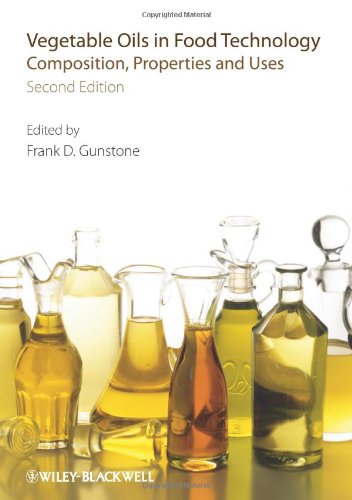
Vegetable Oils in Food Technology Composition Properties and Uses Second Edition by Frank Gunstone ISBN 978-1444339918 1444339918


Original price was: $50.00.$35.00Current price is: $35.00.
Vegetable Oils in Food Technology Composition Properties and Uses Second Edition by Frank D. Gunstone – Ebook PDF Instant Download/Delivery: 978-1444339918, 1444339918
Full download Vegetable Oils in Food Technology Composition Properties and Uses Second Edition after payment
Product details:
ISBN 10: 1444339918
ISBN 13: 978-1444339918
Author: Frank D. Gunstone
Our dietary intake comprises three macronutrients (protein, carbohydrate and lipid) and a large but unknown number of micronutrients (vitamins, minerals, antioxidants, etc). Good health rests, in part, on an adequate and balanced supply of these components. This book is concerned with the major sources of lipids and the micronutrients that they contain.
Now in an extensively updated second edition, the volume provides a source of concentrated and accessible information on the composition, properties and food applications of the vegetable oils commonly used in the food industry. Chapters are devoted to each type of oil, and an introductory chapter by the Editor provides an overview of the current production and trade picture globally. The book includes coverage of the modifications of these oils that are commercially available by means of partial hydrogenation, fractionation and seed breeding. The major food applications are linked, wherever possible, to the composition and properties of the oils.
This new edition widens the range of oils covered, addresses issues related to trans fats reduction, and new composition data is included throughout. The book is an essential resource for food scientists and technologists who use vegetable oils in food processing; chemists and technologists working in oils and fats processing; and analytical chemists and quality assurance personnel.
Praise for the first edition:
“This excellent book consists of 337 pages in 11 chapters, written by 13 experts from six countries…the important vegetable oils are dealt with in great detail. With obesity on all out lips…this book also rightly defends itself and its content – namely, that all vegetable oils, when used correctly and of course in moderation, are indeed necessary to all of us.”
–Food & Beverage Reporter
“Overall, the book covers all of the major oils which the potential reader is likely to approach it for… covers a wide range of topics from production, through composition to nutritional aspects… The volume is well indexed, particularly for the individual subject oils, and it is easy to find specific topics within its chapters.”
–Food Science and Technology
“This latest book edited by Professor Gunstone belongs to the kind of books where the reader rapidly knows it will bring him a wealth of updated information concentrated in one book. The goal to ‘serve as a rich source of data’ on the thirteen major oils and their important minor components has been attained. There is a need for books of such quality.”
–European Journal of Lipid Science and Technology
Table of contents:
1. Production and Trade of Vegetable Oils
Frank D. Gunstone
1.1 Extraction, Refining and Processing
1.2 Vegetable Oils: Production, Consumption, and Trade
1.2.1 Nine Vegetable Oils
1.2.2 Palm Oil
1.2.3 Soybean Oil
1.2.4 Rapeseed/Canola Oil
1.2.5 Sunflower Seed Oil
1.2.6 Groundnut (Peanut) Oil
1.2.7 Cottonseed Oil
1.2.8 Coconut Oil
1.2.9 Palm Kernel Oil
1.2.10 Olive Oil
1.2.11 Corn Oil
1.2.12 Sesame Oil
1.2.13 Linseed Oil
1.3 Some Topical Issues
1.3.1 Imports into China and India
1.3.2 Trade in Oilseeds and in Vegetable Oils
1.3.3 Food and Non-Food Use of Vegetable Oils
1.3.4 Prices
1.3.5 The Food–Fuel Debate
1.3.6 Predictions for Future Supply and Demand
1.3.7 Sustainability
1.3.8 Genetic Modification
References
2. Palm Oil
Siew Wai Lin
2.1 Introduction
2.2 Composition and Properties of Palm Oil and Fractions
2.2.1 Palm Oil
2.2.2 Palm Olein
2.2.3 Palm Stearin
2.3 Physical Characteristics of Palm Oil Products
2.3.1 Palm Oil
2.3.2 Palm Olein
2.3.3 Palm Stearin
2.4 Minor Components of Palm Oil Products
2.4.1 Carotenes
2.4.2 Tocopherols and Tocotrienols (Tocols)
2.4.3 Sterols, Squalene, and Other Hydrocarbons
2.5 Food Applications of Palm Oil Products
2.5.1 Cooking/Frying Oil
2.5.2 Margarines
2.5.3 Shortenings
2.5.4 Vanaspati
2.5.5 Cocoa Butter Equivalents (CBE)
2.5.6 Other Uses
2.6 Nutritional Aspects of Palm Oil
2.7 Sustainable Palm Oil
2.8 Conclusions
References
3. Soybean Oil
Tong Wang
3.1 Introduction
3.2 Composition of Soybean and Soybean Oil
3.2.1 Seed Composition
3.2.2 Oil Composition
3.2.3 Fatty Acid Composition
3.2.4 Minor Components
3.3 Recovery and Refining of Soybean Oil
3.3.1 Oil Extraction
3.3.2 Oil Refining
3.3.3 Modified Non-Alkaline Refining
3.3.4 Co-products from Oil Refining
3.3.5 Fatty Acid Esters of Glycidol and 3-Monochloro-1,2-Propanediol as Processing Contaminants
3.4 Oil Composition Modification by Processing and Biotechnology
3.4.1 Hydrogenation
3.4.2 Interesterification
3.4.3 Crystallization and Fractionation
3.4.4 Traditional Plant Breeding and Genetic Modification
3.4.5 Oxidative and Sensory Properties of Low-Linolenic Acid Soybean Oil
3.5 Physical Properties of Soybean Oil
3.5.1 Polymorphism
3.5.2 Density
3.5.3 Viscosity
3.5.4 Refractive Index
3.5.5 Specific Heat
3.5.6 Melting Point
3.5.7 Heat of Combustion
3.5.8 Smoke, Flash, and Fire Points
3.5.9 Solubility
3.5.10 Plasticity and Spreadability
3.5.11 Electrical Resistivity
3.6 Oxidation Evaluation of Soybean Oil
3.7 Nutritional Properties of Soybean Oil
3.8 Food Uses of Soybean Oil
3.8.1 Cooking and Salad Oils
3.8.2 Margarine and Shortening
3.8.3 Mayonnaise and Salad Dressing
References
4. Canola/Rapeseed Oil
Roman Przybylski
4.1 Introduction
4.2 Composition
4.2.1 Nature of Edible Oils and Fats
4.2.2 Fatty Acid Composition of Canola Oil
4.2.3 Minor Fatty Acids
4.2.4 Triacylglycerols
4.2.5 Polar Lipids
4.2.6 Tocopherols
4.2.7 Sterols
4.2.8 Pigments
4.2.9 Trace Elements
4.2.10 Commercial Crude Oil, Refined, and Deodorized Oil
4.2.11 Oxidative Stability
4.3 Physical and Chemical Properties
4.3.1 Relative Density
4.3.2 Viscosity
4.3.3 Smoke and Flash Point
4.3.4 Cold Test
4.3.5 Crismer Value
4.3.6 Saponification Number
4.3.7 Iodine Value
4.3.8 Melting Characteristics, Polymorphism, and Crystal Properties
4.4 Major Food Uses
4.4.1 Standard Canola/Rapeseed Oil
4.4.2 High-Erucic Acid Rapeseed (HEAR) Oil
4.5 Conclusion and Outlook
References
5. Sunflower Oil
Maria A. Grompone
5.1 Introduction
5.2 Sunflower Oil from Different Types of Seed
5.2.1 Regular Sunflower Seeds
5.2.2 Commercial Sunflower Oil Types
5.2.3 Composition of Commercially Available Sunflower Oil Types
5.2.4 Other Sunflower Seed Types to be Commercialised
5.3 Physical and Chemical Properties
5.3.1 Relative Density
5.3.2 Viscosity
5.3.3 Refractive Index
5.3.4 Smoke Point, Flash Point, and Fire Point
5.3.5 Other Physical Properties
5.4 Melting Properties and Thermal Behaviour
5.4.1 Melting Properties of Regular Sunflower Oil
5.4.2 Thermal Behaviour of Different Sunflower Oil Types
5.5 Extraction and Processing of Sunflower Oil
5.5.1 Preparation of Sunflower Seeds for Extraction
5.5.2 Sunflower Oil Extraction
5.5.3 Processing of Crude Sunflower Oil
5.6 Modified Properties of Sunflower Oil
5.6.1 Hydrogenation of Regular Sunflower Oil
5.6.2 Interesterification of Sunflower Oil
5.7 Oxidative Stability of Commercial Sunflower Oils
5.7.1 Inherent Stability of Different Commercial Sunflower Oil Types
5.7.2 Shelf-Life of Sunflower Oil
5.7.3 Accelerated Ageing of Sunflower Oil
5.7.4 Stabilisation of Sunflower Oil by Added Antioxidants
5.8 Food Uses of Different Sunflower Oil Types
5.8.1 Use of Regular Sunflower Oil as Salad Oil and Cooking Oil
5.8.2 Margarine and Shortening
5.9 Frying Use of Commercial Sunflower Oil Types
5.9.1 Frying Use of Regular Sunflower Oil
5.9.2 Frying Use of High-Oleic Sunflower Oil
5.9.3 Frying Use of Mid-Oleic Sunflower Oil
5.9.4 Frying Use of Sunflower Oils with a High Content of Saturated Fatty Acids
People also search for:
vegetable oils in food technology pdf
vegetable oils in food technology 2011
vegetable oils are included in the food group
what are vegetable.oils
are vegetable oils harmful
Tags: Frank Gunstone, Vegetable Oils, Food Technology, Properties and Uses