
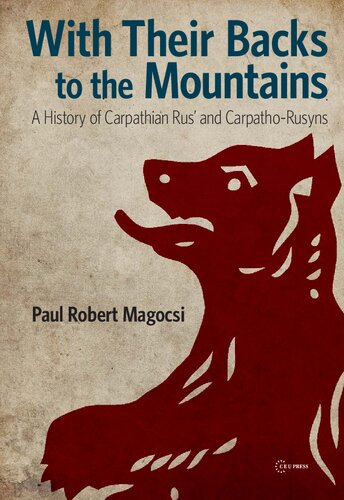
With Their Backs to the Mountains A History of Carpathian Rus and Carpatho Rusyns 1st Edition by Paul Robert Magocsi ISBN 6155053391 978-6155053399
Original price was: $50.00.$35.00Current price is: $35.00.
With Their Backs to the Mountains A History of Carpathian Rus and Carpatho Rusyns 1st Edition by Paul Robert Magocsi – Ebook PDF Instant Download/Delivery: 6155053391, 978-6155053399
Full download With Their Backs to the Mountains A History of Carpathian Rus and Carpatho Rusyns 1st Edition after payment
Product details:
ISBN 10: 6155053391
ISBN 13: 978-6155053399
Author: Paul Robert Magocsi
This is a history of a stateless people, the Carpatho-Rusyns, and their historic homeland, Carpathian Rus’, located in the heart of central Europe. A little over 100,000 Carpatho-Rusyns are registered in official censuses but their population is estimated at around 1,000,000, the greater part in Ukraine and Slovakia. The majority of the diaspora―nearly 600,000―lives in the US.
At the present, when it is fashionable to speak of nationalities as “imagined communities” created by intellectuals or elites who may live in the historic homeland, Carpatho-Rusyns provide an ideal example of a people made―or some would say still being made―before our very eyes. The book traces the evolution of Carpathian Rus’ from earliest prehistoric times to the present, and the complex manner in which a distinct Carpatho-Rusyn people, since the mid-nineteenth century, came into being, disappeared, and then re-appeared in the wake of the revolutions of 1989 and the collapse of communist rule in central and eastern Europe.
Table of contents:
1 Carpatho-Rusyns and the land of Carpathian Rus’
(pp. 1-14)
https://www.jstor.org/stable/10.7829/j.ctt19z395j.6
Carpatho-Rusyns have never had their own state, but they have for centuries inhabited a land called Carpathian Rus’, which today is found within the borders of Poland, Slovakia, Ukraine, and Romania. Carpatho-Rusyns are also found in other countries, whether in compact communities or in isolation, to which their ancestors emigrated for the most part during the past two centuries. The present-day countries with immigrant or diasporan communities are mostly in Europe: Hungary, Serbia, Croatia, and the Czech Republic; and in North America: the United States and Canada.
Being a stateless people, it is difficult to determine with any precision the…
Save
Cite
2 Carpathian Rus’ in prehistoric times
(pp. 15-22)
2 Carpathian Rus’ in prehistoric times
(pp. 15-22)
https://www.jstor.org/stable/10.7829/j.ctt19z395j.7
Much of Carpathian Rus’, in particular the lands on the southern slopes of the mountains, were in prehistoric times part of a somewhat larger territory which archeologists refer to as the Upper Tisza Region. This includes the area drained by the upper reaches of the Tisza River and its tributaries, which in modern-day terms means the Transcarpathian oblast of Ukraine, eastern Slovakia, northeastern Hungary, and northwestern Romania. Since pre-historic times the Upper Tisza Region functioned as a contact zone connecting the peoples and cultures of the Danubian Basin and Balkan Europe in the south with the inhabitants beyond the Carpathian…
Save
Cite
3 The Slavs and their arrival in the Carpathians
(pp. 23-32)
3 The Slavs and their arrival in the Carpathians
(pp. 23-32)
https://www.jstor.org/stable/10.7829/j.ctt19z395j.8
What do the Huns, a nomadic-pastoral people from central Asia, have to do with the Slavic peoples? And, what is the relationship of the Slavs to Carpathian Rus’? About the year 375 the Huns arrived in the steppes of southern Ukraine, where they dispersed the Germanic Ostrogoths living there at the time. The Huns were masterful warriors on horseback who seemed invincible against whichever sedentary and nomadic people, tribal union, and proto-state crossed their path. Fearful of the destructive fate that was likely to befall them from any military encounter with the Huns, Germanic and other tribes hoped to seek…
Save
Cite
4 State Formation in central Europe
(pp. 33-52)
4 State Formation in central Europe
(pp. 33-52)
https://www.jstor.org/stable/10.7829/j.ctt19z395j.9
The ninth and tenth centuries proved to be an important turning point in the history of central and eastern Europe. This is because during that time several state structures came into being, some of which have survived in one form or another until the present-day. For Carpathian Rus’, the most important of these new states was Hungary and Poland. But there were other states which also had a direct or indirect impact on the region: Greater Moravia, the Bulgarian Empire, Kievan Rus’, and the East Roman or Byzantine Empire.
The previous discussion of the Roman Empire (in Chapter 2) concerned…
Save
Cite
5 Carpathian Rus’ until the early 16th century
(pp. 53-72)
5 Carpathian Rus’ until the early 16th century
(pp. 53-72)
https://www.jstor.org/stable/10.7829/j.ctt19z395j.10
In order to understand developments in Carpathian Rus’ during the medieval period, it is necessary to look at the structure of the two states which came to rule the historic region: Hungary and Poland. When those states were initially formed in the late tenth century, neither had yet extended its sphere of influence to the Carpathian Mountains. That process was to take at least another century.
The initial stage of state formation was undertaken by Hungary’s first king, Stephen I (r. 1000–1038). During the first half of the eleventh century, he expanded the realm from its core in Pannonia…
Save
Cite
6 The Reformation, the Counter-Reformation, and Carpathian Rus’
(pp. 73-86)
6 The Reformation, the Counter-Reformation, and Carpathian Rus’
(pp. 73-86)
https://www.jstor.org/stable/10.7829/j.ctt19z395j.11
The sixteenth century was to bring major changes in the political structure of central Europe. This same period also witnessed profound challenges to the hegemony of the Christian churches, both Roman Catholic and Orthodox, which had dominated and formed European society since the waning decades of the Roman Empire. In short, the sixteenth and seventeenth centuries were characterized by the close interplay of politics and religion, a potent combination that often had a negative and destructive impact throughout most of the continent, including its geographic heartland, Carpathian Rus’.
With regard to secular politics, the biggest changes occurred in Hungary. In…
Save
Cite
7 The Habsburg restoration in Carpathian Rus’
(pp. 87-96)
7 The Habsburg restoration in Carpathian Rus’
(pp. 87-96)
https://www.jstor.org/stable/10.7829/j.ctt19z395j.12
The three-way conflict for control of the Kingdom of Hungary between Roman Catholic Habsburg Austria, Protestant Transylvania, and the Islamic Ottoman Empire that characterized much of the seventeenth century reached an even greater level of intensity at the outset of the eighteenth century. Some of the fiercest military encounters, especially between the Habsburg and Transylvanian armies, took place in northeastern Hungary and were focused on the monumental castle-fortress of Mukachevo.
The Rákóczis were one the most powerful magnate families in all of Hungary. The family’s various branches had holdings concentrated in the northern part of the kingdom throughout much of…
Save
Cite
8 Habsburg reforms and their impact on Carpatho-Rusyns
(pp. 97-106)
8 Habsburg reforms and their impact on Carpatho-Rusyns
(pp. 97-106)
https://www.jstor.org/stable/10.7829/j.ctt19z395j.13
In the year 1772, when all Carpatho-Rusyn-inhabited lands were within the Habsburg Empire, that state was headed by rulers who were determined to reform their realm. The dynamic and talented rulers in question were Empress Maria Theresa (r. 1740–1780) and her son Joseph II (r. 1780–1790). Since Joseph became coregent in 1765, many of the reforms after that year were actually inspired and implemented by him. For this reason their reigns, which encompassed a full half century from 1740 to 1790, have come to be known as the era of Theresian and Josephine reforms.
Both mother and son…
Save
Cite
9 The Revolution of 1848 and the Carpatho-Rusyn national awakening
(pp. 107-128)
9 The Revolution of 1848 and the Carpatho-Rusyn national awakening
(pp. 107-128)
https://www.jstor.org/stable/10.7829/j.ctt19z395j.14
The year 1848 is a major landmark in modern European history. In that year revolutions broke out throughout much of the continent, and they were particularly important as a catalyst for political and socioeconomic change in central Europe. The Austrian Empire was deeply shaken by the upheavals of 1848, so much so that it seemed at certain times it would not survive as a state. What was this empire that by the end of the eighteenth century had come to rule all of Carpathian Rus’?
In one sense, the Austrian Empire was a remnant of the Middle Ages, a time…
Save
Cite
10 Carpathian Rus’ in Austria-Hungary, 1868–1914
(pp. 129-150)
10 Carpathian Rus’ in Austria-Hungary, 1868–1914
(pp. 129-150)
https://www.jstor.org/stable/10.7829/j.ctt19z395j.15
The promising beginnings in Carpatho-Rusyn civic and cultural affairs resulting from the Revolution of 1848 were to last for only two decades. The reason that this so-called first national revival came to an end had to do with larger political changes in the 1860s, which saw the transformation of the Austrian Empire into the Austro-Hungarian Dual Monarchy. The two halves of the empire henceforth developed in increasingly different ways, and this had a direct impact on the status of Carpatho-Rusyns. Those living on the northern slopes of the mountains in the Lemko Region benefited from the relatively more tolerant policies…
Save
Cite
11 Carpatho-Rusyn diasporas before World War I
(pp. 151-166)
11 Carpatho-Rusyn diasporas before World War I
(pp. 151-166)
https://www.jstor.org/stable/10.7829/j.ctt19z395j.16
Carpatho-Rusyns were no strangers to migration, especially after the 1848 emancipation from serfdom which released peasants from their landlords. Hence, by the second half of the nineteenth century it was quite common for Carpatho-Rusyn peasant farmers in the Prešov Region and Subcarpathian Rus’ to spend six to eight weeks each year working on the lowland plains of Hungary during the harvest season. Nor was work on the Hungarian plains limited to those Carpatho-Rusyns living on the southern slopes of the mountains. Lemko Rusyns also went annually to work as harvesters in Hungary. It was common for groups of 20 to…
Save
Cite
12 Carpathian Rus’ during World War I, 1914–1918
(pp. 167-174)
12 Carpathian Rus’ during World War I, 1914–1918
(pp. 167-174)
https://www.jstor.org/stable/10.7829/j.ctt19z395j.17
August 1914 is a landmark in modern history. Although people did not realize it at the time, that fateful month witnessed a series of events that were to lead to the outbreak of war—the firstworldwar. That war was to change the face of Europe and set the stage for another conflict that two decades later would change the face of the world. Ironically, by 1914 most Europeans anticipated, and some even hoped, that war would break out. Few, if any, could have foreseen its consequences. During the next four years, most European countries, as well as the…
Save
Cite
13 The end of the old and the birth of a new order, 1918–1919
(pp. 175-190)
13 The end of the old and the birth of a new order, 1918–1919
(pp. 175-190)
https://www.jstor.org/stable/10.7829/j.ctt19z395j.18
By 1915, the second year of World War I, the conflict had reached a stalemate. The opposing armies faced each other along fronts which, despite steadily high casualties, did not move in any significant manner. Occasionally there might be an offensive surge by one side, as with the Russian advance during the summer of 1916 that brought far eastern Galicia and Bukovina once again under tsarist control, but within a few months the front lines returned more or less to where they had been before. The year 1917 did bring, however, two events of significance that were to have a…
Save
Cite
14 Subcarpathian Rus’ in interwar Czechoslovakia, 1919–1938
(pp. 191-218)
14 Subcarpathian Rus’ in interwar Czechoslovakia, 1919–1938
(pp. 191-218)
https://www.jstor.org/stable/10.7829/j.ctt19z395j.19
The postwar political order that formally came into being in the course of 1919–1920 divided historic Carpathian Rus’ among three countries: Poland, Czechoslovakia, and Romania. Of the approximately 640,000 Carpatho-Rusyns living in the European homeland at the time, 70 percent (458,000) found themselves within the borders of Czechoslovakia.
The new state of Czechoslovakia was multinational in composition, a kind of demographic mini-Habsburg Empire. Aside from the Slavic “state-founding” peoples—Czechs, Slovaks, and Carpatho-Rusyns, who comprised together 71 percent of the country’s inhabitants (1930)—there were over 3.2 million Germans living in the western “Czech” provinces of Bohemia and Moravia…
Save
Cite
15 The Prešov Region in interwar Slovakia, 1919–1938
(pp. 219-232)
15 The Prešov Region in interwar Slovakia, 1919–1938
(pp. 219-232)
https://www.jstor.org/stable/10.7829/j.ctt19z395j.20
Carpatho-Rusyns in the Prešov Region of northeastern Slovakia were, like their brethren in neighboring Subcarpathian Rus’, citizens of Czechoslovakia. But whereas in Subcarpathian Rus’ Carpatho-Rusyns in practice functioned as one of the state nationalities (as did Czechs in Bohemia and Moravia and Slovaks in Slovakia), in the Prešov Region they were a national minority. In other words, Carpatho-Rusyns in Slovakia had no political or administrative autonomy, although as a minority they were guaranteed by the Czechoslovak constitution of 1920 the right to use their native language in public affairs and in publications. Moreover, in villages where they comprised 20 percent…
Save
Cite
16 The Lemko Region in interwar Poland, 1919–1938
(pp. 233-240)
16 The Lemko Region in interwar Poland, 1919–1938
(pp. 233-240)
https://www.jstor.org/stable/10.7829/j.ctt19z395j.21
The fate of Carpatho-Rusyns in the Lemko Region was dependent throughout the interwar years on the country of which it was part—Poland. That state, in the form of the Polish-Lithuanian common republic (Rzeczpospolita), had ceased to exist following the third partition of its territory in 1795. Over a century later, Poland was reborn in the wake of World War I in the form of a second republic, which formally came into being on 11 November 1918.
The reconstructed state of Poland was intended to be a democratic republic as outlined by a liberal constitution adopted in March 1921. The…
Save
Cite
17 Carpatho-Rusyn diasporas during the interwar years, 1919–1938
(pp. 241-252)
17 Carpatho-Rusyn diasporas during the interwar years, 1919–1938
(pp. 241-252)
https://www.jstor.org/stable/10.7829/j.ctt19z395j.22
The political transformation of central Europe after World War I and the redrawing of international borders divided Carpathian Rus’. While Czechoslovakia and Poland included within its borders the largest number of Carpatho-Rusyns, others lived in what was now Romania and Hungary. Finally, farther away were diasporan Carpatho-Rusyns in the new state of Yugoslavia and beyond the ocean in North America.
The closest of these various communities, one that in fact was territorially contiguous with the rest of Carpathian Rus’, lived in Romania’s Maramureş Region. That community inhabited the southern part of the historic county of Maramorosh (Hungarian: Máramaros; Romanian: Maramureş),…
Save
Cite
18 Other peoples in Subcarpathian Rus’
(pp. 253-268)
18 Other peoples in Subcarpathian Rus’
(pp. 253-268)
https://www.jstor.org/stable/10.7829/j.ctt19z395j.23
Carpathian Rus’, like other culturally distinct historic territories in Europe, was never inhabited exclusively by one ethnolinguistic or national group. The focus here is on the only part of Carpathian Rus’ which functioned as a distinct administrative unit—Czechoslovakia’s eastern province of Subcarpathian Rus’. No less than 38 percent of the inhabitants in that region comprised a nationality other than the numerically dominant one, Carpatho-Rusyns (see Table 18.1).
Which peoples lived in Subcarpathian Rus’ during the interwar years of 1919–1938? What was their political, socioeconomic, and cultural status, and how did these “other” peoples relate to Carpatho-Rusyns, the national…
Save
Cite
19 Autonomous Subcarpathian Rus’ and Carpatho-Ukraine, 1938–1939
(pp. 269-278)
19 Autonomous Subcarpathian Rus’ and Carpatho-Ukraine, 1938–1939
(pp. 269-278)
https://www.jstor.org/stable/10.7829/j.ctt19z395j.24
Despite the procrastination and reluctance of the Czechoslovak government to fulfill its original promise of autonomous self-rule for Subcarpathian Rus’, that question did not disappear from the political agenda of local activists during the interwar years. In fact, the debate about autonomy increased in intensity during the second half of the 1930s.
The leading local political party which had promoted this issue ever since the 1920s was the Autonomist Agricultural Union headed by Andrii Brodii. It was later joined by the Russian National Autonomist party, established in 1935 and effectively headed by Shtefan Fentsyk. Both parties were supported by Rusyn-American…
Save
Cite
20 Carpathian Rus’ during World War II, 1939–1944
(pp. 279-290)
20 Carpathian Rus’ during World War II, 1939–1944
(pp. 279-290)
https://www.jstor.org/stable/10.7829/j.ctt19z395j.25
It may have taken some time, but the leaders of Britain and France who participated in the Munich Pact of September 1938 eventually realized that the territorial ambitions of Adolf Hitler were not limited to Czechoslovakia. Even his ally in fascist Italy, Benito Mussolini, was enraged at not having been consulted before Germany liquidated what remained of Czechoslovakia on 15 March 1939. Undaunted, Hitler proceeded in the following months to finalize plans for his next conquest—Poland. Poland, however, was much larger than Czechoslovakia, and its armies were poised to resist any attack. Hence, to make his task easier, Hitler…
Save
Cite
21 Carpathian Rus’ in transition, 1944–1945
(pp. 291-304)
21 Carpathian Rus’ in transition, 1944–1945
(pp. 291-304)
https://www.jstor.org/stable/10.7829/j.ctt19z395j.26
Hitler’s conquest of Ukraine and other parts of the Soviet Union, as well as his intention to expand Germany’s borders ever farther eastward depended on the ability of the German Army (Wehrmacht) to continue its success on the battlefield against the Soviet Red Army. What seemed to be German military invincibility came to an end at the outset of 1943. In February of that year, after the incredibly costly three-month Battle of Stalingrad, German forces for the first time were forced to capitulate. The tide of the war had finally turned, and from then on Soviet armies were on the…
Save
Cite
22 Subcarpathian Rus’/Transcarpathia in the Soviet Union, 1945–1991
(pp. 305-320)
22 Subcarpathian Rus’/Transcarpathia in the Soviet Union, 1945–1991
(pp. 305-320)
https://www.jstor.org/stable/10.7829/j.ctt19z395j.27
Between the years 1945 and 1991, the largest part of Carpathian Rus’, the province known as Subcarpathian Rus’, was an integral part of the Soviet Union. During the nearly half century of Soviet rule, the political, socioeconomic, and cultural life of the region, officially called the Transcarpathian oblast of the Ukrainian Soviet Socialist Republic, was profoundly transformed.
Among the first goals of the Soviet regime was to determine and secure the borders of Transcarpathia. Basically, Transcarpathia’s territory coincided with that of Subcarpathian Rus’ when it was part of Czechoslovakia before the Munich Pact of 1938. The Czechoslovak-Soviet Treaty of June…
Save
Cite
23 The Prešov Region in postwar and Communist Czechoslovakia, 1945–1989
(pp. 321-334)
23 The Prešov Region in postwar and Communist Czechoslovakia, 1945–1989
(pp. 321-334)
https://www.jstor.org/stable/10.7829/j.ctt19z395j.28
In contrast to Subcarpathian Rus’, which was spared any substantive destruction during the advance of the Soviet armies, the Prešov Region was part of the zone in which the two-month long and very costly Battle of the Dukla Pass took place. During September and October 1944, many Carpatho-Rusyns had to be evacuated, and several villages in the area north and east of Svidník were severely damaged. Despite their defeat in the Dukla Battle, it took at least two months before the German forces, with their Slovak allies, were driven out of the region. The city of Prešov itself was not…
Save
Cite
24 The Lemko Region and Lemko Rusyns in Communist Poland, 1945–1989
(pp. 335-342)
24 The Lemko Region and Lemko Rusyns in Communist Poland, 1945–1989
(pp. 335-342)
https://www.jstor.org/stable/10.7829/j.ctt19z395j.29
The Lemkos are unique among all of Europe’s Carpatho-Rusyns in that they hold the dubious and unenviable distinction of having been removed from their homes and settled permanently elsewhere. In essence, within a few years after World War II came to an end, the traditional Lemko Region—that is, lands where for centuries the dominant population and culture was Carpatho-Rusyn—ceased to exist. The reasons for this state of affairs had to do with international factors and, in particular, the policies of the state in which Lemko Rusyns once again found themselves—Poland.
As discussed above (Chapter 21), the immediate…
Save
Cite
25 Carpatho-Rusyn diasporas old and new, 1945–1989
(pp. 343-354)
25 Carpatho-Rusyn diasporas old and new, 1945–1989
(pp. 343-354)
https://www.jstor.org/stable/10.7829/j.ctt19z395j.30
The border changes and population exchanges that characterized the immediate post-World War II years created new Carpatho-Rusyn diasporas, while at the same time the political transformation in Soviet-dominated central Europe altered the status of the older diasporas. Among these new and older diasporas were Carpatho-Rusyns living in six countries: Ukraine (Galicia and Volhynia), Poland (Silesia, Lubuskie, and Pomerania), Czechoslovakia (Bohemia and Moravia), Romania (the Banat and Maramureş), Yugoslavia (the Vojvodina and Srem), and the United States. The new Carpatho-Rusyn communities found in western Ukraine and western Poland came into being as a result of events connected with the closing months…
Save
Cite
26 The revolutions of 1989
(pp. 355-362)
26 The revolutions of 1989
(pp. 355-362)
https://www.jstor.org/stable/10.7829/j.ctt19z395j.31
The year 1989 was a major turning point in the history of Carpatho-Rusyns as it was for all of the states and peoples of central and eastern Europe. For nearly half a century since the close of World War II in 1945, the entire region was under the hegemony of the Soviet Union. This meant not only direct Soviet rule in the Transcarpathian oblast of Soviet Ukraine, but also its indirect and often decisive influence in Czechoslovakia, Romania, and Hungary. Throughout the postwar decades, political influence emanating from Moscow was implemented by the ruling Communist parties in each of the…
Save
Cite
27 Post-Communist Transcarpathia—Ukraine
(pp. 363-378)
27 Post-Communist Transcarpathia—Ukraine
(pp. 363-378)
https://www.jstor.org/stable/10.7829/j.ctt19z395j.32
The referendum of 1991 and the emergence of an independent Ukraine brought hope to Carpatho-Rusyn activists in Transcarpathia/Subcarpathian Rus’ that in a future autonomous province which they were promised the nationality question would be resolved. Moreover, hopes were high that the self-governing region would more effectively be able to manage the inevitable challenges of moving from the Soviet-style state-owned and state-directed command economy to some form of a free-market economic system. The first disappointment came with the autonomy question.
In late November 1989, just one week before the 1 December referendum and Ukraine’s presidential elections, the head of the national…
Save
Cite
28 The Post-Communist Prešov Region and the Lemko Region—Slovakia and Poland
(pp. 379-392)
28 The Post-Communist Prešov Region and the Lemko Region—Slovakia and Poland
(pp. 379-392)
https://www.jstor.org/stable/10.7829/j.ctt19z395j.33
The fate of Carpatho-Rusyns in the “western half” of historic Carpathian Rus’ following the Revolutions of 1989 was dependent on the policies of the countries in which they lived: Czechoslovakia and Poland. Despite the differences between the post-Communist experience of these two countries, which in turn was to have an impact on the evolution of the movement for national emancipation and self-awareness, Carpatho-Rusyns on both sides of the Czechoslovak-Polish border were in the end to be brought closer together than they had ever been in the twentieth century, at least since the pre-World War I days of Habsburg-ruled Austria-Hungary.
The…
Save
Cite
29 Other Carpatho-Rusyn communities in the wake of the revolutions of 1989
(pp. 393-406)
29 Other Carpatho-Rusyn communities in the wake of the revolutions of 1989
(pp. 393-406)
https://www.jstor.org/stable/10.7829/j.ctt19z395j.34
The political transformation in central Europe brought about by the revolutions of 1989 made possible the emergence of newly organized Carpatho-Rusyn communities in four countries—Ukraine, the Czech Republic, Hungary, and Romania—and the reinvigoration of the older diasporan communities in the former Yugoslavia (eventually Serbia and Croatia) and in North America (Canada and the United States).
The Lemko diaspora resettled in historic eastern Galicia (Soviet Ukraine’s oblasts of L’viv, Ternopil’, and Ivano-Frankivs’k) eventually took advantage of the positive changes in the political atmosphere of the Soviet Union brought about by Mikhail Gorbachev. In May 1989, activists in L’viv formed…
Save
Cite
30 Carpathian Rus’—real or imagined?
(pp. 407-412)
30 Carpathian Rus’—real or imagined?
People also search for:
with their backs to the world
before the mountains were born stephen hill
their backs were turned
meaning of the mountains win again
back in the mountains
Tags:
Paul Robert Magocsi,Their Backs,the Mountains