
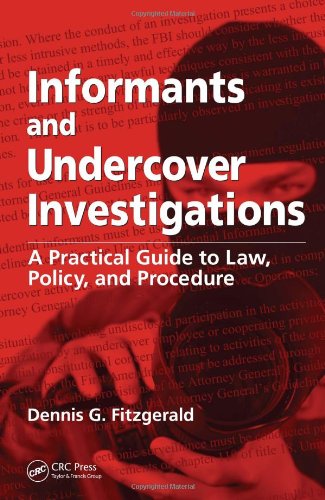
Informants and Undercover Investigations A Practical Guide to Law Policy and Procedure 1st Edition by Dennis Fitzgerald ISBN 978-0849304125 0849304121


Original price was: $50.00.$35.00Current price is: $35.00.
Informants and Undercover Investigations A Practical Guide to Law Policy and Procedure 1st Edition by Dennis G. Fitzgerald – Ebook PDF Instant Download/Delivery: 978-0849304125, 0849304121
Full download Informants and Undercover Investigations A Practical Guide to Law Policy and Procedure 1st Edition after payment
Product details:
ISBN 10: 0849304121
ISBN 13: 978-0849304125
Author: Dennis G. Fitzgerald
Informants are an invaluable, often instrumental aspect of criminal investigations, but they do present certain management issues. In the necessarily clandestine world they inhabit, the imposition of institutional control presents unique challenges. Lack of training and communication among law enforcement professionals tend to ensure the same errors are repeated time and again.
Informants and Undercover Investigations: A Practical Guide to Law, Policy, and Procedure is the most comprehensive examination of informant related issues in a single volume. Designed as a sourcebook with clear explanations of applicable laws, department policies, and time-tested procedures, each chapter addresses a distinct topic, allowing reader sto quickly locate a particular subject. Using pertinent Supreme Court, federal, and state cases; statutory law; federal, state, and local law enforcement guidelines; and field-tested training materials; this book provides relevant information to all levels of investigation from basic search warrant cases to complex criminal investigations.
The author provides the most current and verified information regarding informant motivation, including mitigated sentencing and monetary compensation; recruiting; documentation; corroboration; electronic surveillance; and the witness security program. He addresses the pitfalls and management challenges of handling an informant and recommends strategies for avoiding them. Extensively researched appendices cover the Attorney General’s guidelines for use of informants, FBI undercover operations, IRS informants, DEA policy for cooperating sources, as well as examples of local policy.
Shedding light on the shadowy world of informants and undercover investigations, this book provides law enforcement officials, legal professionals, and criminal justice training institutions a single source reference to understand and streamline the use of this indispensable yet notoriously unpredictable investigative tool.
Table of contents:
1 Informants and Sources Defined
1.1 Generally
1.2 Federal Bureau of Investigation (FBI)
1.2.1 Informants
1.2.2 Cooperative Witness
1.3 Drug Enforcement Administration (DEA)
1.3.1 Confidential Source (CS)
1.3.2 Defendant/CS
1.3.3 Restricted-Use CS
1.3.4 Source of Information
1.4 U.S. Immigration and Customs Enforcement (ICE)
1.5 Bureau of Alcohol, Tobacco, Firearms, and Explosives (BATF)
1.6 Internal Revenue Service (IRS)
1.7 U.S. Marshals Service (USMS)
1.8 Central Intelligence Agency (CIA)
1.9 State and Local Law Enforcement Agencies
References
2 Motivations to Cooperate as an Informant
2.1 Generally
2.2 Money
2.3 Fear of Punishment
2.4 Fear of Criminal Associates and Revenge
2.5 Citizen Informants
2.6 Walk-In Informants
2.7 Jailhouse Informants
2.8 Furloughed Prisoners
2.9 Repentance
2.10 Excitement
2.11 Police Buffs
2.12 The Double Agent
2.13 Unwitting Informants
2.14 Brokered Informants
References
3 Recruiting Informants
3.1 Ruby Ridge
3.2 Factors in Recruiting
3.3 Arrested Defendants
3.3.1 Deportation and Cooperation
3.4 Old Cases
3.5 “Immunity” and Compelled Testimony
3.6 Negotiated Plea Agreements
3.7 Nonprosecution Agreements
3.7.1 Prosecution after the Entry of an Immunity Order
3.7.2 Use of Immunized Testimony in a Perjury or False Statement Prosecution
3.8 Other Recruiting Strategies
4 References
Sources of Compensation for Informants
4.1 Generally
4.2 DEA Awards and Compensation to Cooperating Individuals
4.2.1 Department of Justice Asset Forfeiture Fund
4.2.2 Award Type I: 28 USC § 524(c)(1)(B)
4.2.3 Award Type II: 28 USC § 524(c)(1)(C)
4.3 Tax Responsibilities
4.4 Immigration and Customs Enforcement Awards and Compensation to Sources
4.5 Federal Bureau of Investigation
4.5.1 Citizen Cooperation
4.6 Compensation for FBI Informants and Confidential Sources
4.7 Informant Lawsuits
4.8 Trafficker Directed Funds
4.9 Whistle-Blowers
4.10 Sharing of Federally Forfeited Property with State and Local Agencies
4.10.1 Statutes Enforced by Federal Investigative Agencies That Permit Equitable Sharing with State and Local Agencies
Appendix 4A: Voucher for Purchase of Evidence/Payment for Information/Services
Appendix 4B: FBI Statistical Accomplishments Form References
5 Cooperation and Contingency Fee Agreements
5.1 Generally
5.2 Proprietary Agreements
5.3 Contingent Fee Agreements
5.4 Contingent Fee Agreements and the Courts
5.5 Fifth Circuit
5.6 Eighth Circuit
Appendix 5A: U.S. Attorney’s Proffer to Informant’s Attorney
Appendix 5B: Contract
Appendix 5C: Informant Letter Agreement
Appendix 5D: U.S. Customs Proprietary Agreement
Appendix 5E: U.S. Attorney’s Ground Rules Letter to Informant’s Attorney
Appendix 5F: Informant Agreement and Waiver
Appendix 5G: Plea and Cooperation Agreement References
6 Informant Documentation and Identification
6.1 Generally
6.2 Documentation Data Format
6.3 Informant Code Numbers and Assumed Names
6.4 Once Documented, Who “Owns” the Informant?
Appendix 6A: Source Identification Card
Appendix 6B: Confidential Source Establishment
Report DEA Form 512
Appendix 6C: FBI Request to Open Cooperative Witness File
Appendix 6D: FBI Informant Review Sheet
Appendix 6E: FBI Supervisor’s 60-Day Informant
File Review Log
References
7 Undercover Purchases of Evidence by Informants and Probable Cause
7.1 Generally
7.2 The Controlled Undercover Purchase of Evidence
7.3 Initial Informant Debriefing
7.4 Search of Informant and Vehicle
7.5 Funds Provided for the Purchase of Evidence
7.6 Observation of the CI Entering and Exiting the Location
7.7 Postbuy Informant Search
7.8 Follow-Up Informant Debriefing
7.9 Informant’s Statement
7.10 Informant Purchases
7.11 Informant Introduction of Undercover Agent
Appendix 7A: The DEA Raid Execution Process
Appendix 7B: Operational Plan Format
Appendix 7C: Evidence Fund Accounting Receipt References
8 Corroboration of Informant Information
8.1 Generally
8.2 Surveillance
8.3 Mail Covers
8.4 “Trash Runs”
8.5 Telephone Toll Records
8.6 Credit Card and Financial Records
8.7 Criminal History Record Systems
8.7.1 Federal Systems
8.7.2 State Systems
8.8 Information Obtained from Public Record Sources
8.9 Polygraph Examination of Informants
Appendix 8A: DEA Source Debriefing Guide References
9 Informants and Electronic Surveillance
9.1 Generally
9.2 Consensual Telephone Conversation Intercepts
9.2.1 Concealed Transmitters and Recording Devices
9.3 Concealed Transmitters
9.4 Tape Recorders
9.5 Establishing Consent
9.6 Video Surveillance
9.7 Use of Informants in Telephone Wiretaps 9.7.1 “Nonhuman” Informants
Appendix 9A: Customs Service Request for Authorization to Intercept Nontelephone Communications
Appendix 9B: Monitoring/Interception of Consensual Communications Report of Use
Appendix 9C: U.S. Customs Service Confirmation of Approval for Interception of Nontelephone Communications
Appendix 9D: Certification of Consent References
10 Controlling the Informant
10.1 Generally
10.2 Agents and Prosecutors
10.2.1 Pressure to Recruit Informants
10.2.2 The Prosecutor
10.3 Investigations
10.4 Governmental Liability for Torts Committed by Informants
10.5 Applicable Federal Tort Claims Act (FTCA)
10.6 Intentional Torts Exception
10.7 The Entrapment Defense
Appendix 10A: Confidential Informant Agreement
Appendix 10B: Bureau of Alcohol, Tobacco, and Firearms Informant Agreement
Appendix 10C: DOJ/DEA Cooperating Individual Agreement
Appendix 10D: Confidential Source Acknowledgment
Appendix 10E: FBI Authorization for Informant to Participate in Ordinary Criminal Activity
Appendix 10F: FBI Informant Guidelines and Instructions References
11 The Witness Security Program
11.1 Historical Overview of the U.S. Witness Security Program (WITSEC)
11.1.1 Truthful Testimony = Lifetime Protection
11.1.2 A Two-Tiered Program
11.2 Administration and Eligibility for the Witness Security Program
11.2.1 Eligibility Requirements for the Witness Security Program
11.2.2 Threat Assessment
11.2.3 Risk Assessment
11.3 Informants, Aliens, and Nonfederal Witnesses
11.3.1 Illegal Aliens
11.3.2 State and Local Witnesses
11.4 Program Participants’ Financial Obligations
11.5 Psychological Testing and Evaluation
11.6 Memorandum of Understanding
11.7 Denying Admission to the Witness Security Program
11.8 Entering the Program
11.8.1 Safe-Site and Orientation Center
11.8.2 Hiding in Plain Sight
11.9 Requests for Witness to Return to Danger Area for Court Appearances, Pretrial Conferences, and Interviews
11.10 WITSEC Participants as Informants
11.11 Ejection from the WITSEC Program
11.12 Short-Term Protection Program
11.13 The Emergency Witness Assistance Program
11.14 Witness Protection Alternatives Offered by Investigative Agencies
11.15 Criminalizing Acts Taken against Witnesses
11.16 Crimes Committed by WITSEC Participants
11.17 Liability Issues at the State and Local Levels
11.18 Prisoner-Witnesses
11.18.1 Polygraph Examinations for Prisoner-Witness Candidates
11.18.2 Utilization of Prisoners for Investigative Purposes
References
People also search for:
informants surveillance and undercover operations
undercover informants
informants in criminal investigation
an undercover informants identity is covered by
an informant
Tags: Dennis Fitzgerald, Informants and Undercover, A Practical Guide, Policy and Procedure