
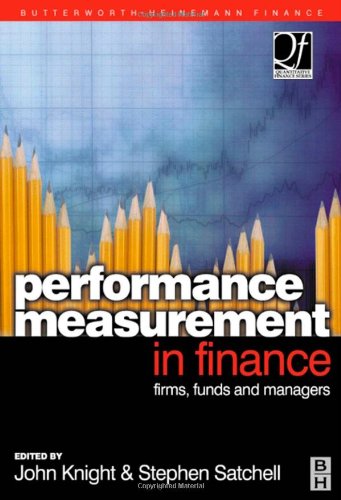
Performance Measurement in Finance 1st Edition by John Knight, Stephen Satchell ISBN 978-0080497631 0080497631

Original price was: $50.00.$35.00Current price is: $35.00.
Performance Measurement in Finance 1st Edition by John Knight, Stephen Satchell- Ebook PDF Instant Download/Delivery: 978-0080497631, 0080497631
Full download Performance Measurement in Finance 1st Edition after payment
Product details:
ISBN 10: 0080497631
ISBN 13: 978-0080497631
Author: John Knight, Stephen Satchell
Table of contents:
Chapter 1. The financial economics of performance measurement
1.2 The Sharpe ratio
1.4 The Jensen measure (1/2)
1.4 The Jensen measure (2/2)
1.5 The Treynor-Mazuy measure
1.6 Parametric and non-parametric tests of market timing abilities (1/2)
1.6 Parametric and non-parametric tests of market timing abilities (2/2)
1.7 The positive period weighting measure
1.8 Conditional performance evaluation
1.9 The 4-index model of performance evaluation
1.10 Carhart’s 4-factor model
1.11 Risk-adjusted performance
1.12 Style/risk-adjusted performance
1.13 The Sharpe style analysis
1.14 Three innovative measures that capture the different faces of a manager’s superior abilities
1.15 Dynamics of portfolio weights: passive and active management
1.16 The portfolio change measure
1.17 The momentum measures
1.18 The herding measures
1.19 Stockholdings and trades measure
1.20 Conclusion
References
Chapter 2. Performance evaluation: an econometric survey
2.2 Statistical properties of performance measures (1/3)
2.2 Statistical properties of performance measures (2/3)
2.2 Statistical properties of performance measures (3/3)
2.3 Mutual funds style
2.4 International empirical results of performance
2.5 Conclusion and future research
References
Chapter 3. Distribution of returns generated by stochastic exposure: an application to VaR calculation in the futures markets
3.1 Introduction
3.2 Distribution of performance returns
3.3 Implications for VaR calculations
3.4 Actively trading the futures markets (1/2)
3.4 Actively trading the futures markets (2/2)
3.5 Conclusion
Acknowledgements
Chapter 4. A dynamic trading approach to performance evaluation
4.2 Traditional performance measures
4.3 A new performance measure
4.4 Sampling error
4.5 Hedge funds and hedge fund returns
4.6 Evaluation of hedge fund index performance
4.7 Conclusion
References
Chapter 5. Performance benchmarks for institutional investors: measuring, monitoring and modifying investment behaviour
5.1 Introduction
5.3 What are the alternatives?
5.3 What are the alternatives?
5.4 Benchmarks based on liabilities (1/2)
5.4 Benchmarks based on liabilities (2/2)
5.5 What happens in other countries?
5.6 Conclusion
5.7 Appendix: Deriving the power function
References
Chapter 6. Simulation as a means of portfolio performance evaluation
6.1 Introduction
6.2 Objectives of simulations
6.3 Methodology
6.5 Examples of portfolio simulation (1/2)
6.5 Examples of portfolio simulation (2/2)
6.6 Applications
6.7 Summary and conclusions
Chapter 7. An analysis of performance measures using copulae
7.1 Introduction
7.2 Performance measures
7.3 Empirical results (1/3)
7.3 Empirical results (2/3)
7.3 Empirical results (3/3)
7.4 Copulae (1/3)
7.4 Copulae (2/3)
7.4 Copulae (3/3)
7.5 An aggregate performance measure
7.6 Conclusions
References
Chapter 8. A clinical analysis of a professionally managed portfolio
8.2 The portfolio
8.3 The data
8.4 The analyses (1/5)
8.4 The analyses (2/5)
8.4 The analyses (3/5)
8.4 The analyses (4/5)
8.4 The analyses (4/5)
8.4 The analyses (5/5)
8.5 Conclusions
References
Chapter 9. The intertemporal performance of investment opportunity sets
9.2 Investment opportunity sets with continuous risk structures
9.3 Measuring the performance of investment opportunity sets
9.4 Rationality restrictions on conditional return moments and GMM estimation (1/2)
9.4 Rationality restrictions on conditional return moments and GMM estimation (2/2)
9.5 Empirical analyses (1/2)
9.5 Empirical analyses (2/2)
9.6 Concluding remarks
Acknowledgements
Chapter 10. Performance measurement of portfolio risk based on orthant probabilitie
10.1 Introduction
10.2 Orthant probability description of portfolio distributions (1/2)
10.2 Orthant probability description of portfolio distributions (2/2)
10.3 Implications for absolute and relative risk
10.5 Conclusions
Acknowledgements
Chapter 11. Relative performance and herding in financial markets
11.2 A model with linear technologies (1/2)
11.2 A model with linear technologies (2/2)
11.3 A market model (1/3)
11.3 A market model (2/3)
11.3 A market model (3/3)
11.4 Extensions
11.5 Concluding remarks
11.6 Appendix (1/2)
11.6 Appendix (2/2)
References
Chapter 12. The rate-of-return formula can make a difference
12.2 Alternative methodologies to measure performance
12.3 Contrasting the methods (1/2)
12.3 Contrasting the methods (2/2)
12.4 Conclusion – summarizing the Findings
References
Chapter 13. Measurement of pension fund performance in the UK
13.2 Previous evidence on performance of managed funds
13.3 Measuring fund performance
13.4 Data
13.5 Results (1/2)
13.5 Results (2/2)
13.6 Conclusions
People also search for:
which are codes that can be used for performance measurement
supply chain performance measurement
project performance measurement
business performance measurement
international performance measurement and verification protocol
Tags: John Knight, Stephen Satchell, Performance Measurement, in Finance