
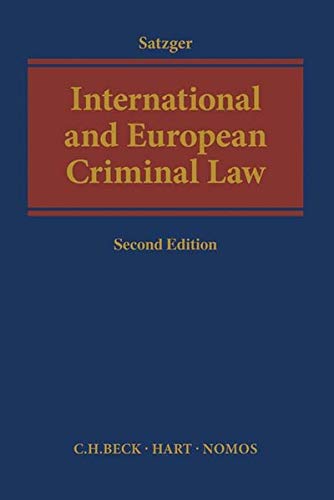
International and European Criminal Law 2nd Edition by Helmut Satzger ISBN 1509922237 978-1509922239


Original price was: $50.00.$35.00Current price is: $35.00.
International and European Criminal Law 2nd Edition by Helmut Satzger – Ebook PDF Instant Download/Delivery: 1509922237, 978-1509922239
Full download International and European Criminal Law 2nd Edition after payment
Product details:
ISBN 10: 1509922237
ISBN 13: 978-1509922239
Author: Helmut Satzger
In the wake of increasing globalisation, criminal law has become an internationalised subject. This revised and updated second edition highlights the most important aspects of European and international criminal law in order to provide the reader with a comprehensive, concise and solid introduction to this modern field of law.
The book focuses on:
– Rules determining the exercise of jurisdiction
– ‘European Criminal Law’ dealing with the question if and how far the EU may create or harmonise criminal law
– Evolution of European Criminal Procedure Law
– Ne bis in idem-principle
– Guarantees under the European Convention of Human Rights
– Principles of International Criminal Law
– Procedures and substantive law of the International Criminal Court (ICC)
Praise for the first edition:
‘… it manages to give a good overview without being unduly long. The book is most definitly worth a read even for those with more specific interests in the topics covered, and it will serve well as a textbook….’
Annika Suominen, European Criminal Law Review
‘This book is both an outstanding and demanding presentation of international criminal law and its current developments and trends caused by globalisation.’
Landeskriminalblatt Niedersachsen
Table of contents:
A. Introduction
§ 1. Criminal Law in an International Context
§ 2. Terminology of “International Criminal Law”
I. Overview
II. International Criminal Law (stricto sensu): Criminal Law under Public International Law
III. Supranational (Especially European) Criminal Law
IV. Criminal Jurisdiction and Rules Determining the Exercise of Jurisdiction
V. Mutual Legal Assistance
B. Jurisdiction and the territorial scope of Criminal Law
§ 3. The Application of National Criminal Law to Cases with International Elements
I. Criminal Jurisdiction
II. Applicable (Substantive) Criminal Law
III. Danger of Double Jeopardy
IV. Relation between the Rules Determining the Scope of Application of Criminal Law and the Material Scope of Protection of Criminal Offences
§ 4. The Principles of Criminal Jurisdiction and their Implementation in National Legal Orders
I. Competence to Determine the Territorial Scope of Application of Criminal Law
II. The Principles of Criminal Jurisdiction
1. Overview of the Principles Recognised by International Law
2. Territorial Principle
a) General considerations
b) In particular: internet criminality
c) Flag principle
d) Implementation of the territorial principle in various national legal systems
3. Nationality Principle
a) General considerations
b) Implementation of the nationality principle in various national legal orders
4. The Protective Principles
a) Protective principle (stricto sensu)
b) Passive personality principle/individual protective principle
5. The Universality Principle
a) General considerations
b) Implementation of the universality principle in various national legal orders
6. Representation Principle
a) General considerations
b) Application in various national legal orders
7. Principle of Distribution of Competences
8. Principle of Protection of European Union Interests
C. European Criminal Law
§ 5. Basic Principles and Issues of European Criminal Law
I. Meaning of the Term “European Criminal Law”
II. The Influence of European Law on Criminal Law
1. History of Primary Law Influence on Criminal Law
2. European Law-Making versus Harmonisation of Laws
§ 6. Supranational Criminal Law
I. Existing Sanctions at Union Level
1. The Different Types of European Sanctions
a) Fines
b) Other financial sanctions
c) Other detriments
2. Classification as Criminal Law in a Broader Sense
II. European Criminal Law
1. Terminology
2. First Instances of a European Criminal Law de lege lata?
3. European Competence Provisions for Adopting Criminal Law
III. Future Projects concerning “European Criminal Law”
1. Corpus Juris of criminal provisions for the protection of the financial interests of the European Communities (Corpus Juris 2000)
2. Commission Green Paper on criminal-law protection of the financial interests of the Community and the establishment of a European Prosecutor
§ 7. The Influence of European Law on Domestic Substantive Criminal Law
I. General Issues
1. Criminal Law under the Influence of European Union Law
2. Particularities of Criminal Law
II. Primary Law as a Restriction on National Criminal Law
1. European Law Serving as Upper Limit for National Criminal Law
a) Elements of a criminal offence conflicting with European law
b) Legal consequences conflicting with European law
aa) Severity of penalty
bb) Type of sanction
2. Minimum Requirements for Criminal Law set by European Law
III. Restrictions on National Criminal Law Resulting from Secondary Law –
in Particular Directives (art. 83 TFEU)
1. Overview
2. Combating Crime with a Cross-Border Dimension (art. 83 (1) TFEU)
a) Amendments in primary law concerning the former third pillar
b) Legal acts adopted prior to the entry into force of the Treaty of Lisbon
c) Prerequisites of art. 83 (1) TFEU
3. Annex Competence (Art. 83 (2) TFEU)
a) “Annex character” of the competence provision
b) Legal situation prior to the entry into force of the Treaty of Lisbon
c) The prerequisites of art. 83 (2) TFEU
4. Competence for Minimum Harmonisation
5. The “Emergency Brake” (Art. 83 (3) TFEU)
a) General idea and procedure
b) Fundamental aspects of the criminal justice system
6. Other Approximation Competences
a) Competence provisions
b) Does the “emergency brake” apply?
7. Excursus: A Concept for a European Criminal Policy
a) Background
b) The specific principles for a European criminal policy
IV. References to European Law in Domestic Criminal Law Provisions
1. Introduction
a) Rules in directives
b) Rules in regulations
2. Problems Arising from the Use of Blanket Criminal Laws Referring to EU
Regulations
a) Effect of blanket references and issues concerning their interpretation
b) Blanket laws and the lex certa requirement
aa) General requirements
bb) References to European law
cc) Cross-references in national statutory instruments
dd) The principle of lex mitior
V. The Influence of European Law on the Interpretation and Application of Domestic Substantive Criminal Law
1. Introduction
2. Neutralising Effect on Domestic Law
a) Actual conflicts with regard to the elements of a criminal offence
b) Actual conflicts with regards to legal consequences
c) Ostensible conflicts
3. Interpretation in the Light of European Law
a) Introduction
b) Interpreting criminal law in the light of European law
c) Examples
aa) Protection of EU legal interests
bb) Defining legal terms in criminal law provisions pursuant to European
laws
cc) Crimes of negligence
dd) Sentencing
4. Relevance of Framework Decisions
§ 8. Criminal Law Enforcement in Europe
I. Institutions of Law Enforcement Within the EU
1. Europol
2. Eurojust
3. The European Anti-Fraud Office (OLAF)
4. The Project of a European Public Prosecutor’s Office
II. The Judicial Cooperation in Criminal Matters on the Basis of the Principle of Mutual Recognition
1. The Principle
2. Legislative Acts on the Basis of the Principle of Mutual Recognition
a) The European arrest warrant
aa) The Framework Decision
bb) The implementation of the Framework Decision within the Member States
b) European supervision order
c) Mutual judicial assistance concerning evidence; the European evidence warrant in particular
d) Enforcement of penalties
3. The Codification of the Principle of Mutual Recognition in Art. 82 TFEU
a) Scope of application
b) Distinction from approximation measures pursuant to art. 82 (2) TFEU ….
4. The Exchange of Information and the “Principle of Availability” in Particular
III. Approximation of Criminal Procedural Law
1. Fields of Application
a) Mutual admissibility of evidence between Member States (lit. a)
b) The rights of individuals in criminal procedure (lit. b)
c) The rights of victims of a crime (lit. c)
d) Other specific aspects of criminal procedure (lit. d)
2. “Emergency Brake” (Art. 82 (3) TFEU)
IV. None bis in idem
1. Merely Internal Effect of “ne bis in idem” as the General Rule
2. Sanctions in Multiple Member States Based on the Same Facts
a) Necessity for and concept of a European “ne bis in idem” principle
b) The relationship between art. 54 CISA and art. 50 CFR
c) Elements and uniform application of art. 54 CISA
aa) “Decision finally disposing of the trial”
bb) “the same acts”
cc) Enforcement element
§ 9. The European Convention on Human Rights
I. Council of Europe
1. The International Organisation
2. The Council of Europe’s Role in Criminal Law
II. European Convention on Human Rights
1. The ECHR in Different Legal Systems
a) The principle of “minimum standard”
b) Significance for domestic law
c) Significance of the Convention for EU Law
aa) The EU’s accession to the ECHR
bb) The Charter of Fundamental Rights
cc) The relationship between ECtHR and ECJ
2. The Interpretation of the ECHR
3. Guarantees Relating to Criminal Law
a) Overview
aa) Subsidiary protection through the ECtHR
bb) Scope of application
b) Testing ECHR rights related to criminal law
c) Right to life art. 2 ECHR
d) Prohibition of torture (and degrading punishment) – art. 3 ECHR
aa) Scope of protection and unexceptional prohibition of torture
bb) Threat of torture
cc) Medical interventions
dd) Deportation and extradition
e) Right to liberty – art. 5 ECHR
f) Right to a fair trial arts 6 (1) and (5) ECHR
aa) Scope of protection
bb) The court and the court proceeding
cc) Fair trial
g) Presumption of innocence art. 6 (2) ECHR
h) No punishment without law – art. 7 ECHR
aa) Scope of protection
bb) The necessity for clarity and definiteness
cc) Prohibition of analogies
dd) Prohibition of ex post facto laws
i) Right to respect for private and family life art. 8 ECHR
j) Right to appeal in criminal matters – art. 2 (1) Additional Protocol No. 7
k) None to in idem
4. Procedural Law and Organs of the ECHR
a) The ECtHR and its role as an organ
b) Individual applications and inter-state cases
c) Judgment
d) Effect
D. International Criminal Law
§ 10. General Introduction to International Criminal Law
I. Definition of International Criminal Law
II. The Enforcement of International Criminal Law
III. International Criminal Law and the Law of State Responsibility
IV. “Treaty Crimes”
§ 11. History of International Criminal Law
I. Development until 1919
II. Versailles and the Leipzig War Crime Trials
1. The Versailles Treaty
2. The Leipzig War Crime Trials
III. The Military Tribunal in Nuremberg.
1. Structure of the International Military Tribunal (IMT)
a) Jurisdiction
b) Composition of the Tribunal
2. Procedural Law
3. Judgment
4. Criticism Concerning the Nuremberg Trials
5. Summary
IV. The International Military Tribunal for the Far East (IMTFE)
V. “Cold War”-Era
VI. International Criminal Tribunal for the Former Yugoslavia (ICTY)
1. Structure of the Tribunal
a) Jurisdiction
b) Composition of the Tribunal
c) Sanctions
2. Overview of the Criminal Offences Applied by the ICTY
3. Legitimacy of the Tribunal
VII. The International Criminal Tribunal for Rwanda (ICTR)
VIII. Hybrid Courts
§ 12. The International Criminal Court (ICC)
I. Structure of the Statute
II. Function of the ICC
III. Jurisdiction
1. Jurisdiction by reason of person
2. Jurisdiction by reason of the matter
3. Jurisdiction ratione loci/”genuine link”
4. Jurisdiction by reason of time
IV. Trigger Mechanisms for the Court’s Activities
1. State Complaint
2. Independent Investigations by the Prosecutor
3. Resolution of the UN Security Council
V. Principle of Complementarity
VI. Institutional Aspects
1. The Judges
2. The Registry
3. The Prosecutor
4. Financing
VII. Procedures
1. Preliminary Investigation
2. Confirmation Hearing
3. Trial
4. Appeal and Revision
5. Victims’ Rights
6. Summary
VIII. Sanctions and their Enforcement
IX. Limitation and Finality
X. Evaluation in Terms of Legal Policy
§ 13. The General Part of International Criminal Law
I. Applicable Law
1. General Sources of International Law
2. Particular Sources of International Criminal Law
II. Rules of Interpretation and the Principle of “nullam crime, nulla poena sine lege”
1. Interpretation of International Law in General
2. Interpretation of International Criminal Law
III. Individual Criminal Responsibility
IV. The Structure of an International Criminal Law Offence
1. The General Material Elements of International Crimes
2. The General Mental Elements of International Crimes
3. Grounds for Excluding Criminal Responsibility
a) Self-defence
b) Necessity
c) Superior orders
d) Mistake
e) Mental incapacity
f) Immunities
g) Statute of limitations
h) Unwritten grounds for excluding criminal responsibility
V. Forms of Participation (Perpetration and Accessoryship)
1. Perpetration
a) Direct perpetration
b) Co-perpetration
c) “Joint Criminal Enterprise” as extension of co-perpetration?
d) Indirect perpetration
2. Accessoryship
a) Inducement
b) Assistance
c) Assistance in a group crime
VI. Superior Responsibility
VII. Attempt and Abandonment of the Attempt
VIII. Omission
§ 14. Special Part of International Criminal Law
I. Genocide
1. History
2. Protected interests
3. Structure of the Crime
4. The Material Elements of Genocide in General
5. The Mental Elements of Genocide in General
6. Individual Genocidal Acts
a) Killing members of the group
b) Causing serious bodily or mental harm to members of the group
c) Deliberately inflicting on the group conditions of life calculated to bring about its physical destruction in whole or in part
d) Imposing measures intended to prevent births within the group
e) Forcibly transferring children of the group to another group
II. Crimes against Humanity
1. History
2. Protected Interests
3. Structure of the Crime
4. Material Elements of the “Chapeau”
5. Mental Elements in Respect of the “Chapeau”
6. Individual Acts
a) Murder
b) Extermination
c) Enslavement
d) Deportation or forcible transfer of population
e) Imprisonment or other severe deprivation of physical liberty in violation of fundamental rules of international law
f) Torture
g) Sexual violence
h) Persecution
i) Enforced disappearance of persons
j) Apartheid
k) Other inhuman acts of a similar character
III. War Crimes
1. History
2. Protected Interests
3. Elements of the Offence
4. Objective Requirements of an Armed Conflict
5. Subjective Requirement of an Armed Conflict
6. Categories of the Individual Acts
a) Material and mental elements
b) Category 1 of offences committed in connection with an international armed conflict: Grave breaches of the Geneva Conventions of 12th August, 1949 (art. 8 (2) (a) ICCSt)
c) Category 2 of offences committed in connection with an international armed conflict: Other serious violations of the laws and customs applicable in international armed conflict (art. 8 (2) (b) ICCSt)
d) Category 1 of offences committed in connection with a non-international armed conflict: serious violations of art. 3 common to the four Geneva Conventions of 12th August, 1949 (art. 8 (2)
(c) ICCSt)
e) Category 2 of offences committed in connection with a non-international armed conflict: Other serious violations of the laws and customs applicable in armed conflicts not of an international character (art. 8 (2) (e) ICCSt) ..
IV. Aggression
1. The Crime of Aggression under Customary International Law
2. The Crime of Aggression in the ICC-Statute
a) Elements of the criminal offence
b) Jurisdiction/trigger mechanism
c) Coming into force
d) Conclusion
§ 15. The Implementation of the ICC-Statute into National Law The German Solution in Particular
I. Introduction
1. Direct Application of Customary International Law
2. Explicit References to Customary International Law
3. Static Reference to the Rome Statute
4. The Ordinary National Crime Solution
5. The Specific National Crime Solution
II. The German Incorporation Solution as a Model
1. National Legislation in Relation to the ICC
2. Legislative Motivation
3. Deficits of German Criminal Law before the Entry-into-Force of the VStGB..
4. No Direct Effect of the Crimes of International Law in the German Jurisdiction
5. No Direct Applicability of the Statute’s Offences as Incorporated by the ICC-Statute-Act
III. The Content of the Code of Crimes against International Law
IV. The Conflict between the Principle of Complementarity and the GG
1. The VStGB Falling Behind the ICC-Statute
a) General Part of the VStGB
b) The Special Part of the VStGB
2. Conflicts with the Principle of Legality according to Art. 103 II GG
a) Uncertain elements of offences
b) References to customary international law
c) References to treaty law
V. Unlimited Principle of Universality Extending the Traditional Rules on the Scope of Application of German Criminal Law
VI. Conclusion
Index
People also search for:
satzger international and european criminal law
essential texts on international and european criminal law
helmut satzger international and european criminal law
international and european criminal law ulb
international european and transnational criminal law