
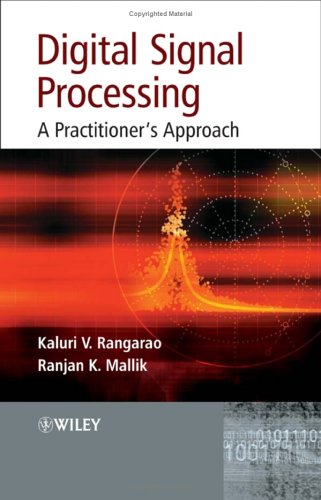
Digital Signal Processing A Practitioner s Approach 1st Edition by Kaluri Rangarao, Ranjan Mallik ISBN 978-0470338728 0470338728


Original price was: $50.00.$35.00Current price is: $35.00.
Digital Signal Processing A Practitioner s Approach 1st Edition by Kaluri V. Rangarao, Ranjan K. Mallik – Ebook PDF Instant Download/Delivery: 978-0470338728, 0470338728
Full download Digital Signal Processing A Practitioner s Approach 1st Edition after payment
Product details:
ISBN 10: 0470338728
ISBN 13: 978-0470338728
Author: Kaluri V. Rangarao, Ranjan K. Mallik
Digital signal processing is essential for improving the accuracy and reliability of a range of engineering systems, including communications, networking, and audio and video applications. Using a combination of programming and mathematical techniques, it clarifies, or standardizes the levels or states of a signal, in order to meet the demands of designing high performance digital hardware.
Written by authors with a wealth of practical experience working with digital signal processing, this text is an excellent step-by-step guide for practitioners and researchers needing to understand and quickly implement the technology. Split into six, self-contained chapters, Digital Signal Processing: A Practitioner’s Approach covers:
- basic principles of signal processing such as linearity, stability, convolution, time and frequency domains, and noise;
- descriptions of digital filters and their realization, including fixed point implementation, pipelining, and field programmable gate array (FGPA) implementation;
- Fourier transforms, especially discrete (DFT), and fast Fourier transforms (FFT);
- case studies demonstrating difference equations, direction of arrival (DoA), and electronic rotating elements, and MATLAB programs to accompany each chapter.
A valuable reference for engineers developing digital signal processing applications, this book is also a useful resource for electrical and computer engineering graduates taking courses in signal processing.
Table of contents:
1. Processing of Signals
1.1 Organisation of the Book
1.2 Classification of Signals
1.2.1 Spectral Domain
1.2.2 Random Signals
1.2.3 Periodic Signals
1.3 Transformations
1.3.1 Laplace and Fourier Transforms
1.3.2 The z-Transform and the Discrete Fourier Transform
1.3.3 An Interesting Note
1.4 Signal Characterisation
1.4.1 Non-parametric Spectrum or Fourier Spectrum
1.4.2 Parametric Representation
1.5 Converting Analogue Signals to Digital
1.5.1 Windowing
1.5.2 Sampling
1.5.3 Quantisation
1.5.4 Noise Power
1.6 Signal Seen by the Computing Engine
1.6.1 Mitigating the Problems
1.6.2 Anatomy of a Converter
1.6.3 The Need for Normalised Frequency
1.6.4 Care before Sampling
1.7 It Is Only Numbers
1.7.1 Numerical Methods
1.8 Summary
References
2. Revisiting the Basics
2.1 Linearity
2.1.1 Linear Systems
2.1.2 Sinusoidal Inputs
2.1.3 Stability
2.1.4 Shift Invariance
2.1.5 Impulse Response
2.1.6 Decomposing hₖ
2.2 Linear System Representation
2.2.1 Continuous to Discrete
2.2.2 Nomenclature
2.2.3 Difference Equations
2.2.4 Transfer Function
2.2.5 Pole–Zero Representation
2.2.6 Continuous to Discrete Domain
2.2.7 State Space Representation
2.2.8 Solution of Linear Difference Equations
2.3 Random Variables
2.3.1 Functions of a Random Variable
2.3.2 Reliability of Systems
2.4 Noise
2.4.1 Noise Generation
2.4.2 Fourier Transform and pdf of Noise
2.5 Propagation of Noise in Linear Systems
2.5.1 Linear System Driven by Arbitrary Noise
2.6 Multivariate Functions
2.6.1 Vectors of More Than Two Dimensions
2.6.2 Functions of Several Variables
2.6.3 System of Equations
2.7 Number Systems
2.7.1 Representation of Numbers
2.7.2 Fixed-Point Numbers
2.7.3 Floating-Point Numbers
2.8 Summary
References
3. Digital Filters
3.1 How to Specify a Filter
3.2 Moving-Average Filters
3.2.1 Area under a Curve
3.2.2 Mean of a Given Sequence
3.2.3 Mean over a Fixed Number of Samples
3.2.4 Linear Phase Filters
3.2.5 MA Filter with Complex Coefficients
3.3 Infinite Sequence Generation
3.3.1 Digital Counter
3.3.2 Noise Sequence
3.3.3 Numerically Controlled Oscillator
3.4 Unity-Gain Narrowband Filter
3.5 All-Pass Filter
3.5.1 Interpolation of Data Using an APF
3.5.2 Delay Estimation Using an APF
3.6 Notch Filter
3.6.1 Overview
3.7 Other Autoregressive Filters
3.8 Adaptive Filters
3.8.1 Varying r
3.8.2 Varying p
3.8.3 Criteria
3.8.4 Adaptation
3.9 Demodulating via Adaptive Filters
3.9.1 Demodulation Method
3.9.2 Step Size
3.9.3 Performance
3.10 Phase Shift via Adaptive Filter
3.11 Inverse Problems
3.11.1 Model Order Problem
3.11.2 Estimating Filter Coefficients
3.11.3 Target Tracking as an Inverse Problem
3.12 Kalman Filter
3.12.1 Estimating the Rate
3.12.2 Fitting a Sine Curve
3.12.3 Sampling in Space
3.13 Summary
References
4. Fourier Transform and Signal Spectrum
4.1 Heterodyne Spectrum Analyser
4.1.1 Spectrum Analyser
4.2 Discrete Fourier Transform
4.3 Decimating the Given Sequence
4.3.1 Sliding DFT
4.4 Fast Fourier Transform
4.4.1 Windowing Effect
4.4.2 Frequency Resolution
4.4.3 Decimation in Time
4.4.4 Decimation in Frequency
4.4.5 Computing Effort Estimate
4.5 Fourier Series Coefficients
4.5.1 Fourier Coefficients
4.6 Convolution by DFT
4.6.1 Circular Convolution
4.7 DFT in Real Time
4.7.1 Vehicle Classification
4.7.2 Instrument Classification
4.8 Frequency Estimation via DFT
4.8.1 Problem Definition
4.8.2 DFT Solution
4.9 Parametric Spectrum in RF Systems
4.9.1 Test Data Generation
4.9.2 Estimating the Parameter Vector
4.10 Summary
References
5. Realisation of Digital Filters
5.1 Evolution
5.2 Development Process
5.3 Analogue-to-Digital Converters
5.3.1 Successive Approximation Method
5.3.2 Flash Converters
5.3.3 Sigma–Delta Converters
5.3.4 Synchro-to-Digital Converters
5.4 Second-Order BPF
5.4.1 Fixed-Point Implementation
5.5 Pipelining Filters
5.5.1 Modelling Hardware Multipliers and Adders
5.5.2 Pipelining FIR Filters
5.5.3 Pipelining IIR Filters
5.5.4 Stability Issues
5.6 Real-Time Applications
5.6.1 Comparison of DSP Processors
5.7 Frequency Estimator on the DSP5630X
5.7.1 Modified Response Error Method
5.7.2 Algorithm to Code
5.8 FPGA Implementation of a Kalman Filter
5.8.1 Fixed-Point Implementation
5.9 Summary
References
6. Case Studies
6.1 Difference Equation to Program
6.2 Estimating Direction of Arrival
6.3 Electronic Rotating Elements
6.3.1 Problem Formulation
6.3.2 Finding the DoA
6.3.3 Straight-Line Fit
6.4 Summary
People also search for:
digital signal processing training
a digital signal processing primer pdf
a digital signal processing primer
digital signal processing for beginners
best digital signal processing course
Tags: Kaluri Rangarao, Ranjan Mallik, Digital Signal, A Practitioner s Approach