
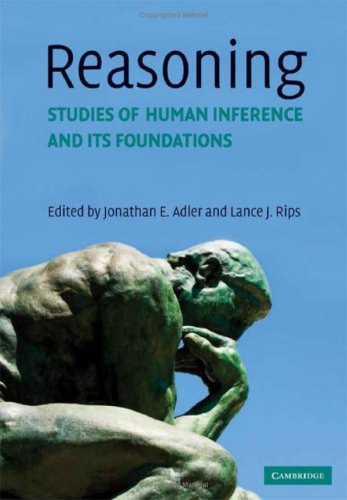
Reasoning Studies of Human Inference and its Foundations 1st Edition by Jonathan Adler , Brooklyn College, City University of New York Lance Rips , Northwestern University, Illinois ISBN 9780521612746 0521612746
Original price was: $50.00.$35.00Current price is: $35.00.
Reasoning Studies of Human Inference and its Foundations 1st Edition by Jonathan E. Adler , Brooklyn College, City University of New York Lance J. Rips , Northwestern University, Illinois – Ebook PDF Instant Download/Delivery: 9780521612746, 0521612746
Full download Reasoning Studies of Human Inference and its Foundations 1st Edition after payment
Product details:
ISBN 10: 0521612746
ISBN 13: 9780521612746
Author: Jonathan E. Adler , Brooklyn College, City University of New York Lance J. Rips , Northwestern University, Illinois
This interdisciplinary work is a collection of major essays on reasoning: deductive, inductive, abductive, belief revision, defeasible (non-monotonic), cross cultural, conversational, and argumentative. They are each oriented toward contemporary empirical studies. The book focuses on foundational issues, including paradoxes, fallacies, and debates about the nature of rationality, the traditional modes of reasoning, as well as counterfactual and causal reasoning. It also includes chapters on the interface between reasoning and other forms of thought. In general, this last set of essays represents growth points in reasoning research, drawing connections to pragmatics, cross-cultural studies, emotion and evolution.
Includes an introductory overview of the foundations of reasoning which provides a survey to readers encountering the topic for the first time
Includes key new contributions from major figures in the field as well as original work giving breadth and depth of coverage
Covers new sub-fields not previously documented and identifies where new research is likely to appear
Table of contents:
Part I. Foundations of Reasoning: Section 1. Some Philosophical Viewpoints:
1. Change in view: principles of reasoning
2. Belief and the will
3. Internal and external reasons
4. Paradoxes
Section 2. Fallacies and Rationality:
5. When rationality fails
6. Extensional versus intuitive reasoning: the conjunction fallacy in probability judgment
7. Can human irrationality be experimentally demonstrated?
8. Breakdown of will
Part II. Modes of Reasoning: Section 3. Deductive Reasoning:
9. Logical approaches to human deductive reasoning
10. Mental modes and deductive reasoning
11. Interpretation, representation, and deductive reasoning
12. Reasoning with quantifiers
13. The problem of deduction
Section 4. Induction:
14. Patterns, rules, and inferences
15. Inductive logic and inductive reasoning
16. Reasoning in conceptual spaces
17. Category-based induction
18. When explanations compete: the role of explanatory coherence on judgments of likelihood
19. Properties of inductive reasoning
Section 5. Dual and Integrative Approaches:
20. Human reasoning and argumentation: the probabalistic approach
21. Individual differences in reasoning and the algorithmic/intentional level distinction in cognitive science
22. Reasoning, decision making, and rationality
Section 6. Abduction and Belief Change:
23. Defeasible reasoning
24. Explanatory coherence
25. Belief revision
26. Belief, doubt, and evidentialism
27. Reflections on conscious reflection: mechanisms of impairment by reasons analysis
28. Belief change as propositional update
Section 7. Causal and Counterfactual Reasoning:
29. Causal thinking
30. Causation
31. Propensities and counterfactuals: the loser that almost won
Section 8. Argumentation:
32. The layout of arguments
33. The skills of argument
34. Reasoning and conversation
Part III. Interactions of Reasoning in Human Thought: Section 9. Reasoning and Pragmatics:
35. Specificationism
36. Presupposition, attention, and why-questions
37. Further notes on logic and conversation
38. The social context of reasoning: conversational inference and rational judgment
Section 10. Domain-Specific, Goal-Based, and Evolutionary Approaches:
39. Domain-specific knowledge and conceptual change
40. Pragmatic reasoning schemas
41. Beyond intuition and instinct blindness: toward an evolutionarily rigorous cognitive science
42. Use or misuse of the selection task? Rejoinder to Fiddick, Cosmides, and Tooby
43. Why we are so good at catching cheaters
44. The modularity of mind: an essay on faculty psychology
45. Commitment Brian Skyrms
46. Evolution of inference
Section 11. Reasoning across Cultures:
47. Reasoning across cultures
48. Culture and systems of thought: holistic versus analytic cognition
49. On the very idea of a conceptual scheme
50. The truth in relativism
Section 12. Biology, Emotions, and Reasoning:
51. Logic and biology: emotional inference and emotions in reasoning
52. Distinct brain loci in deductive versus probabilistic reasoning
53. The emotional dog and its rational tail: a social intuitionist approach to moral judgment
People also search for:
reasoning studies of human inference
inference vs reasoning
human reasoning meaning
human reasoning examples
human inference strategies and shortcomings of social judgment
Tags: JonathanAdler, Brooklyn College, City University of New York Lance Rips, Northwestern University, Illinois, Reasoning Studies, Human Inference