
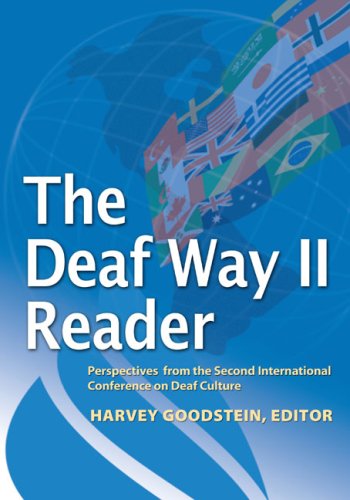
The Deaf Way II Reader Perspectives from the Second International Conference on Deaf Culture No 2 1st Edition by Harvey Goodstein ISBN 978-1563682940 156368294X


Original price was: $50.00.$35.00Current price is: $35.00.
The Deaf Way II Reader Perspectives from the Second International Conference on Deaf Culture No 2 1st Edition by Harvey Goodstein- Ebook PDF Instant Download/Delivery: 978-1563682940, 156368294X
Full download The Deaf Way II Reader Perspectives from the Second International Conference on Deaf Culture No 2 1st Edition after payment
Product details:
ISBN 10: 156368294X
ISBN 13: 978-1563682940
Author: Harvey Goodstein
This extraordinary volume features the very best of the scholarship presented at the Deaf Way II, the second international Deaf gathering in 2002 in Washington, DC. More than 100 contributors from countries as far afield as Brazil, Cyprus, Denmark, Great Britain, Greece, Iran, Ireland, Israel, Japan, Nigeria, Russia, South Africa, Spain, and Thailand share their research on a broad spectrum of disciplines joined together by the common Deaf experience.
The Deaf Way II Reader addresses every facet of the human condition from a Deaf World perspective in 65 unique studies, including all plenary addresses. Editor Harvey Goostein has organized these articles in 12 parts: Advocacy and Community Development; Economics; Education; Family; Health and Mental Health; History; Language and Culture; Literature; Recreation, Leisure, and Sports; Sign Language and Interpreting; Technology; and Youth. Each treatise examines one aspect of the deaf experience within a particular community or country. Together, they reveal how deaf people throughout the world live, study, work, and play, as well as how they relate to their families and the dominant hearing societies in which most of them reside. The Deaf Way II Reader provides a fascinating compendium of current knowledge that can, in the words of Deaf Way II host I. King Jordan, “help make the world a better place for deaf people.”
Table of contents:
PART ONE: Advocacy and Community Development
Changing the World—Together – Benjamin Soukup
Our Inalienable Rights: Global Realization of the Human Rights of Deaf People – Liisa Kauppinen
Are Deaf People in Developing Countries Advocating on a Political Level? A South African Perspective – Wilma Newhoudt-Druchen
World Deaf Leadership Project Enhances Deaf Empowerment in Thailand – Peoungpaka Janyawong
Communication, Sign Language, Culture, and Education as Human Rights – Yukata Osugi
Hands across the Pacific: Partnerships for Progress – Jan Fried, Nancy Bridenbaugh, and Linda Lambrecht
Partnership in the Irish Deaf Community – Kevin Stanley
Deaf Empowerment in Greece – Vassili Kourbetis and Kostas Gargalis
A Model in Accessing the Community for Deaf-Blind Adults – Maricar Marquez and Ilissa Rubinberg
Improving Development Assistance from American Organizations to Deaf Communities in Developing Countries – Amy Wilson
PART TWO: Economics
How We Can Better the Lives of Deaf People in Developing Countries through Business Investment – Adebowale Ogunjirin
Successful Entrepreneurship in Third World Countries – Alok Kumar Kejriwal
Successful Strategies for Deaf Business Professionals – Emilia Chukwuma, Ronald Sutcliffe, Jim MacFadden, Yuri Maximenko, David Barber, and Bernard Brown
PART TWO: Economics (tiếp theo)
A Comparative Investigation of Entrepreneurship among Deaf Populations in Developed and Developing Countries
Tác giả: Isaac O. Agboola
PART THREE: Education
Deaf Education: Whose “Way” Is It?
Tác giả: Laurene Simms
Signs of Literacy: Naturalistic Inquiry into ASL/English Bilingualism at Home and at School
Tác giả: Carol J. Erting, Cynthia Neese Bailes, Lynne C. Erting, Carlene Thumann-Prezioso, and Marlon Kuntze
Deafness and the Pedagogy of Difference
Tác giả: Gladis Perlin
American Sign Language Curriculum for First-Language ASL Students
Tác giả: Heather Gibson
Asian Deaf Perspectives on Deaf Education
Tác giả: Cynthia J. Plue
Academic Writing of Deaf Students in Higher Education: Processing and Improving
Tác giả: Krister Schönström
PART FOUR: Family
Deaf Couples and Adoption
Tác giả: Rune Anda
The Psychological Support Offered to “New Parents” of Deaf and Hard of Hearing Children in Cyprus
Tác giả: Kika Hadjikakou
The Missing Link in Literacy Development—A Parent’s Perspective
Tác giả: Nayantra Kanaye
The Silent Garden: Reaching Out to Your Deaf Children
Tác giả: Paul W. Ogden
Deaf Parents with Teenage Children
Tác giả: Paul Preston
Deaf Parents with Hearing Children: A CODA Symposium
Tác giả: Thomas H. Bull, Elizabeth Beldon, and Bert Pickell
PART FIVE: Health and Mental Health
Mental Health and Deafness Go Global
Tác giả: Barbara Brauer
Mental Health Services in the Philippines: A Deaf Perspective
Tác giả: Maria Tanya L. De Guzman
Cancer Awareness Project: Deaf Cancer Wise
Tác giả: Carly Munro
AIDS and Deaf People: Health Service Delivery and Prevention for Deaf People by Deaf People
Tác giả: Julie Elaine Roy and Michel Turgeon
Reconstructing Deafness: A Solution-Focused Approach to Mental Health
Tác giả: Sue E. Quellette
PART SIX: History
DEAF WAY II
Russian Deaf Towns — Elena Silianova
Iranian Deaf Culture — Abbas All Behmanesh
Our Civil Rights Movements: A Guide for All — Kelby Brick
Houses out of Sand: Building a Deaf Community in Israel — Meir Etedgi
The Status of Deaf People in Developing Countries — Raphael Domingo
PART SEVEN: Language and Culture
The Domino Effect: Changing Values = Changing Language = New Styles of Training — Clark Denmark and Frances Elton
How Is Asian Deaf Culture Different from American Deaf Culture? — Steven Chough and Kristina Dobyns
Sign Language Use among Indigenous Populations — Jeffrey E. Davis
Onomatopoeia in British Sign Language? or, The Visuality/Sensation of Sound — David Fowler and Mark Heaton
What Is Deafhood and Why Is It Important? — Paddy Ladd
Deaf View Image Art: A Manifesto Revisited — Betty Miller, Deborah Sonnenstrahl, Alex Wilhite, and Paul Johnston
PART EIGHT: Literature
Crossing the Divide: Helen Keller and Yvonne Pitrois Dialogue about Vaudeville — Rachel M. Hartig
The Poetics and Politics of Deaf American Literature — Cynthia Peters
ASL Literacy in Early Childhood: ASL Poetry — Robyn Sandford
Conceptual “Rhymes” in Sign Language Poetry — Sarah Taub
PART NINE: Recreation, Leisure, and Sport
The Role of Deaf Sport in Developing and Maintaining Deaf Identity in Great Britain — Jordan Eickman
Deaf Women and Sports in Nigeria: Problems and Prospects — Anthonia Ngozika Euzouwa
The D/deaf Community, Leisure, and Public Recreation — Gina A. Oliva
PART TEN: Sign Language and Interpreting
How to Be All Things to All People: ASK! — Carole Lazorisak and Lynne Eighinger
Variation in Sign Languages: Methodological Issues and Research Findings — Ceil Lucas, Robert Bayley, Ruth Reed, Rob Hoopes, Steven Collins, and Karen Petronio
Linguistic Development and Deaf Identity in Rural Rio Grande do Sul, Brazil — Ricardo Vianna Martins
The Role of the U.S. Court Interpreter in the New Millennium — Carla M. Mathers
Narratives in Tactile Sign Language — Johanna Mesch
PART ELEVEN: Technology
Genetics: A Future Peril Facing the Global Deaf Community — Joseph J. Murray
Making Ourselves Heard: The Promise of No-Barriers Communication — Raymond J. Oglethorpe
The Dilemma of Pediatric Cochlear Implants — John B. Christiansen and Irene W. Leigh
The Impact of Genetics Research on the Deaf Community — Jane Dillehay and Kathleen Arnos
WISDOM: Wireless Information Services for Deaf People on the Move — Gunnar Hellström
Telecommunications Access: An American Civil Right — Karen Peltz Strauss and Gregory Hlibok
Accessible Educational Media: Research, Development, and Standards — Larry Goldberg, Madeleine Rothberg, and Mary Watkins
PART TWELVE: Youth
Climbing the Seven Summits: A Deaf Woman’s Dream — Heidi Zimmer
What Makes a Good Deaf Leadership Camp in Germany, Thailand, and the United States? — Dan Brubaker, Beverly Buchanan, Stefan Goldschmidt, and Simeon Hart
A National Organization of Deaf-Blind Youths — Linda Eriksson, Eva Jansson, and Emil Beijersten
The Past, Present, and Future of Deaf Youth in Russia — Vladimir V. Kotenev
People also search for:
x deaf reader
deaf read
what are the two perspectives of deafness
perspectives of deafness
quizlet through deaf eyes
Tags: Harvey Goodstein, The Deaf Way, Reader Perspectives, Second International