
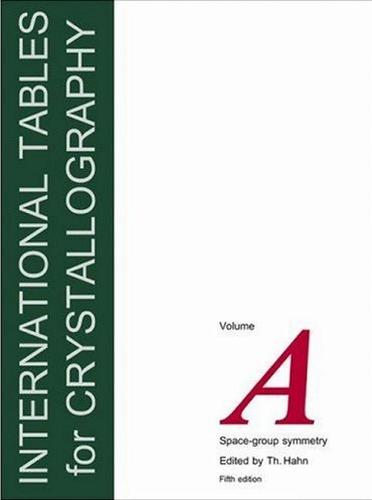
International Tables for Crystallography Space Group Symmetry 5th Edition by Hahn T ISBN 0470689110 978-0470689110


Original price was: $50.00.$35.00Current price is: $35.00.
International Tables for Crystallography Space Group Symmetry 5th Edition by Hahn T – Ebook PDF Instant Download/Delivery: 0470689110, 978-0470689110
Full download International Tables for Crystallography Space Group Symmetry 5th Edition after payment
Product details:
ISBN 10: 0470689110
ISBN 13: 978-0470689110
Author: Hahn T
The Brief Teaching Edition of International Tables for Crystallography Volume A is a handy and inexpensive tool for researchers and students wishing to familiarize themselves with the use of the space-group tables in Volume A. This condensed, inexpensive version of Volume A consists of:
(i) complete descriptions of the 17 plane groups, useful for the teaching of symmetry;
(ii) 24 selected space-group examples, of varying complexity and distributed over all seven crystal systems;
(iii) those basic text sections of Volume A that are necessary for the understanding and handling of space groups.
This volume is designed for use in classroom teaching, and also serves as a useful laboratory handbook because the 24 examples include most of the frequently occurring space groups, for both organic and inorganic crystals.
Table of contents:
PART 1. SYMBOLS AND TERMS USED IN THIS VOLUME
1.1. Printed symbols for crystallographic items (Th. Hahn)
1.1.1. Vectors, coefficients and coordinates
1.1.2. Directions and planes
1.1.3. Reciprocal space
1.1.4. Functions
1.1.5. Spaces
1.1.6. Motions and matrices
1.1.7. Groups
1.2. Printed symbols for conventional centring types (Th. Hahn)
1.2.1. Printed symbols for the conventional centring types of one-, two- and three-dimensional cells
1.2.2. Notes on centred cells
1.3. Printed symbols for symmetry elements (Th. Hahn)
1.3.1. Printed symbols for symmetry elements and for the corresponding symmetry operations in one, two and three dimensions
1.3.2. Notes on symmetry elements and symmetry operations
1.4. Graphical symbols for symmetry elements in one, two and three dimensions (Th. Hahn)
1.4.1. Symmetry planes normal to the plane of projection (three dimensions) and symmetry lines in the plane figure (two dimensions)
1.4.2. Symmetry planes parallel to the plane of projection
1.4.3. Symmetry planes inclined to the plane of projection (in cubic space groups of classes 4̅3m and m3̅m only)
1.4.4. Notes on graphical symbols of symmetry planes
1.4.5. Symmetry axes normal to the plane of projection and symmetry points in the plane of the figure
1.4.6. Symmetry axes parallel to the plane of projection
1.4.7. Symmetry axes inclined to the plane of projection (in cubic space groups only)
References
PART 2. GUIDE TO THE USE OF THE SPACE-GROUP TABLES
2.1. Classification and coordinate systems of space groups (Th. Hahn and A. Looijenga-Vos)
2.1.1. Introduction
2.1.2. Space-group classification
2.1.3. Conventional coordinate systems and cells
2.2. Contents and arrangement of the tables (Th. Hahn and A. Looijenga-Vos)
2.2.1. General layout
2.2.3. Headline
2.2.4. International (Hermann–Mauguin) symbols for plane groups and space groups (cf. Chapter 12.2)
2.2.5. Patterson symmetry
2.2.6. Space-group diagrams
2.2.7. Origin
2.2.8. Asymmetric unit
2.2.9. Symmetry operations
2.2.10. Generators
2.2.11. Positions
2.2.12. Oriented site-symmetry symbols
2.2.13. Reflection conditions
2.2.14. Symmetry of special projections
2.2.15. Maximal subgroups and minimal supergroups
2.2.16. Monoclinic space groups
2.2.17. Crystallographic groups in one dimension
References
PART 3. DETERMINATION OF SPACE GROUPS
3.1. Space-group determination and diffraction symbols (A. Looijenga-Vos and M. J. Buerger)
3.1.1. Introduction
3.1.2. Laue class and cell
3.1.3. Reflection conditions and diffraction symbol
3.1.4. Deduction of possible space groups
3.1.5. Diffraction symbols and possible space groups
3.1.6. Space-group determination by additional methods
References
PART 4. SYNOPTIC TABLES OF SPACE-GROUP SYMBOLS
4.1. Introduction to the synoptic tables (E. F. Bertaut)
4.1.1. Introduction
4.1.2. Additional symmetry elements
4.2. Symbols for plane groups (two-dimensional space groups) (E. F. Bertaut)
4.2.1. Arrangement of the tables
4.2.2. Additional symmetry elements and extended symbols
4.2.3. Multiple cells
4.2.4. Group-subgroup relations
4.3. Symbols for space groups (E. F. Bertaut)
4.3.1. Triclinic system
4.3.2. Monoclinic system
4.3.3. Orthorhombic system
4.3.4. Tetragonal system
4.3.5. Trigonal and hexagonal systems
4.3.6. Cubic system
References
PART 5. TRANSFORMATIONS IN CRYSTALLOGRAPHY
5.1. Transformations of the coordinate system (unit-cell transformations) (H. Arnold)
5.1.1. Introduction
5.1.2. Matrix notation
5.1.3. General transformation
5.2. Transformations of symmetry operations (motions) (H. Arnold)
5.2.1. Transformations
5.2.2. Invariants
5.2.3. Example: low cristobalite and high cristobalite
References
PART 6. THE 17 PLANE GROUPS (TWO-DIMENSIONAL SPACE GROUPS)
PART 7. THE 230 SPACE GROUPS
PART 8. INTRODUCTION TO SPACE-GROUP SYMMETRY
8.1. Basic concepts (H. Wondratschek)
8.1.1. Introduction
8.1.2. Spaces and motions
8.1.3. Symmetry operations and symmetry groups
8.1.4. Crystal patterns, vector lattices and point lattices
8.1.5. Crystallographic symmetry operations
8.1.6. Space groups and point groups
8.2. Classifications of space groups, point groups and lattices (H. Wondratschek)
8.2.1. Introduction
8.2.2. Space-group types
8.2.3. Arithmetic crystal classes
8.2.4. Geometric crystal classes
8.2.5. Bravais classes of matrices and Bravais types of lattices (lattice types)
8.2.6. Bravais flocks of space groups
8.2.7. Crystal families
8.2.8. Crystal systems and lattice systems
8.3. Special topics on space groups (H. Wondratschek)
8.3.1. Coordinate systems in crystallography
8.3.2. (Wyckoff) positions, site symmetries and crystallographic orbits
8.3.3. Subgroups and supergroups of space groups
8.3.4. Sequence of space-group types
8.3.5. Space-group generators
8.3.6. Normalizers of space groups
References
PART 9. CRYSTAL LATTICES
9.1. Bases, lattices, Bravais lattices and other classifications (H. Burzlaff and H. Zimmermann)
9.1.1. Description and transformation of bases
9.1.2. Lattices
9.1.3. Topological properties of lattices
9.1.4. Special bases for lattices
9.1.5. Remarks
9.1.6. Classifications
9.1.7. Description of Bravais lattices
9.1.8. Delaunay reduction
9.1.9. Example
9.2. Reduced bases (P. M. de Wolff)
9.2.1. Introduction
9.2.2. Definition
9.2.3. Main conditions
9.2.4. Special conditions
9.2.5. Lattice characters
9.2.6. Applications
9.3. Further properties of lattices (B. Gruber)
9.3.1. Further kinds of reduced cells
9.3.2. Topological characteristic of lattice characters
9.3.3. A finer division of lattices
9.3.4. Conventional cells
9.3.5. Conventional characters
9.3.6. Sublattices
References
PART 10. POINT GROUPS AND CRYSTAL CLASSES
10.1. Crystallographic and noncrystallographic point groups (Th. Hahn and H. Klapper)
10.1.1. Introduction and definitions
10.1.2. Crystallographic point groups
10.1.3. Subgroups and supergroups of the crystallographic point groups
10.1.4. Noncrystallographic point groups
10.2. Point-group symmetry and physical properties of crystals (H. Klapper and Th. Hahn)
10.2.1. General restrictions on physical properties imposed by symmetry
10.2.2. Morphology
10.2.3. Etch figures
10.2.4. Optical properties
10.2.5. Pyroelectricity and ferroelectricity
10.2.6. Piezoelectricity
References
PART 11. SYMMETRY OPERATIONS
11.1. Point coordinates, symmetry operations and their symbols (W. Fischer and E. Koch)
11.1.1. Coordinate triplets and symmetry operations
11.1.2. Symbols for symmetry operations
11.2. Derivation of symbols and coordinate triplets (W. Fischer and E. Koch with Tables 11.2.2.1 and 11.2.2.2 by H. Arnold)
11.2.1. Derivation of symbols for symmetry operations from coordinate triplets or matrix pairs
11.2.2. Derivation of coordinate triplets from symbols for symmetry operations
PART 12. SPACE-GROUP SYMBOLS AND THEIR USE
12.1. Point-group symbols (H. Burzlaff and H. Zimmermann)
12.1.1. Introduction
12.1.2. Schoenflies symbols
12.1.3. Shubnikov symbols
12.1.4. Hermann–Mauguin symbols
12.2. Space-group symbols (H. Burzlaff and H. Zimmermann)
12.2.1. Introduction
12.2.2. Schoenflies symbols
12.2.3. The role of translation parts in the Shubnikov and Hermann–Mauguin symbols
12.2.4. Shubnikov symbols
12.2.5. International short symbols
12.3. Properties of the international symbols (H. Burzlaff and H. Zimmermann)
12.3.1. Derivation of the space group from the short symbol
12.3.2. Derivation of the full symbol from the short symbol
12.3.3. Non-symbolized symmetry elements
12.3.4. Standardization rules for short symbols
12.3.5. Systematic absences
12.3.6. Generalized symmetry
12.4. Changes introduced in space-group symbols since 1935 (H. Burzlaff and H. Zimmermann)
References
PART 13. ISOMORPHIC SUBGROUPS OF SPACE GROUPS
13.1. Isomorphic subgroups (Y. Billiet and E. F. Bertaut)
13.1.1. Definitions
13.1.2. Isomorphic subgroups
13.2. Derivative lattices (Y. Billiet and E. F. Bertaut)
13.2.1. Introduction
13.2.2. Construction of three-dimensional derivative lattices
13.2.3. Two-dimensional derivative lattices
References
PART 14. LATTICE COMPLEXES
14.1. Introduction and definition (W. Fischer and E. Koch)
14.1.1. Introduction
14.1.2. Definition
14.2. Symbols and properties of lattice complexes (W. Fischer and E. Koch)
14.2.1. Reference symbols and characteristic Wyckoff positions
14.2.2. Additional properties of lattice complexes
14.2.3. Descriptive symbols
14.3. Applications of the lattice-complex concept (W. Fischer and E. Koch)
14.3.1. Geometrical properties of point configurations
14.3.2. Relations between crystal structures
14.3.3. Reflection conditions
PART 15. NORMALIZERS OF SPACE GROUPS AND THEIR USE IN CRYSTALLOGRAPHY
15.1. Introduction and definitions (E. Koch, W. Fischer and U. Müller)
15.1.1. Introduction
15.1.2. Definitions
15.2. Euclidean and affine normalizers of plane groups and space groups (E. Koch, W. Fischer and U. Müller)
15.2.1. Euclidean normalizers of plane groups and space groups
15.2.2. Affine normalizers of plane groups and space groups
15.3. Examples of the use of normalizers (E. Koch and W. Fischer)
15.3.1. Introduction
15.3.2. Equivalent point configurations, equivalent Wyckoff positions and equivalent descriptions of crystal structures
15.3.3. Equivalent lists of structure factors
15.3.4. Euclidean- and affine-equivalent sub- and supergroups
15.3.5. Reduction of the parameter regions to be considered for geometrical studies of point configurations
15.4. Normalizers of point groups (E. Koch and W. Fischer)
People also search for:
international tables for crystallography abbreviation
international tables for crystallography volume a
international tables for crystallography volume a space group symmetry
international tables for crystallography volume a space group symmetry pdf
international tables for crystallography volume a1
Tags:
Hahn T,International Tables,Crystallography Space