
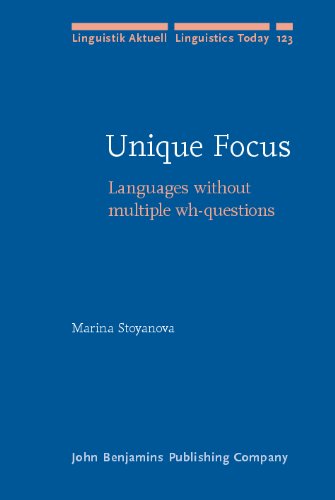
Unique Focus Languages without multiple wh questions 123rd Edition by Marina Stoyanova ISBN 978-9027255068 9027255067
Original price was: $50.00.$35.00Current price is: $35.00.
Unique Focus Languages without multiple wh questions 123rd Edition by Marina Stoyanova – Ebook PDF Instant Download/Delivery: 978-9027255068, 9027255067
Full download Unique Focus Languages without multiple wh questions 123rd Edition after payment
Product details:
ISBN 10:9027255067
ISBN 13: 978-9027255068
Author: Marina Stoyanova
This monograph focuses on an interesting typological property shared by four languages: the ungrammaticality of multiple wh-questions in Irish, Berber, Italian and Somali. It contains a broad discussion of data related to the grammar of wh-questions, a comparative analysis of wh-constructions in the four languages, and a theoretical account for the observed phenomenon. The analysis is based on the minimalist syntax theory as developed by Chomsky since 1995. It takes up the standard assumption that wh-phrases are typical representatives of elements bearing new information, in theoretical terms referred to as information focus. Most importantly, in the languages without multiple wh-questions the information focus is licensed in a unique syntactic position. The basic claim is that languages with unique focus are languages without multiple wh-questions. The analysis makes possible the classification of the languages without multiple wh-questions into the crosslinguistic typology of wh-constructions. Furthermore, this book is a contribution to the better understanding of information structure in natural languages, especially of focusing phenomena.
Table of contents:
CHAPTER 1 Introduction
1.1 The Central Problem: The Languages without Multiple Wh-Questions
1.2 Chapter Outline
1.3 Theoretical Preliminaries
1.3.1 The Framework
1.3.2 The Theory of Multiple Wh-Questions
1.3.3 The Theory of Focus
CHAPTER 2 Previous Analyses of the Ungrammaticality of Multiple Wh-Questions
2.1 The Condition on COMP Adjunction
2.2 Wh-Questions as Instances of Unique Information Focus
2.3 Wh-Questions in a Clitic Polysynthetic Language
CHAPTER 3 The Overview: What is Possible in Which Language?
3.1 Italian
3.1.1 Wh-questions and Focus Constructions
3.1.1.1 Wh-Questions and Contrastive Focus
3.1.1.2 Wh-Questions and Information Focus
3.1.1.3 How many Focus and Wh-Positions?
3.1.1.4 Towards a Unification of Focus
3.1.1.5 The Syntax of Main and Embedded Focus and Wh-Constructions
3.1.1.6 Ideolectal Variation and Multiple Wh-Questions
3.1.2 Defining the Structural Properties of the Wh-Position
3.1.2.1 The Finite Verb in Wh-questions and Focus Constructions of Main Clauses
3.1.2.2 The Finite Verb in Wh-Questions and Focus Constructions of Embedded Clauses
3.1.2.3 An Account for the Differences between Main and Embedded Clauses
3.1.2.4 The Nature of D-Linked Wh-Phrases
3.1.3 The Dialectal Variation of Interrogative Constructions
3.1.4 The Anti-Agreement Effect
3.1.5 Concluding Remarks on the Syntax of Wh-Questions in Italian
3.2 Somali
3.2.1 Preliminaries to the Syntax of Somali
3.2.1.1 Thewaa-Focus Construction
3.2.1.2 The bàalayàa-Focus Construction
3.2.1.3 The waxa(a)-Focus Construction
3.2.2 The Specific Properties of thebaa/ayda-Focus Constructions
3.2.3 Wh-Questions and Focus Constructions
3.2.4 The Derivation of Wh-Questions
3.2.5 A Brief Typology of Wh-Phrases in Somali
3.2.6 The Anti-Agreement Effect
3.2.6.1 Anti-Agreement in Somali
3.2.6.2 A Comparison between Somali and the Italian Dialects
3.2.7 Concluding Remarks on the Syntax of Wh-Questions in Somali
3.3 Berber
3.3.1 Preliminaries to the Syntax of Berber
3.3.1.1 Left Dislocation
3.3.1.2 Focus Clefts
3.3.2 Wh-Questions and Focus Constructions
3.3.3 The Derivation of Wh-Questions
3.3.4 The Dialectal Variation of Wh-Questions
3.3.5 TheAnti-Agreement Effect
3.3.6 Concluding Remarks on the Syntax of Wh-Questions in Berber
3.4 Irish
3.4.1 Wh-Questions and Related Syntactic Constructions
3.4.2 The Derivational Properties of Wh-Questions, Relative Clauses and Clefts
3.4.2.1 Wh-Questions and Relative Clauses
3.4.2.2 Wh-Questions and Reduced Clefts
3.4.3 The Anti-Agreement Effect
3.4.4 Concluding Remarks on the Syntax of Wh-Questions in Irish
3.5 Generalisations and Working Hypotheses
3.5.1 The Head-Adjacency Generalisation
3.5.2 The Uniqueness Hypothesis
3.5.3 The Relation between Anti-Agreement and Multiple Wh-Questions
CHAPTER 4 Analysis
4.1 The Head-Adjacency Generalisation and the Uniqueness Hypothesis Revisited
4.2 Wh-Questions in Languages without Multiple Wh-Questions and their Answers as Focus Constructions
4.3 Wh-in-situ and Optional Licensing of Wh-Phrases in a Focus Position
4.4 Multiple Wh-Questions as Focus Recursion
4.5 Multiple Wh-Fronting as Focus Cluster
4.6 A Feature Checking Analysis for Languages without Multiple Wh-Questions
CHAPTER 5 Conclusion
People also search for:
focus in another language
a language without words
languages with unique features
unique multilingual
c language for loop multiple conditions