
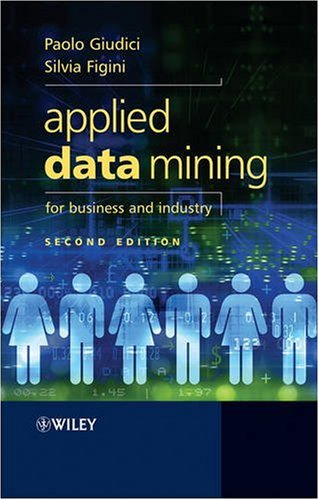
(Ebook PDF) Applied Data Mining for Business and Industry 2nd Edition by Paolo Giudici, Silvia Figini 0470058862 9780470058862 Full chapter

Original price was: $50.00.$35.00Current price is: $35.00.
Applied Data Mining for Business and Industry 2nd Edition by Paolo Giudici, Silvia Figini – Ebook PDF Instant Download/Delivery: 0470058862, 978-0470058862
Full dowload Applied Data Mining for Business and Industry 2nd Edition after payment
Product details:
ISBN 10: 0470058862
ISBN 13: 978-0470058862
Author: Paolo Giudici, Silvia Figini
- Introduces data mining methods and applications.
- Covers classical and Bayesian multivariate statistical methodology as well as machine learning and computational data mining methods.
- Includes many recent developments such as association and sequence rules, graphical Markov models, lifetime value modelling, credit risk, operational risk and web mining.
- Features detailed case studies based on applied projects within industry.
- Incorporates discussion of data mining software, with case studies analysed using R.
- Is accessible to anyone with a basic knowledge of statistics or data analysis.
- Includes an extensive bibliography and pointers to further reading within the text.
Applied Data Mining for Business and Industry, 2nd edition is aimed at advanced undergraduate and graduate students of data mining, applied statistics, database management, computer science and economics. The case studies will provide guidance to professionals working in industry on projects involving large volumes of data, such as customer relationship management, web design, risk management, marketing, economics and finance.
Applied Data Mining for Business and Industry 2nd Table of contents:
1. Introduction
Part I: Methodology
2. Organisation of the Data
- 2.1 Statistical Units and Statistical Variables
- 2.2 Data Matrices and Their Transformations
- 2.3 Complex Data Structures
- 2.4 Summary
3. Summary Statistics
- 3.1 Univariate Exploratory Analysis
- 3.2 Bivariate Exploratory Analysis of Quantitative Data
- 3.3 Multivariate Exploratory Analysis of Quantitative Data
- 3.4 Multivariate Exploratory Analysis of Qualitative Data
- 3.5 Reduction of Dimensionality
- 3.6 Further Reading
4. Model Specification
- 4.1 Measures of Distance
- 4.2 Cluster Analysis
- 4.3 Linear Regression
- 4.4 Logistic Regression
- 4.5 Tree Models
- 4.6 Neural Networks
- 4.7 Nearest-Neighbor Models
- 4.8 Local Models
- 4.9 Uncertainty Measures and Inference
- 4.10 Non-Parametric Modelling
- 4.11 The Normal Linear Model
- 4.12 Generalised Linear Models
- 4.13 Log-Linear Models
- 4.14 Graphical Models
- 4.15 Survival Analysis Models
- 4.16 Further Reading
5. Model Evaluation
- 5.1 Criteria Based on Statistical Tests
- 5.2 Criteria Based on Scoring Functions
- 5.3 Bayesian Criteria
- 5.4 Computational Criteria
- 5.5 Criteria Based on Loss Functions
- 5.6 Further Reading
Part II: Business Case Studies
6. Describing Website Visitors
- 6.1 Objectives of the Analysis
- 6.2 Description of the Data
- 6.3 Exploratory Analysis
- 6.4 Model Building
- 6.5 Model Comparison
- 6.6 Summary Report
7. Market Basket Analysis
- 7.1 Objectives of the Analysis
- 7.2 Description of the Data
- 7.3 Exploratory Data Analysis
- 7.4 Model Building
- 7.5 Model Comparison
- 7.6 Summary Report
8. Describing Customer Satisfaction
- 8.1 Objectives of the Analysis
- 8.2 Description of the Data
- 8.3 Exploratory Data Analysis
- 8.4 Model Building
- 8.5 Summary
9. Predicting Credit Risk of Small Businesses
- 9.1 Objectives of the Analysis
- 9.2 Description of the Data
- 9.3 Exploratory Data Analysis
- 9.4 Model Building
- 9.5 Model Comparison
- 9.6 Summary Report
10. Predicting E-Learning Student Performance
- 10.1 Objectives of the Analysis
- 10.2 Description of the Data
- 10.3 Exploratory Data Analysis
- 10.4 Model Specification
- 10.5 Model Comparison
- 10.6 Summary Report
11. Predicting Customer Lifetime Value
- 11.1 Objectives of the Analysis
- 11.2 Description of the Data
- 11.3 Exploratory Data Analysis
- 11.4 Model Specification
- 11.5 Model Comparison
- 11.6 Summary Report
12. Operational Risk Management
- 12.1 Context and Objectives of the Analysis
- 12.2 Exploratory Data Analysis
- 12.3 Model Building
- 12.4 Model Comparison
- 12.5 Summary Conclusions
People also search for Applied Data Mining for Business and Industry 2nd:
what is applied business analytics
applied business analytics mit
a firm would use data mining if it wanted to
the value of data mining to the business is
business intelligence data mining
Tags:
Paolo Giudici,Silvia Figini,Applied,Data Mining,Business,Industry 2nd