
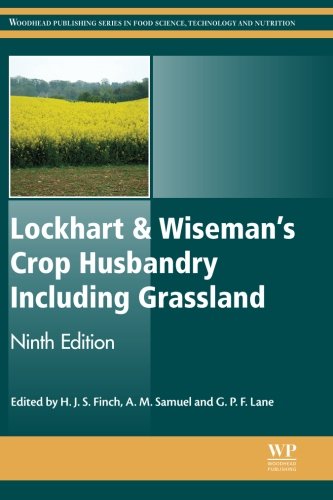
Lockhart and Wiseman s crop husbandry including grassland 9th Edition by H J S Finch, Alison Samuel, Gerry Lane ISBN 1782423710 978-1782423713

Original price was: $50.00.$35.00Current price is: $35.00.
Lockhart and Wiseman s crop husbandry including grassland 9th Edition by H J S Finch, Alison Samuel, Gerry Lane – Ebook PDF Instant Download/Delivery: 1782423710, 978-1782423713
Full download Lockhart and Wiseman s crop husbandry including grassland 9th Edition after payment
Product details:
ISBN 10: 1782423710
ISBN 13: 978-1782423713
Author: H J S Finch, Alison Samuel, Gerry P. Lane
Increased yields, markets, and profitability have led to changes in crop husbandry. Since its first publication in 1966, revised editions of Lockhart & Wiseman’s Crop Husbandry Including Grassland have upheld and increased the book’s good reputation. This ninth edition maintains its status as the standard textbook for many agricultural courses.
Part one covers the principles of crop production with chapters concerning plants, climate, soil management, fertilizers, manures, weeds, and diseases threatening farm crops. Part two surveys crop husbandry techniques. Environmental impact has been addressed in greater detail in this edition. This section looks at issues such as sustainable crop management, precision farming, and organic crop husbandry. The way these general techniques apply to individual crops is explained in part three. This part considers a range of cereals, combinable break crops, root crops, industrial crops, and fresh produce crops. Part four looks at the use of grassland and forage crops, with chapters considering arable forage crops, the characteristics of grassland, and the corresponding methods for establishing and improving grassland. This part also includes information regarding equine grassland management and conservation of grass and forage crops.
This ninth edition of Lockhart and Wiseman’s Crop Husbandry Including Grassland is relevant for students throughout the United Kingdom and Europe. It is a useful reference book for agriculture National Diploma courses, Foundation Degrees, and BSc degrees, and is important for Masters level students entering agriculture from another discipline.
- The previous edition has been widely expanded and remains the standard text for general agriculture, land management, and agri-business courses
- Includes new chapters on cropping techniques, integrated crop management and quality assurance, seed production and selection, and the influence of climate
- Discusses basic conditions for crop growth, how techniques are applied to particular crops, the influence of weather, and the use of grassland
Table of contents:
Part I: Principles of crop production
1. Plants
Abstract:
1.1 Introduction
1.2 Plant physiology
1.3 Plant groups
1.4 Structure of the seed
1.5 Plant structure
1.6 Plant requirements
1.7 Legumes and nitrogen fixation
1.8 The control of plant growth and development
1.9 Sources of further information and advice
2. Climate and weather
Abstract:
2.1 Introduction
2.2 Solar radiation and rainfall
2.3 Air and soil temperature
2.4 Other aspects of climate and weather
2.5 Climate change
2.6 Sources of further information and advice
3. Soils and soil management
Abstract:
3.1 Introduction
3.2 Soil formation
3.3 The physical make-up of soil and its effect on plant growth
3.4 Farm soils
3.5 Soil fertility and productivity
3.6 Sources of further information and advice
4. Fertilisers and manures
Abstract:
4.1 Nutrients required by crops
4.2 Trace elements
4.3 Units of plant food
4.4 Straight fertilisers
4.5 Compound fertilisers
4.6 Application of fertilisers
4.7 Organic manures
4.8 Residual values of fertilisers and manures
4.9 Fertilisers and the environment
4.10 Sources of further information and advice
5. Weeds of farm crops
Abstract:
5.1 The impact of weeds
5.2 Weed types and identification
5.3 Control of weeds: general
5.4 Herbicide resistance
5.5 Spraying with herbicides: precautions
5.6 Sources of further information and advice
6. Diseases of farm crops
Abstract:
6.1 Introduction to plant disorders
6.2 Symptoms
6.3 Some important types of plant pathogens
6.4 Other disorders
6.5 The control of plant diseases
6.6 Fungicide resistance
6.7 Sources of further information and advice
7. Pests of farm crops
Abstract:
7.1 Introduction
7.2 Insect pests
7.3 Other pests of crops
7.4 Types of pest damage
7.5 Methods of pest control
7.6 Classification of pesticides
7.7 Resistance
7.8 Integrated pest management
7.9 Sources of further information and advice
Part II: Crop husbandry techniques
8. Cropping techniques
Abstract:
8.1 Introduction
8.2 Drainage
8.3 Irrigation
8.4 Warping
8.5 Claying
8.6 Tillage and cultivations
8.7 Control of weeds by cultivation
8.8 Crop management: key issues
8.9 Break crops and crop rotations
8.10 Sources of further information and advice
9. Sustainable crop management
Abstract:
9.1 Introduction
9.2 The Common Agricultural Policy (CAP)
9.3 Sustainable agriculture
9.4 The development of Integrated Crop Management (ICM), Integrated Farm Management (IFM) and sustainable crop production
9.5 Food quality and safety in the food chain: farm assurance schemes
9.6 Wildlife and conservation
9.7 Key points
9.8 Sources of further information and advice
10. Precision farming
Abstract:
10.1 Introduction
10.2 Data collection
10.3 Data interpretation
10.4 Auto-steering and controlled traffic farming
10.5 The technology
10.6 Sources of further information and advice
11. Organic crop husbandry
Abstract:
11.1 Introduction
11.2 Achieving organic status
11.3 Rotations
11.4 Soil and plant nutrition
11.5 Weed control
11.6 Disease control
11.7 Pest control
11.8 Husbandry examples
11.9 Other systems
11.10 Organic farming and the environment
11.11 Sources of further information and advice
12. Plant breeding and seed production
Abstract:
12.1 Introduction
12.2 Plant breeding methods
12.3 Target traits in breeding
12.4 Choosing the right variety
12.5 Seed quality
12.6 Seed production
12.7 Sources of further information and advice
Part III: The management of individual crops
13. Cereals
Abstract:
13.1 Introduction
13.2 Cereal identification
13.3 Grain quality in cereals
13.4 Cereal growth, yield and inputs
13.5 Harvesting
13.6 Grain-drying methods
13.7 Moist grain storage
13.8 Cereal straw
13.9 Wheat
13.10 Durum wheat
13.11 Barley
13.12 Oats
13.13 Rye
13.14 Triticale
13.15 Maize for grain
13.16 Sources of further information and advice
14. Combinable break crops
Abstract:
14.1 Introduction
14.2 Oilseed rape
14.3 Linseed and flax
14.4 Sunflowers
14.5 Soya beans
14.6 Evening primrose
14.7 Borage
14.8 Combinable pulses
14.9 Sources of further information and advice
15. Root crops
Abstract:
15.1 Introduction
15.2 Potatoes
15.3 Sugar beet
15.4 Future trends
15.5 Sources of further information and advice
16. Industrial crops
Abstract:
16.1 Introduction
16.2 Specific crops: Miscanthus
16.3 Short Rotation Coppice
16.4 Wetland crops
16.5 Crops for anaerobic digestion (AD)
16.6 Woodland biomass
16.7 Liquid biofuel crops
16.8 Lubricant oil crops
16.9 Fibre crops
16.10 Pharmaceuticals, neutraceuticals, essential oils and cosmetics
16.11 Carbohydrate crops
16.12 Sources of further information and advice
17. Fresh produce crops
Abstract:
17.1 Growing fresh produce crops
17.2 Fresh peas
17.3 Broad beans
17.4 Green beans
17.5 Lettuce
17.6 Baby leaves and herbs
17.7 Cabbages
17.8 Broccoli
17.9 Cauliflowers
17.10 Brussels sprouts
17.11 Bulb onions
17.12 Leeks
17.13 Carrots
17.14 Edible swede and turnips
17.15 Strawberries
17.16 Sources of further information and advice
Part IV: Grassland and forage crops
18. Arable forage crops
Abstract:
18.1 Crops grown for their yield of roots
18.2 Crops grown for grazing
18.3 Crops grown for ensiling
18.4 Sources of further information and advice
19. Introduction to grass production/characteristics of grassland and the important species
Abstract:
19.1 Types of grassland
19.2 The nutritive value of grassland herbage
19.3 Identification of grasses
19.4 Identification of legumes
19.5 Grasses of economic importance
19.6 Forage legumes of economic importance
19.7 Herbs
19.8 Grass and legume seed mixtures
19.9 Sources of further information and advice
20. Establishing and improving grassland
Abstract:
20.1 Establishing leys
20.2 Grassland improvement and renovation
20.3 Improving a sward by changing the management
20.4 Improving a sward by renovation
20.5 Fertilisers for grassland
20.6 Irrigation of grassland
20.7 Sources of further information and advice
21. Grazing management
Abstract:
21.1 Introduction
21.2 Stocking rate or density
21.3 Principles of grazing management
21.4 Grazing systems
21.5 Strategies to minimise parasitism at grass
21.6 The energy yield from grass and forage – the Utilised Metabolisable Energy (UME) calculation
21.7 Sources of further information and advice
22. Conservation of grass and forage crops
Abstract:
22.1 Introduction
22.2 Crops for silage making
22.3 The silage-making process
22.4 Factors affecting silage fermentation
22.5 Hay
22.6 Green-crop drying
22.7 Sources of further information and advice
People also search for:
lockhart and wiseman s crop
lockhart vs pieper
lockhart’s theory of exchange
lockhart vs icon
lockhart vs 3sk
Tags: H J S Finch, Alison Samuel, Gerry Lane, Lockhart and Wiseman, husbandry including