
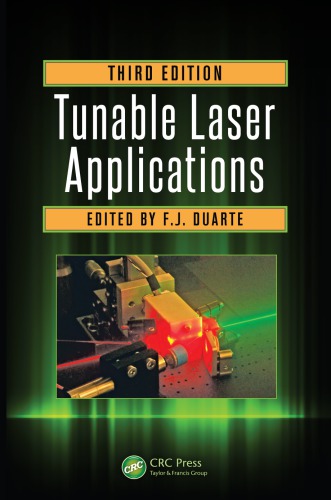
Tunable laser applications 3rd Edition by Duarte ISBN 9781498788144


Original price was: $50.00.$35.00Current price is: $35.00.
Tunable laser applications 3rd Edition by F.J. Duarte – Ebook PDF Instant Download/Delivery: 9781498788144
Full download Tunable laser applications 3rd Edition after payment
Product details:
ISBN 13: 9781498788144
Author: F.J. Duarte
Table of contents:
Preface
Editor
Contributors
Chapter 1 – Introduction
1.1 Introduction
1.2 Tunable Laser Complementarity
1.3 Tunable Laser Applications
1.4 Tunable Laser Applications: 1st Edition
1.5 Tunable Laser Applications: 2nd Edition
1.6 Focus of This Book
Acknowledgments
References
Chapter 2 – Spectroscopic Applications of Tunable Optical Parametric Oscillators
2.1 Introduction
2.1.1 “Good-bye to Ti: and Dye”?
2.1.2 OPO-Based Spectroscopy Has Come a Long Way …
2.2 Optical Parametric Devices: How They Operate
2.2.1 Optical Parametric Processes
2.2.2 χ(2)-Based Optical Parametric Gain and Amplification
2.2.3 Choice of Optical Parametric Gain Medium
2.2.4 Operating Regimes for Optical Parametric Processes
2.3 Elements of Optical Parametric Oscillator Design
2.3.1 Nanosecond-Pulsed Optical Parametric Oscillators
2.3.2 Continuous-Wave Optical Parametric Oscillators
2.3.3 Ultrafast Optical Parametric Oscillators
2.3.4 Optical Parametric Devices for Spectroscopic Applications
2.3.5 Spectroscopy with Ultrafast OPOs and Frequency Combs
2.4 Optical Bandwidth Control in Nanosecond-Pulsed OPOs
2.4.1 Factors Influencing Optical Bandwidth and Tunability
2.4.2 Injection-Seeded Nanosecond-Pulsed OPOs: Early Days
2.4.2.1 Historical Overview
2.4.2.2 Mechanism of Injection-Seeded OPOs
2.4.2.3 Passively Seeded OPO Cavities
2.4.2.4 Multiplex and Multiwavelength-Seeded OPOs
2.4.3 Injection-Seeded Nanosecond-Pulsed OPOs: Subsequent Progress
2.4.3.1 Actively Seeded OPO cavities
2.4.3.2 Intensity-Dip OPO Cavity Control
2.4.3.3 Self-Adaptive Tunable OPO
2.4.3.4 Chirp-Controlled, Injection-Seeded OPOs
2.4.3.5 Dynamics of SLM Nanosecond-Pulsed OPO Operation
2.5 OPO-Based Spectroscopic Measurements
2.5.1 Spectroscopic Verification of OPO Performance
2.5.2 OPO-Spectroscopic Sensing of Atoms and Molecules
2.5.2.1 Fundamental OPO Spectroscopy of Atoms, Molecules, and Ions
2.5.2.2 OPO Applications to Atmospheric Sensing
2.5.2.3 OPO Applications to Industrial and Environmental Monitoring
2.5.3 Coherent Raman Microscopy: A Biomedical Application of OPOs
2.5.4 Fiber-Based OPOs: Applications to Coherent Raman Microscopy
2.5.5 Defense Applications of OPOs: Infrared Countermeasures
2.5.6 Terahertz Waves from Coherent Optical Parametric Systems
2.6 Conclusion: OPO-Spectroscopic Predictions Realized
Acknowledgments
References
Chapter 3 – Solid-State Organic Dye Lasers
3.1 Introduction
3.2 Materials
3.2.1 Organic Polymers
3.2.2 Organic–Inorganic Hybrid Materials
3.2.3 Silicon-Modified Organic Matrices
3.2.4 Polymers with Nano- and Micro-Particles
3.3 Applications
References
Chapter 4 – Organic Dye-Doped Polymer-Nanoparticle Tunable Lasers
4.1 Introduction
4.2 Tunable Laser Oscillator Review
4.3 Synthesis of DDPN Laser Gain Media
4.4 Experimental Results and Laser Emission
4.4.1 Tunable Laser Emission
4.4.2 Narrow-Linewidth Laser Emission
4.4.3 Optical Ruggedness of Dye-Doped Polymer Gain Media
4.5 Interferometric Interpretation
4.6 Invisibility of Nanoparticle Distributions in the Visible Electromagnetic Spectrum
4.7 Applications for DDPN Gain Media
4.7.1 Laser Spectroscopy
4.7.2 Laser Medicine
4.7.3 Laser Development and Nonlinear Optics
References
Chapter 5 – Broadly Tunable External-Cavity Semiconductor Lasers
5.1 Introduction
5.2 Dispersive Oscillator Cavities
5.2.1 Optimized Dispersive Oscillator Cavities
5.3 Optical Theory
5.3.1 Interference and Diffraction
5.3.2 Intracavity Dispersion
5.3.3 Dispersion Theory of Multiple-Prism Pulse Compression
5.3.4 Ray Transfer Matrices
5.3.5 Laser Linewidth
5.3.6 Wavelength Tuning
5.3.7 Tuning Miniature MEMS-Driven Cavities
5.3.8 Tuning Using Bragg Gratings
5.4 Performance of Tunable External-Cavity Semiconductor Lasers
5.5 Performance of Ultrashort-Pulse External-Cavity Semiconductor Lasers
5.6 Applications
5.7 Conclusions
References
Chapter 6 – Tunable Fiber Lasers
6.1 Introduction
6.2 Core- and Cladding-Pumped Fiber Lasers
6.3 Tunable Fiber Laser Configurations
6.3.1 Multiple-Prism Grating Configuration
6.4 Tunable Fiber Laser Performance
6.5 Summary
References
Chapter 7 – Fiber Laser Overview and Medical Applications
7.1 Introduction
7.2 Lasers in Medicine and Life Sciences
7.2.1 Optical versus Thermal Response
7.3 Principles, Types, and Performance of Fiber Lasers
7.3.1 Host Fibers: Silica-, Phosphate-, and Fluoride-Based Glasses
7.3.2 Gain Media
7.3.3 Lasing Wavelengths
7.3.4 Pumping and Laser Efficiency
7.3.5 Advantages and Challenges
7.4 Gain Material and Operation Mode—Relation to Particular Applications
7.4.1 Erbium Lasers
7.4.2 Ytterbium Lasers
7.4.3 Thulium Lasers
7.4.4 Holmium Lasers
7.4.5 Codoped and ZBLAN Fiber Lasers
7.4.6 Supercontinuum Fiber Lasers
7.4.7 Making and Marking Tools and Instruments for Medical Industry
Acknowledgments
References
Chapter 8 – Medical Applications of Organic Dye Lasers
8.1 Introduction
8.2 Dye Laser Systems for PDT
8.2.1 Argon-Pumped Dye Laser
8.2.2 Metal-Vapor-Pumped Dye Laser
8.2.3 KTP-Pumped Dye Laser
8.2.4 Future Perspectives
8.3 Dye Lasers in Dermatology
8.3.1 Dye Lasers for Vascular Lesions
8.3.1.1 Dye Lasers for PWSs
8.3.1.2 Dye Lasers for Hemangiomas
8.3.1.3 Dye Lasers for Telangiectases
8.3.1.4 Dye Lasers for Human Papilloma Virus-Induced and Other Warts
8.3.1.5 Dye Lasers for Hypertrophic Scars and Keloids
8.3.2 Dye Lasers for Pigmented Lesions
8.3.3 Dye Lasers for Tattoo Removal
8.3.4 Dye Lasers for Inflammatory Skin Diseases
8.3.4.1 Plaque Psoriasis
8.3.4.2 Acne
8.4 Safety During Operation and Maintenance of Dye Lasers
References
Chapter 9 – Tunable Laser Microscopy
9.1 Introduction
9.2 Basic Illumination Geometries for Microscopy
9.3 Microscopy via Ultrashort Laser Pulses
9.3.1 Survey of Femtosecond Laser Sources
9.3.2 Femtosecond Laser Near-Field Microscopy
9.4 Light Sheet Illumination
9.5 Interferometric Microscopy
References
Chapter 10 – Interferometric Imaging
10.1 Introduction
10.2 Tunable Lasers
10.3 The N-Slit Laser Interferometer
10.3.1 Extremely Elongated Gaussian Beams
10.3.2 Minimizing the Vertical Dimensions of the Extremely Elongated Gaussian
10.3.3 Multiple-Prism Dispersion
10.4 Interferometric Theory
10.5 Interferometric Calculations
10.6 Applications
10.6.1 Densitometry in the Macroscopic Domain
10.6.2 Detection of Surface Microdefects
10.6.3 Photographic Film Grain Structure
10.6.4 Assessment of Transmission Gratings and MTF
10.6.5 Theoretical Enhancement of the Resolution of Digital Detectors
10.6.6 Laser Printing
10.6.7 Wavelength Measurements
10.6.8 Secure Interferometric Communications in Free Space
10.6.9 Detection of Clear Air Turbulence
10.6.10 Interferometry in Textiles
10.6.11 Applications to Biomedicine
10.7 Conclusions
Acknowledgments
References
Chapter 11 – Tunable Laser Atomic Vapor Laser Isotope Separation
11.1 Introduction
11.2 Atomic Vapor Laser Isotope Separation
11.2.1 Geometry of Excitation
11.2.2 Excitation Mechanisms
11.3 Molecular Laser Isotope Separation
11.4 Narrow-Linewidth Tunable Lasers for AVLIS
11.4.1 High-Power Tunable Narrow-Linewidth Dye Lasers
11.4.2 Narrow-Linewidth Tunable Diode Lasers
11.4.2.1 Example
11.5 Uranium AVLIS
11.6 Lithium AVLIS
11.7 Historical Note
References
Chapter 12 – Coherent Electrically Excited Organic Semiconductors
12.1 Introduction
12.2 Amplified Spontaneous Emission (ASE) in Organic Lasers
12.3 Tunable Narrow-Linewidth Solid-State Organic Lasers
12.4 Spatial and Spectral Coherence
12.5 Electrically Excited Interferometric Emitter
12.6 Measured Beam Divergence and Interferograms
12.7 Energetics
12.8 Physical Interpretation of the Measurements
12.8.1 Beam Divergence
12.8.2 Interferometric Linewidth Estimate
12.9 Coherent Emission and Laser Emission
12.9.1 Interferometric Visibility of the Interferometric Emitter
12.9.2 Interferometric Visibility and Laser Emission
12.10 Conclusion
References
Chapter 13 – Multiple-Prism Arrays and Multiple-Prism Beam Expanders: Laser Optics and Scientific Applications
13.1 Introduction
13.2 Dispersion Theory of Multiple-Prism Arrays
13.2.1 Multiple-Prism Dispersion Theory of Laser Pulse Compression
13.2.2 The Interferometric Origin of Angular Dispersion
13.3 Dual Multiple-Prism Beam Expanders
13.3.1 Multiple-Prism Arrays for Beam Geometrical Compression
13.4 Applications to Laser Optics
13.5 Applications to Laser Spectroscopy and Laser Isotope Separation
13.6 Applications to Guide Stars and Astronomy
13.7 Applications to Pulse Compression in Ultrashort Pulse Lasers
13.8 Applications to Microscopy and Ultrafast Spectroscopy
13.9 Applications to Interferometry and Optical Metrology
References
Chapter 14 – Optical Quantities and Conversions of Units
14.1 Introduction
14.2 Linewidth Equivalence
14.3 Photon-Energy Wavelength Equivalence
References
People also search for:
what is a tunable laser
tunable laser source
how tunable lasers work
tunable laser diode absorption spectroscopy
tunable lasers
Tags:
Duarte,Tunable laser,laser applications