
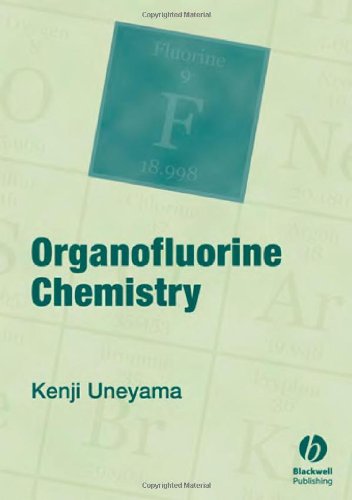
Organofluorine Chemistry 1st Edition by Uneyama Kenji ISBN 978-1405125611 1405125616

Original price was: $50.00.$35.00Current price is: $35.00.
Organofluorine Chemistry 1st Edition by Uneyama Kenji – Ebook PDF Instant Download/Delivery: 978-1405125611, 1405125616
Full download Organofluorine Chemistry 1st Edition after payment
Product details:
ISBN 10: 1405125616
ISBN 13: 978-1405125611
Author: Uneyama Kenji
The replacement of hydrogen with fluorine in organic molecules can profoundly influence their chemical and physical properties, leading to a range of compounds with highly desirable properties. These molecules are of interest across the wide spectrum of industrial and academic organic chemistry, so that organofluorine chemistry is economically highly important.
Organofluorine Chemistry will help chemists to develop a systematic knowledge of the chemistry of fluorine with a view towards its application in the design of new reactions and syntheses, and the creation of novel fluorinated molecules and materials. With initial chapters focusing on why fluorine creates such unique properties in organic compounds, the book then covers general reactions of fluorine. Coverage is chosen from the recent research literature, concentrating on the development of novel bioactive compounds and catalytic ligands, and explaining, in the context of the initial chapters, how and why fluorine is so effective. With a final chapter covering the general synthetic chemistry of organofluorine compounds, the book is a cohesive summary of the fundamental principals of organofluorine chemistry.
Table of contents:
1 Fundamentals in Organic Fluorine Chemistry
1.1 Some physical properties of organic fluorine compounds
Effect of the fluorine atom on the molecular orbital energy levels of organic molecules and refractive index
1.1.2 Boiling points
1.1.3 Miscibility
1.1.4 Lipophilicity
1.1.5 Gas solubility
1.1.6 Surface tension
1.1.7 Summary
1.2 Electronic effect
1.2.1 Electroniceffects of the fluorine atom: insight from Hammett substituent constants
1.2.2 Electronic effects on acidity, bond length, and bond energy of fluoroorganic molecules
1.2.3 Halogen bonding
1.2.4 Electronic effect on the destabilization of carbonyl and imono groups
1.2.5 ㅠ-ㅠ Stacking of fluoroaromatics
1.2.6 Increased p-character (Bent’s rule) and low-lying LUMO in carbon-fluorine bonding orbitals
1.2.7 Negative hyperconjugation
1.2.8 Electron-donating effect (stabilization of carbocation)
1.2.9 Effect of fluorine substituents on the structure, stability, and reactivity of fluoroalkyl radicals
1.3 Steric effects of fluorine substituents
References
2 Unique Reactions Induced by Fluorine
2.1 Nucleophilic substitution on fluoroaromatic rings
2.2 SN2′ reactions of alkenes bearing a trifluoromethyl group
2.3 Nucleophilic substitution on the gem-difluoromethylene double bond
2.4 Single electron transfer reaction of perfluoroalkyl halides
2.5 Fluorine-activated electrophilic reagents (F-X and XF)
2.5.1 Halogen monofluoride (F-halogen)
252 Bromine trifluoride (BrF3)
2.5.3 Iodine pentafluoride (IF5)
2.5.4 Iodoarene difluoride (ArIF₂)
2.5.5 Benzeneselenenyl fluoride (PhSeF)
2.5.6
tert-Butyl and methyl hypofluorites
2.5.7 Hypofluorous acid. MeCN complex (HOF. MeCN)
References
3 Reactions Activated by a Strong Interaction Between Fluorine and
Other Atoms
3.1 Reaction induced by F-Li interaction
3.1.1 Li-F interaction in aromatic C-F bonds
3.1.2 Li-F interaction in aliphatic C-F bonds
3.2 The fluorine-aluminum interaction
3.3 Reactions induced by F-Si interaction
3.3.1 Fluoride-ion mediated desilylative alkylations
3.4 Reactions induced by B-F interaction
3.5 Reactions activated by a strong interaction between fluorine and Sm, Yb, Sn, Ti
References
4 Hydrogen Bonding in Organofluorine Compounds
4.1 Organofluorine as a hydrogen-bonding acceptor
4.1.1 Definition and classifications of hydrogen bonds
4.1.2 Some examples of O-HF-Cand N-H…F-C hydrogen-bonding systems
4.1.3 Some examples on nonconventional hydrogen bonding: C-HF-C interactions
4.1.4 Summary of organic fluorine as hydrogen-bonding acceptor
4.2 Hydrogen bonding of B-fluorinated alcohols, its structural character, and utilization in organic syntheses
4.2.1 Use of TFE and HFIP for protonating agents and/or proto-nating solvents
4.2.2 Use of TFE and HFIP for cation-stabilizing solvents
References
5 Fluorinated Ligands for Selective Catalytic Reactions
5.1 Ligands with fluorine-substituted aryl groups
5.1.1 Ligands for stereoselective reactions
5.1.2 Ligands for olefin polymerization
5.2 Ligands and auxiliaries with fluorinated alkyl groups
5.3 Fluorinated ligands usable for catalytic reactions in scCO₂ and fluorous solvents
References
6 Fluorine in Drug Designs
6.1 Electron-withdrawing effect
6.2 Electron-withdrawing effect for lowering basicity of amines
6.3 ㅠ-ㅠ Stacking of polyfluorinated aromatic rings
6.4 Interaction of fluorine in the C-F bond with an electron-deficient center
6.5 Metabolic blocking
6.6 Increased hydrophobicity of fluoroaryl groups
6.7 Mechanism-based design of bioactive molecules
6.8 Fluoroalkenes as isosteres of the amide bond
6.9 Summary
References
7 Methods for Introduction of Fluorine-Functionality into Molecules
7.1 Monofluorination
7.1.1 Electrophilic reagent: F2, CsSO4F, R2NF, CF3OF, RCO₂F, ArIF, XeF2
7.1.2 DAST (diethylaminosulfur trifluoride) and related reagents
7.1.3 Deoxofluor: [(CH₃OCH2CH2)2N-SF3]
7.1.4 Ring opening of epoxide
7.1.5 Halofluorination
7.1.6 Selenofluorination
7.1.7 Electrochemical fluorination
7.1.8 Nucleophilic reagent
7.1.9
TASF [(Me₂N)3S]+ [MeSiF2]
7.1.10 Schiemann reaction
7.1.11 Others
7.1.12 Fluorinated building blocks
7.2 Difluorination
7.2.1 Difluorocarbene route and halodifluoromethyl radicals and anions
7.2.2 Transformation of carbonyl group to-CF2-
7.2.3 Fluorine addition
7.2.4 -CH2- (active methylene) -CF2- (difluoromethylene)
7.2.5 Defluorination from CF3
7.2.6 Difluoromethyl synthetic blocks: Halodifluoroacetate (XCF₂CO₂R)
7.3 Trifluoromethylation
7.3.1 CF anion from CF3I, CF3Br, CF3H
7.3.2 FSO2CF2CO2Me
7.3.3
CF3-TMS
7.3.4 Others
7.3.5 CF3 radicals
7.3.6
CF3+ equivalent
7.3.7 CF₂CH₂+ equivalent
7.3.8
CO₂H → CS2H or CS₂R→ CF3
7.3.9 Trifluoromethyl building blocks
7.3.10 Imidoyl halides
7.4 Perfluoroalkylation
7.4.1
Rf-Li perfluoroalkyl lithium
7.4.2 Rf-Zn perfluoroalkyl zinc
7.4.3 Sm-promoted perfluoroalkylation
7.4.4 Rf-Cu perfluoroalkyl copper
7.4.5 Rf-Ru
7.4.6
Miscellaneous
7.4.7 Polyfluorobenzene
People also search for:
synthetic organofluorine chemistry
organofluorine chemistry principles and commercial applications
organofluorine chemistry synthesis modeling and applications
organofluorine chemistry applications sources and sustainability
organofluorine compounds chemistry and applications
Tags: Uneyama Kenji, Organofluorine Chemistry